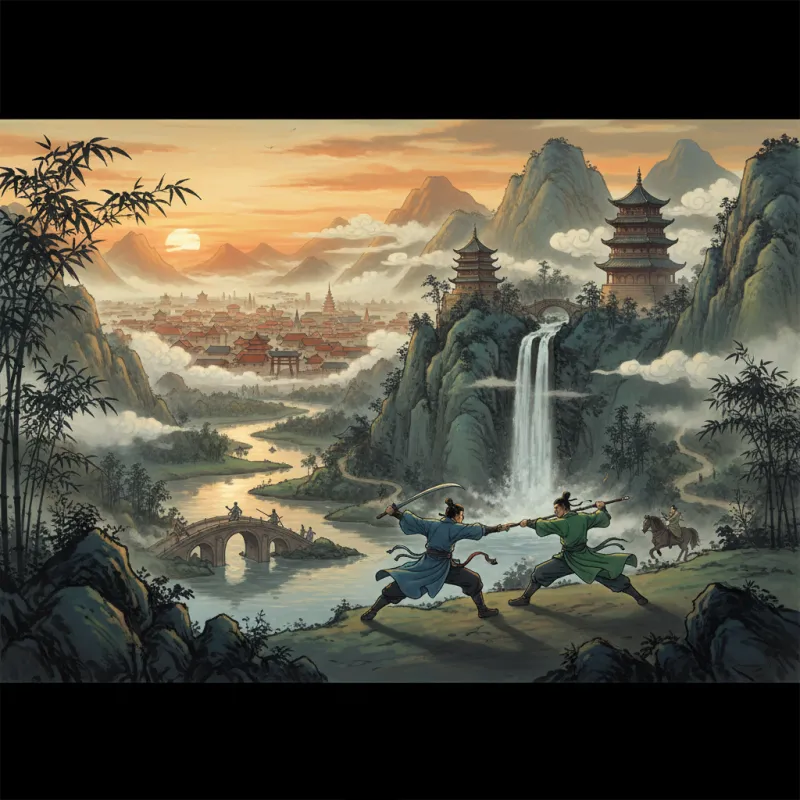
A swordsman stands at the edge of a cliff, his white robes whipping in the mountain wind. Below him, the jianghu (江湖, jiānghú) — the "rivers and lakes" — stretches endlessly: a shadow world where imperial law holds no sway, where reputation is currency, and where a single duel can reshape the balance of power among martial sects. This is the world of wuxia (武俠, wǔxiá), and once you enter it, you never quite leave.
What Makes Wuxia Different From Everything Else
Wuxia isn't just Chinese fantasy with swords. It's a specific cultural phenomenon that emerged from centuries of Chinese history, philosophy, and social anxiety. The term itself breaks down into wu (武, martial) and xia (俠, chivalrous hero), but that translation barely scratches the surface. A xia is someone who operates outside conventional society, using martial prowess to right wrongs that the official system cannot or will not address. They're vigilantes, yes, but with a strict moral code rooted in Confucian loyalty, Daoist freedom, and Buddhist compassion.
What sets wuxia apart from Western fantasy or Japanese samurai tales is the concept of qinggong (輕功, qīnggōng) — lightness skill — and neigong (內功, nèigōng) — internal energy cultivation. Characters don't just swing swords; they channel qi (氣, qì) through their meridians, leap across rooftops, and fight on bamboo leaves without breaking them. Jin Yong's Demi-Gods and Semi-Devils (1963) features Duan Yu, who masters the Lingbo Weibu (凌波微步) footwork technique by studying the I Ching hexagrams. This blend of martial arts, mysticism, and classical Chinese learning creates something entirely unique.
The Jianghu: A Society Within Society
The jianghu operates by its own rules, completely parallel to imperial authority. It's populated by martial sects like the Shaolin Temple, Wudang Sect, and Emei Sect, each with distinct philosophies and fighting styles. There are also beggar gangs, assassin guilds, merchant associations, and wandering heroes. The Beggar's Sect (丐幫, gàibāng), despite its lowly status, often wields enormous influence — in Jin Yong's The Legend of the Condor Heroes (1957), the sect's Dog Beating Staff Technique is one of the most respected martial arts in the jianghu.
Reputation in the jianghu is everything. A martial artist's standing depends on their kung fu level, their adherence to xia principles, and crucially, their connections. The wulin (武林, wǔlín) — the martial forest — remembers everything. Betray a sworn brother, and your name becomes mud for generations. Save someone's life, and you've created a debt that might be repaid decades later. This intricate web of obligations, vendettas, and alliances drives much of wuxia's narrative tension.
The jianghu also has its own economy. Martial artists frequent inns and taverns, paying with silver taels. They buy weapons from legendary smiths, seek rare medicinal herbs to heal internal injuries, and sometimes stumble upon secret martial arts manuals hidden in caves or ancient tombs. Gu Long's The Legend of Lu Xiaofeng series (1970s) brilliantly captures this economy, with its protagonist constantly broke despite being one of the jianghu's most famous heroes.
The Golden Age: Jin Yong and Gu Long
Modern wuxia reached its apex in the mid-20th century with two giants: Jin Yong (金庸, Jīn Yōng, 1924-2018) and Gu Long (古龍, Gǔ Lóng, 1938-1985). Their approaches couldn't be more different, yet both revolutionized the genre.
Jin Yong, whose real name was Louis Cha, wrote sweeping epics set against real historical events. His novels span dynasties, feature dozens of interconnected characters, and explore deep philosophical questions about loyalty, nationalism, and the nature of heroism. The Return of the Condor Heroes (1959) asks whether love can transcend social taboos — its protagonist Yang Guo falls for his teacher, sixteen years his senior. Demi-Gods and Semi-Devils examines how good intentions lead to tragedy when characters like Xiao Feng discover their identities conflict with their loyalties.
Gu Long took wuxia in a noir direction. His prose is terse, almost poetic, with short sentences that punch like fists. His heroes are often loners, drinkers, gamblers — flawed men navigating a morally ambiguous jianghu. Li Xunhuan from The Sentimental Swordsman Ruthless Sword (1969) is the quintessential Gu Long protagonist: a master of the flying dagger who gave up the woman he loved to his sworn brother, and now wanders the jianghu carving wooden figurines of her face. Where Jin Yong gives you grand battles between hundreds of martial artists, Gu Long gives you two men in a dark alley, and you never see the blade that ends it.
Sects, Schools, and Martial Arts Philosophy
Every wuxia reader eventually picks a favorite sect. The Shaolin Temple represents Buddhist martial arts — external, hard, focused on physical conditioning and straightforward techniques like the Arhat Fist and Iron Shirt. The Wudang Sect embodies Daoist principles — internal, soft, emphasizing qi cultivation and techniques that redirect force rather than meet it head-on. Zhang Sanfeng's Taiji Sword in Jin Yong's Heaven Sword and Dragon Saber (1961) can defeat harder styles through perfect circular motion and timing.
Then there are the unorthodox sects (邪派, xiépài) — groups that practice forbidden techniques, often at terrible cost. The Star Absorbing Great Technique from The Smiling, Proud Wanderer (1967) allows practitioners to absorb others' internal energy, but risks qi deviation and madness. These dark arts create moral dilemmas: is it acceptable to use evil methods for righteous ends? Characters like Linghu Chong struggle with this question throughout their journeys.
The relationship between master and disciple is sacred in wuxia. A shifu (師父, shīfu) doesn't just teach techniques; they pass down an entire lineage, philosophy, and responsibility. Betraying your master is among the worst crimes in the jianghu. Yet some of wuxia's most compelling stories involve students who must surpass or even oppose their teachers. The complex dynamics of martial arts sects shape every character's journey.
Why Wuxia Still Matters
Wuxia endures because it addresses timeless questions through the lens of martial arts. What does it mean to be honorable in a corrupt world? How do you balance personal desires against duty to family, sect, or nation? Can violence ever be truly righteous? These aren't abstract philosophical debates — they're embodied in every sword fight, every choice to intervene or walk away.
The genre also offers escapism with substance. Yes, you get incredible fight scenes where masters exchange hundreds of moves in seconds, where swords sing and palms shatter stone. But you also get complex characters wrestling with impossible choices. Wei Xiaobao from The Deer and the Cauldron (1969) is a lying, womanizing scoundrel with no martial arts ability whatsoever, yet he's one of Jin Yong's most beloved protagonists because he's so utterly human in his contradictions.
Modern wuxia continues to evolve. Web novels have exploded the genre's boundaries, incorporating elements from cultivation fiction and xianxia, where martial artists pursue immortality through increasingly fantastical means. Yet the core appeal remains: the dream of mastering an art so completely that you transcend ordinary human limitations, of living by a code in a world that respects skill and honor above all else.
Enter the Rivers and Lakes
Reading wuxia is like learning a martial art itself — you start as a beginner, confused by the terminology and conventions, but gradually you internalize the rhythms, recognize the patterns, understand why certain moments land with such impact. You learn that when a master says "Your kung fu is not bad," they're giving enormous praise. You understand why characters cup their fists in salute, why they're so obsessed with avenging their masters, why a duel at the summit of Mount Hua carries such weight.
The jianghu is always there, waiting just beyond the edges of ordinary life. All you need to do is step into it. Pick up The Legend of the Condor Heroes or The Legend of Lu Xiaofeng. Let yourself be swept into a world where loyalty means everything, where a single technique practiced for decades can change your destiny, and where the rivers and lakes call to anyone brave or foolish enough to answer. Once you've tasted the freedom of the jianghu, the mundane world never quite satisfies again.
Related Reading
- Wuxia Web Novels: The Online Revolution in Martial Arts Fiction
- The Smiling Proud Wanderer: A Story About Freedom
- Legend of the Condor Heroes: A Complete Reading Guide
- The Best Wuxia Novels for English Readers
- 12 Best Wuxia Novels for Beginners: Where to Start Reading
- Celestial Masters and Heavenly Generals: Daoism's Divine Warriors
- How Wuxia Heroes Train: From Waterfall Meditation to Iron Palm
- Unraveling the Mystique of Wuxia: Horror Elements in Chinese Martial Arts Fiction
Explore Chinese Culture
- Explore Jin Yong's martial arts novels
- Explore cultivation fiction and immortal heroes
- Explore the real history behind wuxia