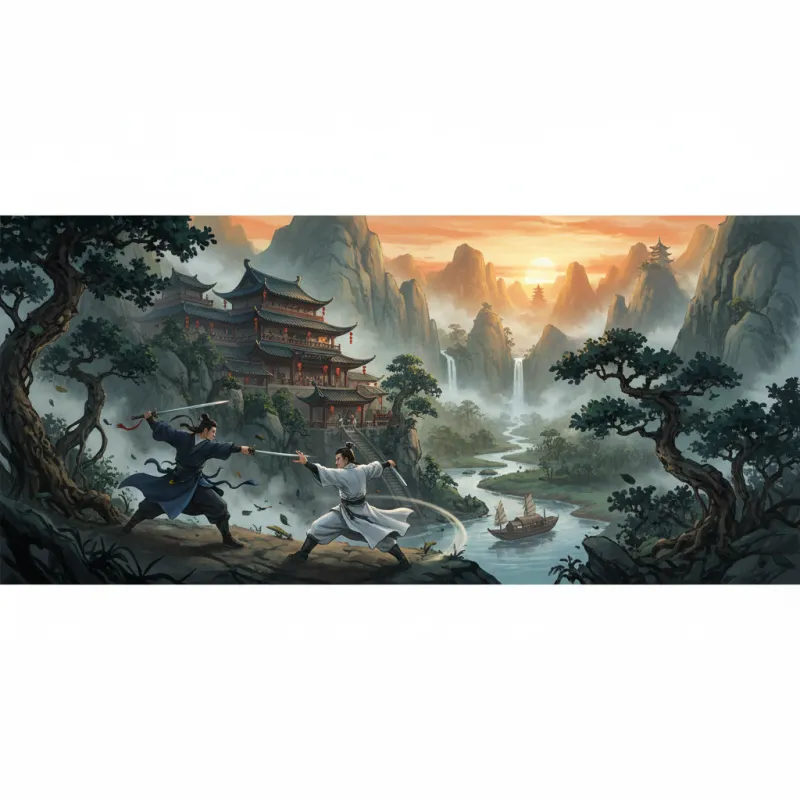
A swordsman stands at a crossroads in the rain. Behind him, the man who saved his life ten years ago. Ahead, the woman he swore to protect. His former benefactor demands he hand her over. She looks at him with eyes that say she already knows what he'll choose. This is the jianghu's cruelest test: when two unbreakable rules collide, something has to break. Usually, it's the person caught between them.
The martial world operates without courts, without written law, without the bureaucratic machinery that holds the imperial world together. What it has instead is more binding than any legal code: a web of obligations, promises, and face so intricate that one wrong move can unravel your entire existence. These aren't suggestions. They're the architecture of survival in a world where your reputation is the only currency that matters.
The Debt That Never Expires
有恩必报 (yǒu ēn bì bào) — "a debt of gratitude must be repaid." This isn't about keeping score or being polite. In the jianghu, saving someone's life creates a bond that transcends family, sect, and personal desire. The person who pulled you from the river, who took the blade meant for you, who shared their last bowl of rice when you were starving — they own a piece of your future.
Gu Long understood this better than anyone. In The Eleventh Son, the protagonist Xiao Shiyi Lang spends the entire novel navigating a maze of life debts that pull him in opposite directions. He owes his martial skills to one master, his life to another, and his freedom to a third. Each debt comes due at the worst possible moment, and each payment costs him something irreplaceable.
The genius of this rule is its asymmetry. The person who saves you might be a saint or a monster, but it doesn't matter. You owe them. They can call in that debt to ask you to commit murder, betray your sect, or abandon your principles. And if you refuse? You're not just breaking a promise — you're declaring yourself outside the social contract that makes the jianghu function. You become 不义之人 (bù yì zhī rén), a person without righteousness, and in the martial world, that's a death sentence that doesn't require an executioner.
The Weight of a Single Word
一诺千金 (yī nuò qiān jīn) — "one promise is worth a thousand gold." When a jianghu figure gives their word, they're not making a casual commitment. They're staking their entire identity on following through. This is why characters in wuxia novels are so careful about what they promise, and why villains often try to trap heroes into making vows they can't keep.
Jin Yong's Demi-Gods and Semi-Devils revolves around promises made decades before the story begins. Xiao Feng's father made a promise to a Khitan general. That promise, given in good faith during a moment of brotherhood, eventually forces Xiao Feng to choose between his Han Chinese upbringing and his Khitan blood. The promise doesn't care about changed circumstances, new information, or personal growth. A promise is a promise.
The martial world has no patience for excuses. "I didn't understand what I was agreeing to" — irrelevant. "The situation changed" — doesn't matter. "Keeping this promise will destroy me" — then you should have thought of that before you spoke. This inflexibility seems cruel until you realize it's the only thing preventing the jianghu from collapsing into pure chaos. In a world without contracts or courts, your word is the only guarantee anyone has.
Face: The Currency You Can't Afford to Lose
面子 (miànzi) — "face" — is the invisible force that governs every interaction in the martial world. It's not about ego or vanity. It's about the social capital that determines whether people will help you, trust you, or even acknowledge your existence. Lose face and you lose everything.
This is why jianghu conflicts escalate so quickly. Someone bumps into you in a tavern without apologizing — that's a loss of face. You demand an apology — they refuse, which means they're challenging your status. Now you have to respond, because if you don't, everyone watching will know you're weak. Before you know it, someone's dead over a spilled cup of wine.
The concept of face in jianghu culture operates on multiple levels. There's personal face — your individual reputation. Sect face — the honor of your martial arts school. And jianghu face — your standing in the broader martial community. You can sacrifice personal face to preserve sect face, or sacrifice sect face to preserve jianghu face, but you can't sacrifice all three. Do that and you might as well be dead.
Yue Buqun in The Smiling, Proud Wanderer is the perfect example of someone who understands face too well. He commits increasingly terrible acts to preserve the Huashan Sect's reputation, until the gap between his public image and private reality becomes so vast that it destroys him. He couldn't accept that sometimes, the honorable choice is to lose face.
The Rules of Combat That Aren't Really About Combat
武林规矩 (wǔlín guījǔ) — "martial forest rules" — govern how fights happen, but they're really about maintaining order in a community of people who can kill with their bare hands. You don't attack someone weaker than you without cause. You don't gang up on a single opponent unless they've done something truly heinous. You don't strike someone who's already injured or mourning.
These rules exist because without them, the jianghu would be a bloodbath. If every conflict escalated to maximum violence immediately, there would be no martial world left — just a wasteland of corpses and burned-out sects.
But here's the interesting part: these rules are constantly being tested. In The Heaven Sword and Dragon Saber, the six major sects besiege Bright Peak together, clearly violating the principle of fair combat. They justify it by claiming the Ming Cult is evil and therefore outside the rules. This is how the jianghu code evolves — someone finds a loophole, exploits it, and if they win, the loophole becomes precedent.
The hierarchy of martial arts sects matters here too. A top-tier sect can bend the rules in ways a minor sect can't. When Shaolin or Wudang does something questionable, people call it "upholding justice." When a small sect does the same thing, it's "banditry." The code isn't as egalitarian as it pretends to be.
The Impossible Position of the Righteous Hero
Here's what the jianghu code doesn't tell you: following all the rules simultaneously is impossible. The system is designed to create moral dilemmas that have no good solution. You owe a life debt to someone who asks you to break a promise. You must preserve face while also showing humility. You must be loyal to your sect while also following your personal sense of justice.
The greatest wuxia protagonists aren't the ones who follow the code perfectly — those characters are boring. The great ones are the people who understand that the code is a tool, not a religion. They know when to follow it and when to break it, and they accept the consequences of their choices.
Linghu Chong in The Smiling, Proud Wanderer gets expelled from his sect for violating its rules, but he never stops being a righteous person. He understands that 义 (yì) — righteousness — is more important than 规矩 (guījǔ) — rules. The code exists to serve righteousness, not the other way around.
When the Code Breaks Down
The jianghu code only works when most people follow it most of the time. When too many people start exploiting loopholes, when powerful sects use the rules to justify atrocities, when the gap between the code's ideals and its practice becomes too wide — that's when you get the kind of moral chaos that drives the best wuxia stories.
The code isn't perfect. It's patriarchal, it's rigid, and it often punishes people for circumstances beyond their control. But it's also the only thing standing between civilization and savagery in a world where everyone carries a weapon and knows how to use it.
The real question isn't whether you follow the code. It's what you do when following the code requires you to betray everything you believe in. That's the moment when you discover what kind of person you really are — and in the jianghu, that discovery usually comes with a body count.
Related Reading
- Unveiling Jianghu: The Rich Tapestry of Wuxia and Kung Fu Novels
- Wuxia Slang You Need to Know: A Guide to Jianghu Terminology
- Jianghu Terminology Glossary: Essential Martial World Vocabulary
- Jianghu Slang: The Secret Language of the Martial World
- Martial World Etiquette: The Social Rules of the Jianghu
- The Wuxia Training Montage: How Heroes Are Made
- Magical Plants of the Shanhai Jing: Trees That Grant Immortality
- Mountain and Water Poetry (山水诗): When Landscape Becomes Literature
Explore Chinese Culture
- Explore Jin Yong's martial arts novels
- Explore cultivation fiction and immortal heroes
- Explore the real history behind wuxia