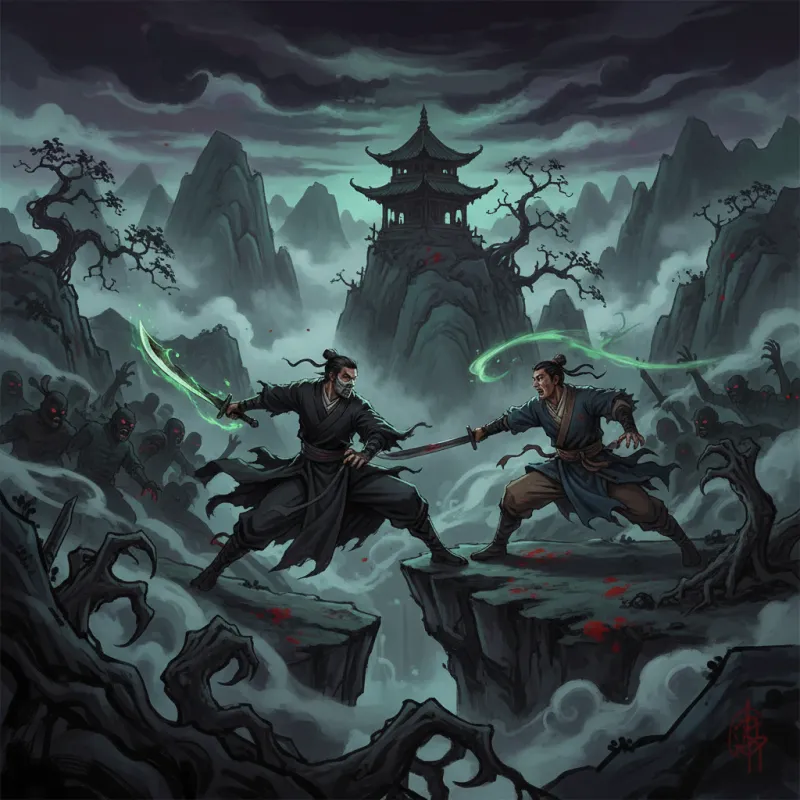
The corpse sat upright in the coffin, its eyes snapping open with an audible click. For Zhang Wuji, who had seen countless battles and survived poisonings that would kill ordinary men ten times over, this moment in the abandoned temple marked his first true encounter with something beyond the martial world's comprehension. This scene from Jin Yong's The Heaven Sword and Dragon Saber (倚天屠龙记, Yitian Tulong Ji) exemplifies a truth that Western readers often miss: wuxia fiction has always harbored horror in its bones, a darkness that runs deeper than mere violence or bloodshed.
The Jianghu's Haunted Geography
The jianghu (江湖, literally "rivers and lakes") isn't just a metaphorical space where martial artists roam—it's a landscape actively hostile to human presence. Gu Long understood this better than most. His novels place heroes in decaying temples where incense smoke mingles with the stench of decay, in fog-shrouded valleys where sounds carry wrong, in underground palaces where the architecture itself seems designed to drive visitors mad. The Bat Island sequence in Juedai Shuangjiao (Legendary Siblings) transforms a physical location into psychological horror, where Jiang Xiaoyu's imprisonment becomes a study in isolation and creeping dread.
These aren't mere backdrops. The abandoned Shaolin temple in Liang Yusheng's works, the poison-filled valleys of the Five Poison Sect (五毒教, Wudu Jiao), the mass graves that dot the landscape after sect wars—these locations carry weight because they're consequences. Every haunted place in wuxia earned its reputation through human action, through the accumulated violence of the martial world. The horror isn't supernatural; it's historical.
Neigong Gone Wrong: When Internal Energy Becomes Body Horror
The cultivation of internal energy (内功, neigong) promises transcendence, but wuxia literature obsesses over what happens when it goes catastrophically wrong. Jin Yong's Sunflower Manual (葵花宝典, Kuihua Baodian) requires self-castration as its first step, transforming Yue Buqun and Lin Pingzhi into something neither fully male nor female, their bodies twisted by their ambition. This isn't metaphorical emasculation—Jin Yong describes the physical transformation, the way their voices change, how their movements become uncanny.
Worse still is huorumozhang (火入魔障), the phenomenon of "fire deviation" where internal energy turns against its practitioner. Gu Long's Xiao Shiyilang features a martial artist whose qi has inverted, causing his body to age backwards while his mind deteriorates. He becomes a living paradox, a child's body housing a fragmenting consciousness. The scene where he tries to remember his own name, his juvenile face contorting with adult anguish, achieves genuine horror through the corruption of the body's fundamental processes.
The Beiming Divine Art (北冥神功, Beiming Shengong) from Demi-Gods and Semi-Devils allows practitioners to absorb others' internal energy—essentially vampirism dressed in Daoist terminology. Duan Yu's horror at discovering he's been involuntarily draining life force from those he touches creates a moral dimension to body horror: what if your very existence consumes others?
The Sect as Gothic Institution
Wuxia sects function like Gothic castles—isolated, hierarchical, harboring terrible secrets. The Xingxiu Sect (星宿派, Xingxiu Pai) in Jin Yong's novels operates on systematic psychological torture, where disciples must constantly praise their master Ding Chunqiu while he casually poisons them to test new toxins. The horror lies in the banality: this is simply how the sect functions, day after day, year after year.
Gu Long's Yihua Palace (移花宫, Yihua Gong) takes this further. Two sisters rule this all-female sect, their beauty preserved through techniques that require regular human sacrifice. They raise Jiang Xiaoyu and Hua Wuque as an experiment in nature versus nurture, treating human lives as variables in a decades-long study. The palace itself becomes a character—beautiful, isolated, fundamentally wrong. Disciples who fail are buried in the garden, their bodies nourishing the flowers that give the palace its name.
The forbidden techniques that sects guard often carry horror in their very conception. The Corpse Transformation Skill requires practicing among the dead until your qi takes on the properties of decay. The Blood Shadow Divine Art demands drinking fresh blood daily. These aren't evil techniques practiced by villains—they're legitimate martial arts with terrible costs, and the sects that preserve them must continuously make those payments.
Revenge and the Undying Grudge
Chinese ghost stories emphasize yuanqi (怨气, "resentment energy"), the belief that intense hatred can persist beyond death. Wuxia fiction secularizes this concept while maintaining its horror. Mei Chaofeng in The Legend of the Condor Heroes practices the Nine Yin Skeleton Claw, a technique that requires desecrating corpses to strengthen her fingers. She's not supernatural, but her obsession with revenge has transformed her into something that violates natural boundaries.
The most disturbing revenge narratives span generations. In The Book and the Sword, the revelation that Chen Jialuo and Qianlong are brothers—that the entire Honghua Society's rebellion is built on fraternal hatred—creates horror through dramatic irony. Readers watch characters unknowingly destroy their own bloodlines, the past reaching forward to corrupt the present.
Gu Long's The Eleventh Son features a protagonist hunting his father's killers, only to discover that his father was a monster who deserved death. The horror isn't the violence but the realization that revenge has consumed his entire life for an unworthy cause. The grudge becomes a parasite, hollowing out the host while wearing their face.
The Uncanny Valley of Martial Arts Mastery
When martial artists reach the highest levels, they stop being quite human. Dugu Qiubai (独孤求败, "Lonely Seeking Defeat") from Jin Yong's novels never appears alive—he exists only as a legend and a corpse in a cave, surrounded by the swords he used at different life stages. His final weapon is a heavy iron sword, then no sword at all. The progression suggests a transformation beyond human limitation, and his absence from the narrative makes him more disturbing than any living character.
The Dugu Nine Swords (独孤九剑, Dugu Jiu Jian) technique he created has no fixed forms—it's pure adaptation, pure response. Practitioners describe a state where conscious thought ceases and the body simply reacts. This sounds like enlightenment until you consider what it means: the erasure of self, the transformation of a person into a perfect killing instrument.
Feng Qingyang, who teaches this technique to Linghu Chong, lives alone on a mountain, having transcended the need for human society. He's achieved what martial artists dream of and become something alien in the process. When he demonstrates techniques, other characters describe feeling like they're watching something that shouldn't be possible, a wrongness in how he moves through space.
Poison, Plague, and the Corruption of Nature
The Five Poison Sect doesn't just use poison—they embody it. Practitioners cultivate toxins in their own bodies, becoming living weapons. He Tishou in The Heaven Sword and Dragon Saber has practiced poison arts so long that his touch causes necrosis, his breath carries venom. He's transformed himself into something that nature itself rejects, unable to touch another human without causing harm.
The Thousand Spiders Ten Thousand Poison Hands technique requires being bitten by venomous creatures repeatedly until your body adapts. Survivors develop immunity but at the cost of their humanity—their blood becomes toxic, their sweat acidic. They must live apart from others, their very existence a threat to normal life.
Ouyang Feng's snake pit in The Legend of the Condor Heroes represents nature weaponized and perverted. He breeds snakes for venom potency, creating species that shouldn't exist, that are too toxic to survive in the wild. When the pit is destroyed, the snakes escape and create an ecological disaster, a reminder that martial arts' manipulation of natural forces has consequences beyond individual combat.
The plague sequences in wuxia fiction achieve horror through helplessness. Martial arts mastery means nothing against disease. When plague strikes the jianghu, heroes who can split boulders with their palms die like anyone else, their internal energy useless against microscopic enemies. These sequences strip away the genre's power fantasy, revealing the fragility beneath.
The Psychological Horror of Disguise and Identity
Wuxia fiction obsesses over hidden identities, but the horror lies in how completely characters can be replaced. In The Smiling, Proud Wanderer, Yue Buqun maintains his disguise as a righteous sect leader for decades while secretly practicing evil techniques. The horror isn't the revelation but the implication: how many years can someone perform righteousness before the performance becomes indistinguishable from reality? Is there still a "real" Yue Buqun underneath, or has the disguise consumed the original?
Gu Long's The Sentimental Swordsman, Ruthless Sword features Li Xunhuan, whose face never changes expression. He's trained himself into emotional suppression so complete that even he can't access his true feelings. The novel treats this as tragedy, but it's also body horror—the deliberate mutilation of one's own emotional capacity, the transformation of a human into a mask.
The Yirong (易容, face-changing) technique allows perfect physical disguise, but extended use causes practitioners to forget their original faces. They become collections of masks with no true self beneath. Several Gu Long novels feature characters who've worn disguises so long they experience identity dissolution, unable to remember who they were before the deception began.
The Weight of Wulin History
Every generation of martial artists in wuxia fiction inherits the crimes of their predecessors. The blood debts never expire; they compound. Jin Yong's novels span centuries, showing how a single act of betrayal in one generation creates cascading consequences that destroy families three generations later. The horror is structural—the jianghu itself is built on accumulated violence that can never be fully repaid.
The Wulin Mengzhu (武林盟主, "Martial Arts Alliance Leader") position exemplifies this. It promises authority over the jianghu but comes with the weight of every decision previous leaders made. In The Heaven Sword and Dragon Saber, the position has become cursed—every leader dies violently, destroyed by the contradictions inherent in trying to impose order on a fundamentally anarchic space.
Ancient manuals and techniques carry their creators' obsessions forward through time. When characters discover a centuries-old martial arts manual, they're not just learning techniques—they're being possessed by the dead master's will, their bodies moving in patterns designed by someone long gone. The past literally inhabits the present through martial arts transmission, and there's no way to learn the technique without accepting this haunting.
The genre's horror elements aren't decorative—they're diagnostic. They reveal what happens when human ambition encounters the limits of flesh, when social structures calcify into prisons, when the past refuses to stay buried. Wuxia's darkness isn't a corruption of the genre but its foundation, the shadow that gives its heroism meaning. The jianghu is haunted because it's built on graves, and every martial artist walks on bones.
Related Reading
- The Best Chinese Horror Films: A Genre Guide
- Chinese Internet Ghost Stories: The Creepypasta of the East
- Chinese Horror Novels That Will Keep You Up at Night
- The Knight-Errant (游侠): Real Warriors Who Inspired Wuxia
- Mountain and Water Poetry (山水诗): When Landscape Becomes Literature
- The Smiling Proud Wanderer: A Story About Freedom
Explore Chinese Culture
- Explore Jin Yong's martial arts novels
- Explore cultivation fiction and immortal heroes
- Explore the real history behind wuxia