Picture this: A young martial artist stands chest-deep in a mountain stream at dawn, arms extended, holding a horse stance while the current tries to sweep his legs away. He's been there for three hours. His thighs are screaming. His master sits on the bank, drinking tea, occasionally throwing rocks at his head to "test his awareness." This is Tuesday.
Wuxia training methods make modern fitness influencers look soft. These aren't your standard push-ups and protein shakes — we're talking about techniques designed to transform ordinary humans into the kind of people who can punch through walls, leap across rooftops, and fight for three days straight without a bathroom break. The wild part? Many of these methods have actual historical precedent, even if the novels cranked the results up to eleven.
The Waterfall Meditation Industrial Complex
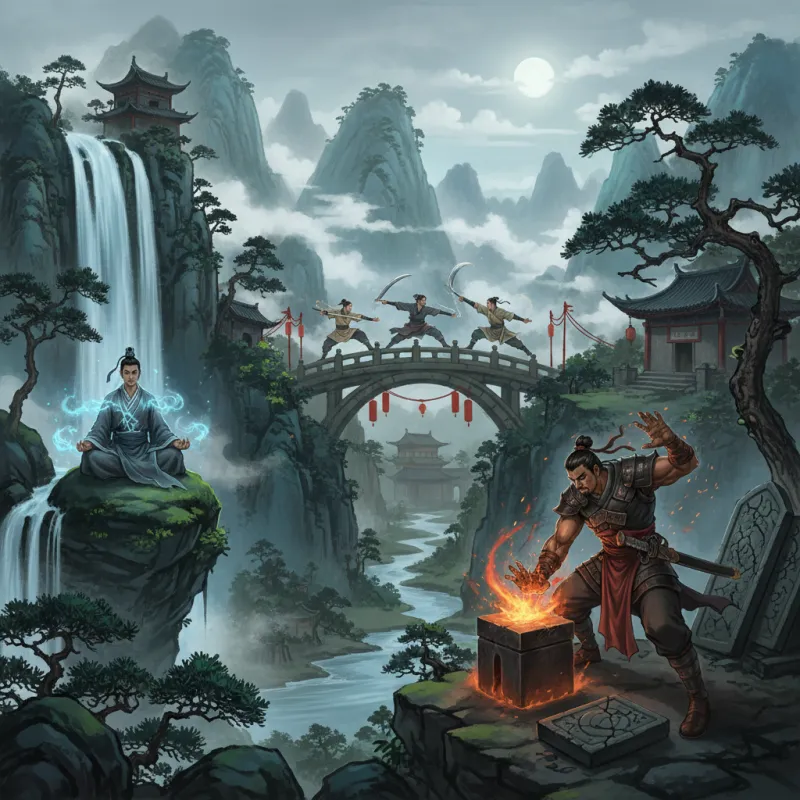
Standing under waterfalls (瀑布修炼 pùbù xiūliàn) has become the visual shorthand for "serious martial arts training" in every wuxia adaptation ever filmed. You've seen it: our hero sits in lotus position while thousands of gallons of water pound his shoulders, looking serene and slightly constipated.
The real practice, part of what Shaolin monks called "hardening" (硬功 yìnggōng), was less about enlightenment and more about building ridiculous pain tolerance. Historical records from Song Mountain (嵩山 Sōngshān) describe monks standing under waterfalls, but they weren't just sitting there looking photogenic. They were practicing forms, holding stances, and conditioning their bodies to function under constant physical stress.
Jin Yong's Demi-Gods and Semi-Devils (天龙八部 Tiānlóng Bābù) features Xuzhu training under a waterfall at Shaolin, but the novel actually undersells how brutal this would be. The force of falling water can easily exceed 100 pounds per square foot. Maintaining any posture under that pressure for extended periods would require core strength that would make Olympic gymnasts weep. The meditation aspect isn't mystical — it's the only way to mentally endure something that physically miserable.
Iron Palm and the Art of Hitting Things Until Your Hands Break (Then Heal Stronger)
Iron Palm (铁砂掌 tiěshā zhǎng) training is where wuxia meets body horror. The traditional method involves repeatedly striking bags filled with iron sand, mung beans, or gravel while applying medicinal wine (药酒 yàojiǔ) to prevent permanent damage. The goal: hands that can shatter bricks, snap swords, and generally ruin someone's day with a single strike.
This practice is 100% real, though the results in novels are... optimistic. Real Iron Palm practitioners develop thickened skin, denser bones, and increased pain tolerance. Qiu Qianren from The Legend of the Condor Heroes (射雕英雄传 Shèdiāo Yīngxióng Zhuàn) can allegedly split stone tablets with his palm — in reality, a master might crack a few bricks after decades of training. Still impressive, just not "demolish a wall" impressive.
The medicinal component is crucial and often ignored in adaptations. Without the herbal treatments, you're not building Iron Palm — you're just giving yourself arthritis and nerve damage. Traditional formulas included ingredients like safflower (红花 hónghuā), myrrh (没药 mòyào), and dragon's blood resin (血竭 xuèjié) to promote circulation and healing. The training philosophy recognized that you were essentially creating controlled micro-trauma; the medicine ensured your body rebuilt stronger rather than just... broken.
Carrying Water Up Mountains: The Unglamorous Truth
Here's a training method that sounds boring but shows up constantly in wuxia: carrying increasingly heavy objects up and down mountains. Water buckets, stone locks (石锁 shísuǒ), weighted vests — anything to make basic movement exhausting.
Linghu Chong in The Smiling, Proud Wanderer (笑傲江湖 Xiào'ào Jiānghú) spends months carrying water for his sect before learning any actual techniques. This isn't hazing (well, not entirely) — it's foundational conditioning. The uneven terrain builds ankle stability and proprioception. The constant load develops the kind of structural strength that can't be replicated in a gym. The repetition ingrains movement patterns until they're unconscious.
Modern strength coaches have rediscovered this as "loaded carries," but they do it for 50 meters in a climate-controlled facility. Wuxia disciples did it for miles, in all weather, while their masters critiqued their posture. The mental fortitude required might be more valuable than the physical adaptation. Anyone can train when motivated; martial artists need to train when exhausted, injured, and completely over it.
Qi Circulation: Meditation That Actually Does Something
Internal energy cultivation (内功 nèigōng) is where wuxia training gets mystical, but strip away the fantasy elements and you're left with sophisticated breathing and meditation practices that have measurable effects. The novels describe circulating qi (气 qì) through meridians (经络 jīngluò) to enhance strength, speed, and healing — real practitioners use similar techniques to regulate their nervous system, improve focus, and optimize physical performance.
The "small circulation" (小周天 xiǎo zhōutiān) involves directing attention through specific points along the torso in coordination with breathing. The "large circulation" (大周天 dà zhōutiān) extends this through the limbs. Modern research suggests these practices activate the parasympathetic nervous system, reduce cortisol, and improve heart rate variability — not magical, but legitimately beneficial for anyone doing intense physical training.
Zhang Wuji's nine-year meditation session in The Heaven Sword and Dragon Saber (倚天屠龙记 Yǐtiān Túlóng Jì) to master the Nine Yang Divine Skill (九阳神功 Jiǔyáng Shéngōng) is obviously exaggerated, but the underlying principle — that patient, consistent internal work can transform your physical capabilities — holds up. The difference is that real results take years of daily practice, not a convenient time-skip montage.
Sparring With Nature: When Your Training Partner Is a Tree
Plum blossom pole training (梅花桩 méihuā zhuāng) involves jumping between wooden posts of varying heights, practicing forms while maintaining balance on surfaces barely wider than your foot. It develops spatial awareness, leg strength, and the kind of agility that makes parkour look clumsy.
But wuxia takes it further. Characters train by fighting on bamboo poles, walking across rope bridges during storms, or practicing sword forms on ice. The environment becomes an active opponent. Duan Yu from Demi-Gods and Semi-Devils learns lightness kung fu (轻功 qīnggōng) by running across increasingly fragile surfaces — first wooden planks, then paper, then allegedly water itself (that last one is artistic license).
The real-world version is less dramatic but still effective. Shaolin monks practiced on pole arrays, sometimes while carrying weights or being attacked by training partners. The instability forces your body to constantly micro-adjust, building the kind of reflexive balance that becomes automatic in combat. Your brain learns to process and respond to environmental feedback faster than conscious thought.
The Poison Resistance Subplot
Multiple wuxia novels feature heroes building poison immunity by ingesting gradually increasing doses of toxins, often while practicing internal cultivation to "burn away" the poison with qi. This is mithridatism, named after King Mithridates VI of Pontus, who allegedly made himself immune to assassination by poison through similar methods.
The Condor Heroes trilogy features this repeatedly — Yang Guo gains partial immunity after exposure to various toxins, while Huang Rong uses her medical knowledge to help others survive poisoning. The novels treat this as a viable training method, which is... technically possible but wildly dangerous. Real historical figures attempted this, with mixed results (Mithridates himself eventually tried to commit suicide by poison and failed, which is either ironic or tragic depending on your perspective).
Modern toxicology confirms you can build tolerance to specific toxins, but the therapeutic window is narrow and the long-term health effects are severe. This is one training method that should stay firmly in fiction, no matter how cool it sounds. The wuxia version also ignores that most martial artists would die during the "building immunity" phase, which makes for poor storytelling.
Copying Masters: The Observational Learning Shortcut
One of the most common training shortcuts in wuxia is learning by observation — watching a master perform a technique once and somehow absorbing years of training through pure genius. Linghu Chong learns the Dugu Nine Swords (独孤九剑 Dúgū Jiǔjiàn) this way, as does Zhang Wuji with the Taiji Sword.
This actually has basis in motor learning theory. Mirror neurons fire when we observe skilled movement, creating neural patterns similar to physical practice. Elite athletes use visualization and observation as legitimate training tools. But — and this is a big but — observation supplements physical practice, it doesn't replace it. You can't watch someone do a backflip and suddenly be able to do one yourself.
The wuxia version works because these characters already have the physical foundation and body awareness from years of basic training. They're not learning from scratch; they're recognizing patterns and applications that their bodies can already execute. It's still compressed for narrative convenience, but less absurd than it initially appears. The real skill isn't copying the movements — it's understanding the principles behind them quickly enough to adapt and apply them.
The Unspoken Foundation: Boring Consistency
Here's what wuxia novels usually skip: the thousands of hours of basic drilling that precede any cool techniques. Horse stance (马步 mǎbù) until your legs shake. Punching the air until your shoulders burn. Practicing the same sword form until you could do it in your sleep, then doing it in your sleep.
The training montages show the dramatic stuff — the waterfall meditation, the iron palm conditioning, the death-defying balance exercises. They don't show the protagonist doing basic stretches every morning for a decade. They don't show the repetitive drilling that ingrains fundamental movements until they're reflexive. That's not exciting television, but it's the actual foundation of martial skill.
The internal energy cultivation and weapon mastery that make wuxia heroes superhuman are built on this unglamorous base. The fancy techniques are the penthouse; the boring basics are the foundation. You can't skip to the good stuff, no matter how talented you are.
The genius of wuxia training methods isn't that they're realistic — it's that they take real practices and amplify them to mythological proportions while maintaining internal logic. A waterfall meditation session might not give you supernatural powers, but it will absolutely build mental and physical resilience. Iron Palm won't let you shatter stone, but it will develop striking power beyond normal human capability. The novels understand that transformation requires suffering, consistency, and time — they just compress the timeline and exaggerate the results for narrative impact.
Which is probably for the best. Nobody wants to read 800 pages about someone doing horse stance.
Related Reading
- Exploring Chinese Martial Arts Fiction: Training and Tradition in Wuxia Novels
- Wuxia Training Montages: How Heroes Are Made
- Internal Energy (Neigong): The Hidden Power Behind Every Martial Art
- The Wuxia Training Montage: How Heroes Are Made
- The Poison Arts: Wuxia Fiction's Most Feared Discipline
- Chinese Internet Ghost Stories: The Creepypasta of the East
- The Tang Clan: Masters of Hidden Weapons and Poison
- Sacred Objects of Chinese Mythology: Seals, Mirrors, and Cauldrons
Explore Chinese Culture
- Explore Jin Yong's martial arts novels
- Explore cultivation fiction and immortal heroes
- Explore the real history behind wuxia