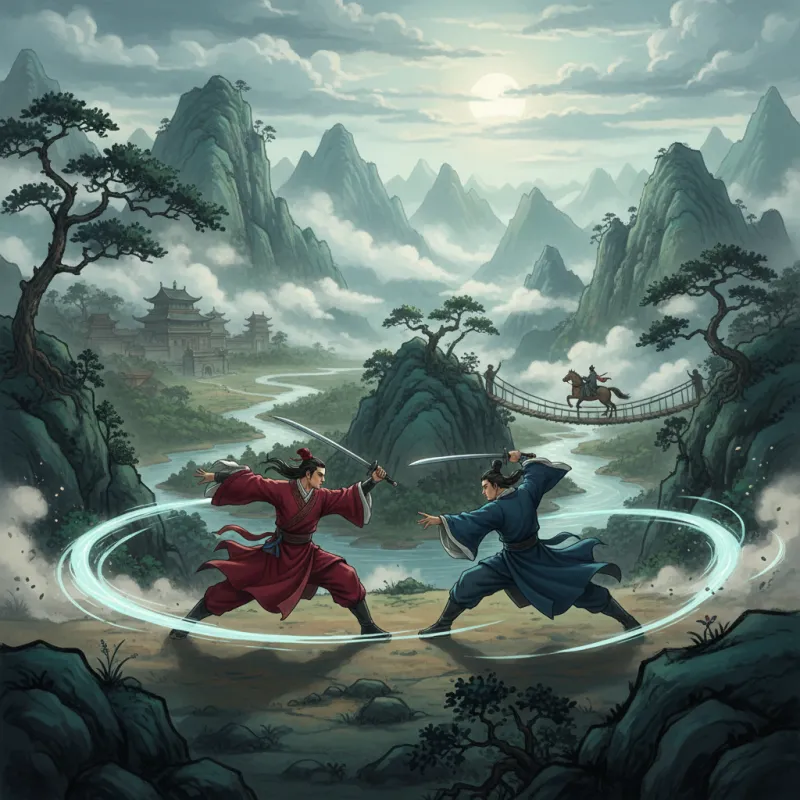
The blade whistles through bamboo, and somewhere in the mist-shrouded mountains, a wanderer with no name settles an old debt. This is jianghu—not a place you can find on any map, but a shadow world that has captivated Chinese readers for over a thousand years. If you've ever wondered why kung fu novels feel like they're describing a parallel universe with its own laws, customs, and moral code, you're not imagining things. The jianghu (江湖, jiānghú—literally "rivers and lakes") is exactly that: a counterculture so deeply embedded in Chinese imagination that it shapes everything from how heroes introduce themselves to why they'd rather die than break a promise.
The Origins: When Outlaws Became Legends
Wuxia didn't spring fully formed from Jin Yong's typewriter in the 1950s. The genre's DNA traces back to the Tang Dynasty (618-907 CE), when short tales called chuanqi (传奇, chuánqí) featured swordsmen with supernatural abilities. But the real blueprint emerged during the Song Dynasty with Water Margin (水浒传, Shuǐhǔ Zhuàn), written around the 14th century. This novel about 108 outlaws gathering at Mount Liang established the template: society's rejects forming their own brotherhood, living by a code more honorable than the corrupt officials hunting them. The jianghu was born not as escapist fantasy, but as pointed social commentary—a space where justice could exist when the imperial system failed.
What makes this fascinating is how the concept evolved. By the Ming and Qing dynasties, jianghu had transformed from a refuge for bandits into something more philosophical. It became the realm of youxia (游侠, yóuxiá)—wandering knights-errant who owed allegiance to no lord, only to their personal code of yi (义, yì), often translated as "righteousness" but really meaning something closer to "doing right by your people, consequences be damned."
The Unwritten Laws: How Jianghu Actually Works
Here's what Western readers often miss: jianghu operates on a completely different social contract than the imperial world. When Guo Jing in The Legend of the Condor Heroes introduces himself, he doesn't mention his family's wealth or official rank—he states his shifu (师父, shīfù, master), his martial arts lineage, and which sect he belongs to. This isn't just politeness; it's survival information. In jianghu, your martial arts sect is your identity, your insurance policy, and your credit rating rolled into one.
The famous jianghu guiju (江湖规矩, jiānghú guīju—"rules of jianghu") aren't written anywhere, yet everyone knows them. Challenge someone to a duel? You set the time and place, and both parties show up alone. Receive a favor? You owe a debt that might take decades to repay. Betray your sect? You're not just expelled—you're hunted. These rules create dramatic tension that modern wuxia writers exploit brilliantly. In Gu Long's The Legendary Siblings, the entire plot hinges on characters trapped between conflicting jianghu obligations, each one ironclad.
The concept of mianzi (面子, miànzi—"face") operates on steroids in jianghu. It's not just about reputation; it's about whether other martial artists will help you when you're cornered, or whether they'll pretend not to see you bleeding out in an alley. This is why wuxia heroes make seemingly irrational choices—turning down imperial appointments, refusing to use poison even when outmatched, or keeping promises made to enemies. They're not being naive; they're investing in their jianghu credit score.
The Martial Arts: More Than Just Fight Choreography
When Jin Yong describes Duan Yu learning the Lingbo Weibu (凌波微步, Língbō Wēibù—"Wave Striding Steps") in Demi-Gods and Semi-Devils, he's not just adding a cool power-up. Each martial art in wuxia carries philosophical weight. The Eighteen Dragon-Subduing Palms embodies Confucian directness and overwhelming force. The Nine Yin Manual represents Daoist principles of yielding and internal cultivation. Even the names tell stories—Dugu Qiubai (独孤求败, Dúgū Qiúbài) literally means "Lonely Seeking Defeat," a swordsman so skilled he spent his life searching for a worthy opponent.
The concept of neigong (内功, nèigōng—"internal energy") versus waigong (外功, wàigōng—"external techniques") reflects actual Chinese martial philosophy, though wuxia cranks it to eleven. In real martial arts, internal cultivation means breath control and body mechanics. In wuxia novels, it means shooting energy blasts and healing mortal wounds through meditation. But the underlying principle remains: true mastery comes from within, not from memorizing forms. This is why the most powerful characters in kung fu novels often seem unassuming—they've transcended flashy techniques.
The Social Hierarchy: Sects, Gangs, and Lone Wolves
Jianghu society is Byzantine in its complexity. At the top, you have the orthodox sects (zhengpai, 正派, zhèngpài) like Shaolin, Wudang, and Emei—institutions with centuries of history, vast resources, and political clout. They're the Harvard and Yale of martial arts, and they know it. Then you have the unorthodox sects (xiejiao, 邪教, xiéjiào), which aren't necessarily evil despite the translation—they just don't play by orthodox rules. The Ming Cult in The Heaven Sword and Dragon Saber gets labeled "demonic" by orthodox sects, but they're actually freedom fighters against Mongol occupation.
Below the major sects, you have smaller schools, family clans, and regional gangs like the Beggar's Sect—which, despite the name, is one of the most powerful organizations in jianghu, with intelligence networks spanning the entire country. At the bottom are lone wanderers and sanren (散人, sǎnrén—"scattered people") who belong to no faction. They have the most freedom and the least protection.
What's brilliant about this hierarchy is how it mirrors and inverts real Chinese society. In the imperial world, scholars and officials ranked highest. In jianghu, they're irrelevant unless they can fight. Beggars, who occupied the lowest rung of Confucian society, run one of jianghu's most respected organizations. It's a complete value inversion, which is precisely why jianghu stories resonated with readers across centuries—they offered an alternative to rigid social stratification.
The Code of Xia: What Makes a Hero
The character xia (侠, xiá) is notoriously difficult to translate. "Knight-errant" is close but misses the Chinese specificity. A xia isn't just skilled in combat—they embody wuyi (武义, wǔyì), the fusion of martial prowess and moral righteousness. The famous phrase xia yi wei guo wei min (侠之大者,为国为民, xiá zhī dà zhě, wèi guó wèi mín—"the greatest heroes serve their country and people") from Jin Yong's work captures this ideal, but it's more complex than simple patriotism.
Real xia figures operate in moral gray zones. They might rob corrupt officials (righteous) but keep some of the money (pragmatic). They'll avenge murdered friends (honorable) even if it means killing someone's father (tragic). Gu Long's heroes especially embody this ambiguity—Li Xunhuan in Sentimental Swordsman, Ruthless Sword is an alcoholic gambler who happens to be the most honorable man in jianghu. The tension between personal desires and xia obligations drives the best wuxia narratives.
Modern Wuxia: The Genre's Evolution and Global Reach
Contemporary wuxia has splintered into fascinating subgenres. Xianxia (仙侠, xiānxiá) adds Daoist cultivation and immortality-seeking, transforming jianghu into a cosmic hierarchy where martial artists can literally become gods. Xuanhuan (玄幻, xuánhuàn) throws in Western fantasy elements—magic systems, different worlds, whatever works. These aren't corruptions of "pure" wuxia; they're the genre doing what it's always done: absorbing new influences while maintaining core themes.
The global explosion of Chinese web novels has introduced millions of non-Chinese readers to jianghu culture, though something gets lost in translation. The weight of a character saying "I am from Wudang" doesn't hit the same if you don't know Wudang's eight-century history. The tragedy of a master expelling a student from their sect feels less devastating if you don't understand that this severs not just a relationship but an entire identity.
Yet the core appeal transcends culture: stories about people choosing honor over survival, about found families bound by choice rather than blood, about a world where your worth depends on your character and skills rather than your birth. That's why a 14th-century Chinese novel about outlaws still resonates, why Jin Yong's works sell millions globally, why new wuxia stories keep finding audiences. The jianghu isn't just a setting—it's a promise that somewhere, there's a world where the right kind of strength matters, where keeping your word means something, where wanderers can find home.
The mist hasn't cleared from those mountains, and the wanderer is already gone, but the story continues. That's jianghu—eternal, elusive, and endlessly compelling.
Related Reading
- Lingzhi: The Mushroom of Immortality from Myth to Medicine
- The Peaches of Immortality: The Most Famous Fruit in Chinese Mythology
- Mythical Plants of the Shanhaijing: Trees That Grant Immortality and Flowers That Kill
- The Bizarre Plants of the Shanhaijing: Trees That Cure Death and Fruits That Grant Flight
- Magical Plants of the Shanhai Jing: Trees That Grant Immortality
- The Hetu and Luoshu: Magical Diagrams from the Rivers
- Female Martial Artists in Wuxia Fiction
- Mountain and Water Poetry (山水诗): When Landscape Becomes Literature
Explore Chinese Culture
- Explore Jin Yong's martial arts novels
- Explore cultivation fiction and immortal heroes
- Explore the real history behind wuxia