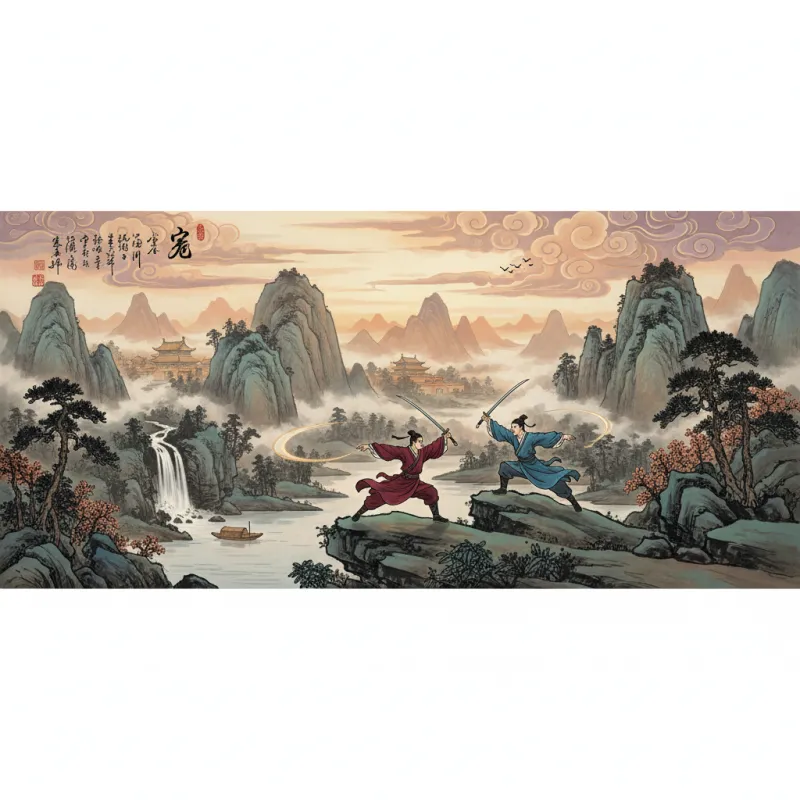
Every wuxia novel has that moment when the hero squares off against a villain, and the translator suddenly throws a dozen unfamiliar terms at you in rapid succession. "He gathered his neigong and executed the qinggong technique, his zhang strike meeting the opponent's jian in a clash of gangqi." Wait, what just happened? Did he win? Is he flying? Why are there so many italicized words?
Here's the truth: wuxia vocabulary isn't just flavor text. These terms carry specific meanings that English approximations can't capture. When a character uses qinggong (轻功, qīnggōng), they're not just "jumping really high" — they're employing a distinct category of martial skill that manipulates weight and movement. When someone cultivates neigong (内功, nèigōng), they're not doing generic "meditation" — they're following systematic internal energy practices that differentiate masters from amateurs.
This glossary covers the core vocabulary you'll encounter across Jin Yong, Gu Long, Liang Yusheng, and virtually every other wuxia author. Master these terms and you'll never again wonder whether "lightness skill" and "cloud-stepping" refer to the same thing (they do — both translate qinggong).
Internal Power and Energy Cultivation
Neigong (内功, nèigōng) — Internal martial arts training focused on cultivating qi within the body. This isn't mystical nonsense in the wuxia context; it's a systematic practice with specific techniques, breathing patterns, and meditation postures. When Guo Jing spends years learning the Jiuyin Zhenjing (Nine Yin Manual) in The Legend of the Condor Heroes, he's building neigong foundations that amplify every external technique he learns.
Waigong (外功, wàigōng) — External martial arts emphasizing physical conditioning, technique precision, and combat forms. The Shaolin Temple's Yijin Jing (Muscle-Tendon Change Classic) bridges both categories, but most waigong focuses on perfecting strikes, blocks, and weapon forms through repetition. Characters with pure waigong training hit a ceiling that neigong practitioners eventually surpass.
Qi (气, qì) — The internal energy cultivated through neigong practice. Translations vary wildly: "chi," "internal energy," "inner power," "vital force." In wuxia novels, qi becomes tangible force — it can heal injuries, enhance strength, project attacks at range, and even form protective barriers. The amount and quality of your qi determines your rank in the martial world.
Dantian (丹田, dāntián) — The energy center located roughly three finger-widths below the navel where qi accumulates and circulates. Serious injuries to the dantian can cripple a martial artist permanently. When Linghu Chong loses his neigong in The Smiling, Proud Wanderer, it's because his dantian was damaged — a catastrophe that drives much of the novel's plot.
Zhenqi (真气, zhēnqì) — "True qi," the refined form of qi achieved through advanced cultivation. This isn't just more qi; it's qualitatively different, like comparing crude oil to refined gasoline. Top-tier masters manipulate zhenqi, while intermediate practitioners work with basic qi.
Gangqi (罡气, gāngqì) — Protective energy projected outside the body as an invisible shield. When a master stands calmly while arrows bounce off empty air around them, that's gangqi at work. It's the defensive application of highly refined qi, and only top-tier martial artists can maintain it.
Movement and Agility Techniques
Qinggong (轻功, qīnggōng) — Lightness techniques that allow practitioners to move with supernatural agility. This covers everything from running up walls to gliding across water to leaping between rooftops. The mechanics vary by author: some treat it as pure qi manipulation that reduces effective body weight, others as advanced physical conditioning. Either way, qinggong separates martial artists from ordinary people more visibly than any other skill.
Shenfa (身法, shēnfǎ) — Body techniques and footwork used in combat. While qinggong handles dramatic movement, shenfa governs the subtle positioning, evasion, and stance work that determines victory in actual fights. A character might have mediocre qinggong but devastating shenfa — think of how Huang Rong in Condor Heroes uses clever positioning to defeat stronger opponents.
Weapons and Combat Tools
Jian (剑, jiàn) — The straight, double-edged sword favored by scholars and refined martial artists. This is the "gentleman's weapon," associated with Daoist practitioners and elegant swordplay. When translators write "sword" without qualification, they usually mean jian. Linghu Chong's Dugu Jiujian (Solitary Nine Swords) technique uses a jian.
Dao (刀, dāo) — The single-edged saber or broadsword, considered more practical and military than the jian. Heavier, designed for cutting rather than thrusting. The Blade of Fire in Demi-Gods and Semi-Devils is a dao, as are most weapons used by soldiers and rougher martial artists.
Qiang (枪, qiāng) — The spear, king of battlefield weapons. In wuxia novels, spear techniques often emphasize reach and piercing power. Yang Guo's Anran Xiaohun Zhang (Ecstasy Palm) in Return of the Condor Heroes was developed partly to counter spear users.
Zhang (掌, zhǎng) — Palm strikes, one of the most versatile unarmed techniques. The Jianglong Shibazhang (Eighteen Dragon-Subduing Palms) that Guo Jing masters is a zhang technique. These aren't slaps — they're devastating strikes that channel qi through the palm.
Quan (拳, quán) — Fist techniques and boxing methods. Shaolin's Luohan Quan (Arhat Fist) is the foundation of countless quan styles in wuxia fiction. Generally more straightforward than palm techniques but no less deadly.
Anqi (暗器, ànqì) — Hidden weapons: throwing needles, darts, projectiles. The Tang Sect in Sichuan specializes in anqi, particularly poison-coated variants. These weapons suit ambush tactics and assassination more than honorable dueling, giving them a morally ambiguous reputation.
Martial Arts Manuals and Techniques
Miji (秘笈, mìjí) — Secret martial arts manuals that contain advanced techniques. These drive countless wuxia plots: everyone wants the Jiuyin Zhenjing, the Jiuyang Shengong, or whatever legendary miji promises ultimate power. Realistic? No. Dramatically effective? Absolutely.
Xinfa (心法, xīnfǎ) — The mental formulas or cultivation methods that accompany martial techniques. You can learn the external movements of a technique, but without the xinfa, you're just going through motions. This is why martial arts can't be learned purely through observation — you need the internal methodology.
Zhaoshi (招式, zhāoshì) — Individual moves or techniques within a martial arts style. A complete style might contain dozens or hundreds of zhaoshi. When characters call out attack names in combat, they're announcing specific zhaoshi.
Wugong (武功, wǔgōng) — Martial arts skill or achievement, used both for specific techniques and general martial ability. "His wugong is profound" means he's highly skilled. "She learned the wugong of the Emei Sect" means she trained in their specific techniques.
Jianghu Social Structures
Shifu (师父, shīfu) — Master or teacher in the martial arts context. This relationship carries profound obligations: a shifu must guide and protect students, while disciples owe lifelong loyalty. Betraying your shifu is among the worst crimes in jianghu ethics.
Shixiong/Shimei (师兄/师妹, shīxiōng/shīmèi) — Senior martial brother and junior martial sister, terms for fellow disciples under the same master. These relationships structure sect hierarchies and create complex social dynamics. The shixiong who entered the sect first outranks the more talented shidi (junior brother) who arrived later.
Zhangmen (掌门, zhǎngmén) — Sect leader or head of a martial arts school. This position carries immense authority and responsibility. When Yue Buqun becomes zhangmen of the Huashan Sect in Smiling, Proud Wanderer, he gains power that eventually corrupts him.
Menpai (门派, ménpài) — Martial arts sect or school. The Wudang menpai, Shaolin menpai, and Emei menpai represent distinct traditions with different philosophies and techniques. Conflicts between menpai drive much wuxia drama.
Combat Concepts and Conditions
Dianxue (点穴, diǎnxué) — Pressure point strikes that can paralyze, injure, or kill by disrupting qi flow through meridians. A skilled practitioner can seal an opponent's xue (acupoints) with precise finger strikes, leaving them helpless. The technique requires extensive anatomical knowledge and precise qi control.
Zouhuo rumo (走火入魔, zǒuhuǒ rùmó) — "Fire deviation" or "qigong deviation," the catastrophic result of improper neigong cultivation. This can cause insanity, permanent injury, or death. Characters who practice stolen techniques without proper xinfa often suffer zouhuo rumo. It's the wuxia equivalent of a critical system failure.
Neishang (内伤, nèishāng) — Internal injuries affecting qi circulation and organ function. These are far more serious than external wounds because they're harder to detect and treat. A character might appear fine while suffering severe neishang that will kill them without proper treatment.
Jiedu (解毒, jiědú) — Detoxification or poison neutralization. Given how often wuxia characters get poisoned, jiedu skills are surprisingly valuable. Some characters like Hu Qingniu in Heavenly Sword and Dragon Saber specialize in both poison and jiedu, making them indispensable.
Cultivation and Achievement Levels
Jingmai (经脉, jīngmài) — Meridians through which qi flows in the body. Opening blocked jingmai increases martial power dramatically. The Ren and Du meridians are particularly important — connecting them creates the "small circulation" that marks a major cultivation breakthrough.
Dacheng (大成, dàchéng) — Great achievement or mastery of a martial art. When a character reaches dacheng in a technique, they've perfected it completely. This is the goal of cultivation, though few achieve it.
Ruhuo chunjing (入火纯青, rùhuǒ chúnqīng) — Reaching the "pure blue flame" level of mastery where technique becomes effortless and natural. This is beyond mere dacheng — it's the realm where martial arts transcend conscious thought.
Why These Terms Matter
Learning this vocabulary doesn't just help you read wuxia novels more smoothly. It reveals the underlying logic of the genre. When you understand that neigong and waigong represent fundamentally different approaches to martial arts, you grasp why certain characters develop the way they do. When you know that qinggong is a distinct skill category, you stop being confused when a character who's deadly in combat can't catch a fleeing opponent with superior lightness techniques.
The best wuxia translators leave many of these terms untranslated precisely because English equivalents don't exist. "Internal energy" doesn't capture what neigong means. "Lightness skill" sounds ridiculous compared to qinggong. By learning the Chinese terms, you're reading closer to what the original authors intended.
And here's the practical benefit: once you know these terms, you can read multiple translations of the same novel and understand what's happening regardless of the translator's choices. You'll recognize that "Eighteen Dragon-Subduing Palms," "Eighteen Stages to Subdue Dragons," and "Eighteen Dragon Subjugating Palms" all refer to Jianglong Shibazhang. You'll know that "internal injury," "internal damage," and "wounded meridians" all point to neishang.
This glossary covers maybe 5% of total wuxia vocabulary, but it's the essential 5% that appears everywhere. Master these terms and you've built the foundation. The rest you'll pick up naturally as you read, each new term adding another layer to your understanding of the martial world's complex culture.
Related Reading
- Martial World Etiquette: The Social Rules of the Jianghu
- Sworn Brotherhood in Wuxia: The Sacred Ritual of Jiéyì
- Unveiling Jianghu: The Rich Tapestry of Wuxia and Kung Fu Novels
- The Jianghu Code: Unwritten Rules That Govern the Martial World
- Wuxia Slang You Need to Know: A Guide to Jianghu Terminology
- Chinese Internet Ghost Stories: The Creepypasta of the East
- Internal Energy (Neigong): The Hidden Power Behind Every Martial Art
- Sects and Clans in Wuxia: The Organizations That Rule the Martial World
Explore Chinese Culture
- Explore Jin Yong's martial arts novels
- Explore cultivation fiction and immortal heroes
- Explore the real history behind wuxia