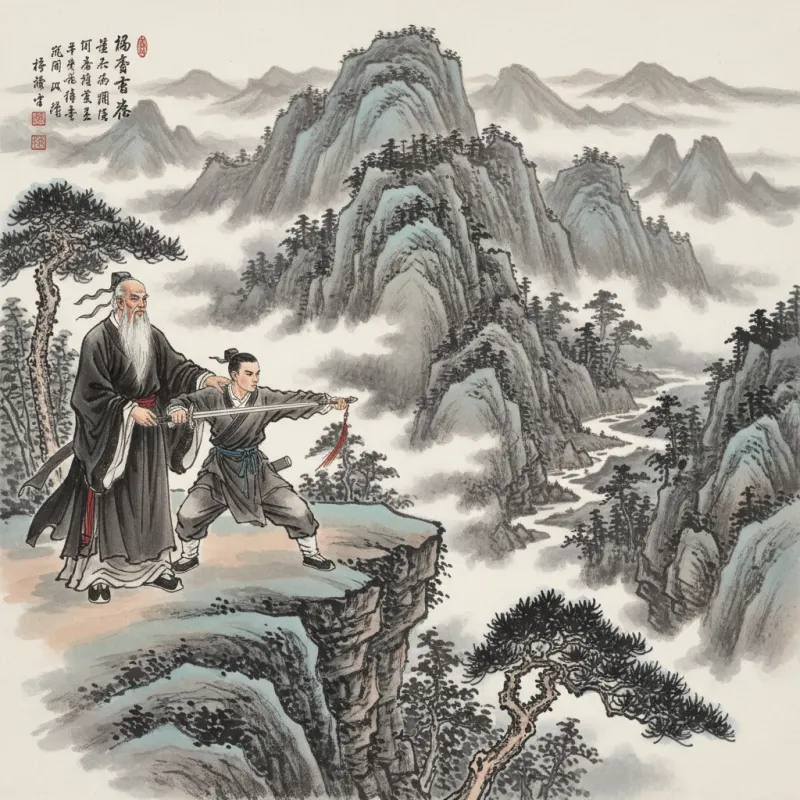
A young man kneels in the snow outside a mountain temple for three days and three nights. He hasn't eaten. He hasn't slept. His lips are blue, his fingers numb, but he doesn't move. Inside, an old master watches through a crack in the door, testing the boy's resolve. This isn't hazing—it's the beginning of the most consequential relationship in wuxia fiction, one that will define everything from the disciple's fighting style to their moral compass to whether they live or die when the final battle comes.
The Proverb That Changes Everything
一日为师,终身为父 (yī rì wéi shī, zhōngshēn wéi fù). "One day as your teacher, a lifetime as your father." This isn't metaphor. In the jianghu (江湖 jiānghú)—the martial world of rivers and lakes—your shifu (师父 shīfu, master) literally replaces your biological parent in terms of authority, loyalty, and obligation. You don't just learn kung fu from them. You inherit their enemies, their debts, their reputation, and their place in the complex web of martial sects and alliances that make up the wulin (武林 wǔlín, martial forest).
Western martial arts students switch dojos when they move cities or find better instruction. In wuxia, changing masters is like disowning your family—it brands you as disloyal, destroys your credibility, and can make you a target for both your old and new master's enemies. The bond is permanent, which is why the acceptance ritual matters so much.
The Kowtow That Seals Your Fate
You don't become a disciple by filling out a registration form. The baishi (拜师 bàishī) ceremony—literally "paying respects to the master"—is a formal ritual that often involves witnesses, tea ceremonies, and most importantly, the kowtow. The prospective disciple kneels and touches their forehead to the ground three times (三叩首 sān kòushǒu), a gesture of absolute submission reserved for emperors and ancestors.
But here's what makes wuxia interesting: the master can refuse. In fact, they usually do, at least at first. Jin Yong's The Legend of the Condor Heroes (1957) shows Guo Jing being rejected by the Seven Freaks of Jiangnan multiple times before they finally accept him—not because he's talented (he's famously slow-witted), but because he demonstrates the character traits they value: persistence, sincerity, and moral integrity.
The testing period can last days, months, or years. Linghu Chong in The Smiling, Proud Wanderer (1967) spends a decade as Yue Buqun's disciple before realizing his master is a hypocrite who values power over righteousness. By then, it's too late—the bond has been formed, and breaking it will cost Linghu Chong everything.
What the Master Owes the Disciple
The relationship isn't one-sided. A shifu who accepts a disciple takes on massive responsibilities. They must teach their martial arts (武功 wǔgōng) without holding back critical techniques—a master who deliberately teaches incomplete or flawed methods is considered one of the worst betrayals in the jianghu. They must provide for the disciple's basic needs, protect them from enemies they're not ready to face, and guide their moral development.
Most importantly, the master must pass down their lineage (传承 chuánchéng). In wuxia, martial arts aren't just techniques—they're living traditions that die if not transmitted. When Dugu Qiubai's sword techniques are lost because he had no disciples, it's treated as a tragedy for the entire martial world. The master-disciple relationship is how knowledge survives across generations, which is why masters are so selective about who they teach.
Good masters like Hong Qigong in Jin Yong's work embody this responsibility. He teaches Guo Jing the Eighteen Dragon-Subduing Palms (降龙十八掌 Jiàng Lóng Shíbā Zhǎng) not because Guo Jing is talented, but because he recognizes the boy's good heart and knows these techniques should serve righteousness, not ambition.
What the Disciple Owes the Master
Everything. The disciple's obligations are absolute and lifelong. You must obey your master's commands, even when they seem unreasonable. You must avenge your master's death, even if it means facing opponents far beyond your skill level. You must uphold your master's reputation, even if they're dead and can't benefit from it. And you must never, under any circumstances, use your martial arts against your master or their other disciples.
This creates the central dramatic tension in countless wuxia stories. What happens when your master is wrong? When they're corrupt, like Yue Buqun? When they order you to do something immoral? When their enemy is actually in the right? The disciple faces an impossible choice: betray your master and lose your identity as a martial artist, or obey and betray your own conscience.
Xiao Feng in Demigods and Semi-Devils (1963) faces this dilemma when he discovers his master participated in the massacre of his biological family. He can't take revenge without violating the master-disciple bond, but he can't ignore the truth either. His solution—leaving the jianghu entirely—shows how destructive these conflicts can be.
The Sect System: Extended Family or Prison?
The master-disciple relationship doesn't exist in isolation. It's embedded in the menpai (门派 ménpài) system—martial sects that function like extended families or clans. When you become someone's disciple, you also become a member of their sect, with all the rivalries and politics that entails.
Your shixiong (师兄 shīxiōng, senior martial brother) and shimei (师妹 shīmèi, junior martial sister) become your siblings. Your master's master becomes your grand-master (师祖 shīzǔ). Your master's martial siblings become your uncles and aunts (师叔 shīshū, 师伯 shībó). This creates a complex hierarchy where a young disciple might have to show deference to someone only a few years older simply because they joined the sect earlier.
The Wudang Sect (武当派 Wǔdāng Pài) in The Heaven Sword and Dragon Saber (1961) perfectly illustrates this system. Zhang Sanfeng has seven disciples, each with their own students, creating a multi-generational structure where everyone knows their exact place in the hierarchy. When conflicts arise, they're resolved according to seniority and lineage, not merit or justice.
This system provides security and belonging, but it can also trap people in toxic relationships. Leaving your sect is like leaving your family—possible, but at enormous social cost.
When the Bond Breaks: Betrayal and Expulsion
Qingchu shimen (清出师门 qīngchū shīmén)—expulsion from the sect—is the ultimate punishment, a social death that strips you of your identity and makes you an outcast in the jianghu. Masters can expel disciples for serious violations: betraying sect secrets, killing fellow disciples, or bringing shame to the sect's name.
But expulsion works both ways. A disciple can also renounce their master, though this is rarer and even more scandalous. Yang Guo in The Return of the Condor Heroes (1959) essentially does this when he refuses to follow the Quanzhen Sect's rules, choosing his love for Xiaolongnü over his obligations to his martial uncles. The jianghu never fully forgives him for it.
The most tragic scenarios involve mutual betrayal. When Yue Buqun reveals his true nature in The Smiling, Proud Wanderer, Linghu Chong must choose between loyalty to a corrupt master and his own moral code. He chooses righteousness, but the cost is his place in the Huashan Sect and years of psychological torment.
These betrayals hurt so much because the relationship is supposed to be unbreakable. When it breaks anyway, it doesn't just end a mentorship—it shatters a fundamental assumption about how the jianghu works.
Why This Relationship Dominates Wuxia
The master-disciple bond is more than a plot device—it's the structural foundation of wuxia fiction. It explains how martial arts are transmitted, how conflicts escalate across generations, how heroes develop their moral codes, and why characters make seemingly irrational choices in the name of loyalty.
It also reflects deep currents in Chinese culture: Confucian respect for teachers, the importance of lineage and inheritance, and the tension between individual conscience and social obligation. The proverb "一日为师,终身为父" predates wuxia by centuries, rooted in a worldview where relationships create obligations that transcend personal preference.
Modern wuxia writers sometimes subvert this tradition—Gu Long's protagonists are often masterless wanderers who reject traditional hierarchies—but even these subversions acknowledge the power of the master-disciple bond by showing what happens when it's absent. Characters without masters are free, but they're also rootless, lacking the guidance and belonging that make the jianghu navigable.
In the end, the master-disciple relationship endures in wuxia because it creates the perfect dramatic engine: a bond strong enough to inspire absolute loyalty, but fragile enough to break under the weight of conflicting obligations. Every time a disciple kneels in the snow, waiting for acceptance, we know we're watching the beginning of a relationship that will define their entire story—for better or worse.
Related Reading
- Tragic Heroes of Wuxia: When Honor Leads to Destruction
- The Heroes of Wuxia: What Makes a Xia Different from a Fighter
- ** Unraveling the Legends of Jianghu: The Cultural Allure of Wuxia Heroes
- Qu Yuan: The First Named Poet in Chinese History
- Women Warriors of Wuxia: Breaking Boundaries in the Martial World
- The Wuxia Film Renaissance: Why Hong Kong Cinema Matters
- Exploring Chinese Martial Arts Fiction and Jianghu Culture in Kung Fu Novels
- Mythical Plants of the Shanhaijing: Trees That Grant Immortality and Flowers That Kill
Explore Chinese Culture
- Explore Jin Yong's martial arts novels
- Explore cultivation fiction and immortal heroes
- Explore the real history behind wuxia