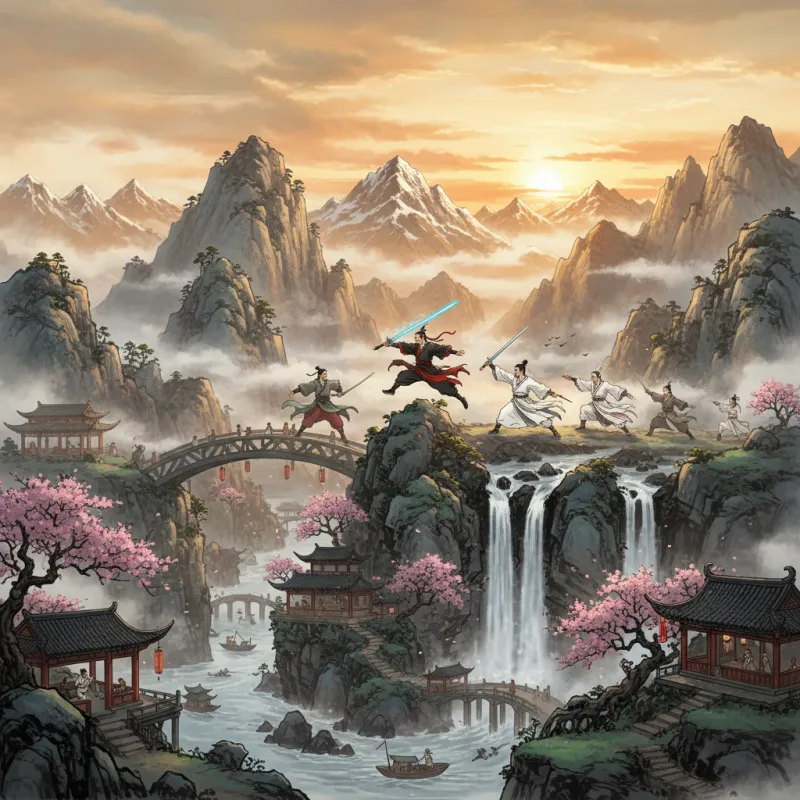
A swordsman stands at a crossroads in the rain. To his left, a merchant caravan under attack by bandits. To his right, the mountain path leading to the duel that will restore his master's honor. He has time to save only one. Which does he choose? Your answer reveals which type of jianghu hero you understand — and which you've yet to meet.
The Chinese martial arts world recognizes that heroism isn't monolithic. The wandering swordsman who rights wrongs in dusty villages operates under different principles than the sect leader who maintains order through institutional power. Both embody 侠 (xiá) — that untranslatable concept of martial chivalry — but they express it through radically different philosophies, methods, and costs.
The Wandering Knight-Errant: 游侠 (Yóuxiá)
This is the archetype most Western readers picture when they think "wuxia hero." The 游侠 (yóuxiá) — literally "wandering knight" — travels alone or with a small group, intervenes in local injustices, and moves on before anyone can properly thank them. Think Guo Jing from The Legend of the Condor Heroes in his early wandering days, or Li Xunhuan from Sentimental Swordsman, Ruthless Sword.
The 游侠 operates outside formal power structures. They don't wait for magistrates to deliver justice or sect elders to authorize action. When they see a bully extorting a tea house owner, they act. When corrupt officials oppress a village, they intervene. Their legitimacy comes not from institutional authority but from personal martial skill and moral conviction.
But here's the tension Jin Yong understood better than anyone: this archetype is fundamentally unstable. The 游侠 can solve immediate problems — rescue the kidnapped daughter, defeat the bandit chief — but they can't build lasting institutions. They're firefighters, not architects. Guo Jing eventually realizes this and transforms into something else entirely, but many 游侠 remain perpetual wanderers, solving the same types of problems in different towns until age or injury catches up with them.
The 游侠 typically follows a strict personal code: never kill unnecessarily, protect the weak, repay debts of gratitude, and maintain one's word even at great personal cost. This code is self-imposed and self-enforced, which makes it both noble and precarious. Without external accountability, the line between righteous knight-errant and self-righteous vigilante can blur.
The Sect Leader: Institutional Power and Its Discontents
Where the 游侠 operates through personal action, the sect leader wields organizational power. Characters like Zhang Sanfeng of Wudang or Hong Qigong of the Beggars' Sect don't just fight individual battles — they shape the entire jianghu through the institutions they lead.
This archetype faces a completely different set of moral challenges. A sect leader can't simply draw their sword whenever they see injustice. Every action carries political implications. Intervene in a dispute between two smaller sects, and you risk appearing to take sides. Fail to intervene, and you're accused of indifference. The sect leader must balance immediate moral imperatives against long-term institutional stability.
Jin Yong's The Smiling, Proud Wanderer explores this tension brilliantly through the Five Mountains Sword Sects Alliance. The leaders who prioritize sect survival and political maneuvering aren't necessarily villains — they're trying to protect hundreds or thousands of disciples. But in doing so, they often compromise the very principles of 侠 that their sects were founded to uphold.
The sect leader archetype also reveals how power corrupts even well-intentioned heroes. Yue Buqun begins as a respected leader trying to protect his sect, but the pressures of institutional politics gradually transform him into something monstrous. The tragedy isn't that he was evil from the start — it's that the role itself created incentives that rewarded increasingly ruthless behavior.
Yet some sect leaders manage to maintain their integrity. Zhang Sanfeng remains incorruptible precisely because he refuses to let Wudang become entangled in jianghu politics. He builds an institution strong enough to protect itself but restrained enough not to dominate others. It's a razor's edge that few can walk.
The Righteous Outlaw: When Heroes Become Criminals
Some of the most compelling heroes in wuxia fiction are technically criminals. They've killed corrupt officials, stolen from the wealthy, or violated imperial law in pursuit of justice. The jianghu calls them 义贼 (yìzéi) — righteous bandits — and their existence poses uncomfortable questions about the relationship between law and morality.
The classic example is the 108 heroes of Water Margin (水浒传 Shuǐhǔ Zhuàn), who gather at Liangshan Marsh after being driven to outlawry by corrupt officials. These aren't common criminals — they're skilled martial artists and former government officials who chose rebellion over complicity. Their motto "替天行道" (tì tiān xíng dào) — "carry out the way on Heaven's behalf" — claims a higher moral authority than imperial law.
Modern wuxia fiction inherits this archetype but complicates it. Gu Long's heroes often operate in moral gray zones where the distinction between righteous outlaw and common criminal becomes genuinely unclear. Is Chu Liuxiang a heroic thief or just a very charming criminal? The novels refuse to give easy answers.
The righteous outlaw archetype forces readers to confront a central question: what do you do when the legal system itself is corrupt? The 游侠 can work around bad laws by operating in their margins. The sect leader can try to reform institutions from within. But the righteous outlaw has concluded that the system is irredeemable and must be opposed directly, even at the cost of becoming a fugitive.
This path carries enormous costs. The righteous outlaw sacrifices social legitimacy, family ties, and any hope of normal life. They live in constant danger not just from enemies but from the state itself. Yet wuxia fiction treats them as heroes precisely because they're willing to pay these costs rather than compromise their principles.
The Reluctant Hero: Power Without Desire
Perhaps the most psychologically complex archetype is the reluctant hero — the martial artist who possesses extraordinary skill but no desire to use it. They want to retire, to live quietly, to be left alone. But circumstances keep dragging them back into the jianghu.
Gu Long mastered this archetype. Li Xunhuan has already achieved fame and proven his skill, but he's tired. He drinks too much, coughs blood, and just wants to carve wooden figurines in peace. Yet people keep seeking him out — to challenge him, to ask for help, to drag him into their conflicts. His heroism lies not in seeking glory but in accepting responsibility even when he desperately wants to refuse it.
The reluctant hero reveals something important about the nature of 侠: it's not about personal fulfillment or self-actualization. It's about duty, often unwelcome duty. The reluctant hero would be happier running a noodle shop or tending a garden, but they possess skills that others need and a conscience that won't let them refuse.
This archetype also explores the costs of martial excellence. The reluctant hero has usually seen too much violence, lost too many friends, and understands too well that every problem solved with a sword creates new problems. They're not naive idealists — they're experienced warriors who know exactly what they're getting into and do it anyway.
The tension here is exquisite: the reluctant hero is often more capable than the eager young swordsman, but less willing to act. They need to be pushed, provoked, or guilt-tripped into heroism. Yet once committed, they're utterly reliable. Their reluctance makes their eventual action more meaningful, not less.
The Vengeance Seeker: When Justice Becomes Personal
Not all heroes fight for abstract principles. Some fight for intensely personal reasons: to avenge murdered family members, to restore a destroyed sect, to reclaim stolen honor. The vengeance seeker's heroism is complicated by the fact that their primary motivation is self-interested, even if their methods align with broader justice.
Chen Jialuo from The Book and the Sword begins as a vengeance seeker trying to overthrow the Qing dynasty and restore the Ming. His cause happens to align with broader anti-Manchu sentiment, but his motivation is deeply personal. This creates moral ambiguity: is he a freedom fighter or just someone using political rhetoric to justify personal revenge?
The vengeance seeker archetype asks whether motivation matters if the outcome is just. If someone kills a corrupt official who's been oppressing peasants, does it matter whether they did it for justice or because that official murdered their family? Wuxia fiction generally suggests that yes, motivation matters enormously — because it determines what the hero does after achieving their revenge.
Some vengeance seekers, having accomplished their goal, discover they've become the very thing they fought against. Others find that revenge brings no satisfaction and must discover new purpose. The most interesting ones realize midway through their quest that their enemy isn't as simple as they thought, forcing them to choose between revenge and genuine justice.
This archetype also explores how personal trauma shapes heroic identity. The vengeance seeker's entire sense of self is built around their quest. What happens when it's over? Can they become a different type of hero, or are they forever defined by their loss?
The Idealist: Changing the Jianghu Itself
The rarest and most ambitious archetype is the idealist who doesn't just want to fight injustice — they want to transform the entire jianghu system that produces injustice. These heroes look at the endless cycle of sect conflicts, personal vendettas, and martial competitions and ask: what if we could build something better?
Guo Jing's evolution in The Legend of the Condor Heroes and The Return of the Condor Heroes represents this archetype's fullest expression. He starts as a simple 游侠, but gradually realizes that individual heroic acts aren't enough. By the end, he's defending Xiangyang not just because it's the right thing to do, but because he believes in building a society where ordinary people don't need heroes to protect them.
The idealist faces the hardest path because they're fighting not just individual villains but systemic problems. They must build alliances, create institutions, and convince others to share their vision. Most fail. The jianghu is conservative, resistant to change, and full of people who benefit from the current system.
Jin Yong was fascinated by this archetype but also deeply skeptical of it. His idealists often achieve temporary success but can't create lasting change. The jianghu returns to its old patterns. This pessimism reflects Jin Yong's understanding of Chinese history: reformers come and go, but fundamental power structures prove remarkably durable.
Yet the idealist remains heroic precisely because they try despite knowing the odds. They represent the hope that the jianghu could be different, even if that hope is never fully realized. Their failure is tragic, but their attempt is noble.
The Synthesis: Heroes Who Transcend Categories
The greatest wuxia heroes don't fit neatly into any single archetype. They evolve, combining elements from multiple categories as circumstances demand. Linghu Chong begins as a carefree disciple, becomes a reluctant hero, briefly leads a sect, and ultimately chooses the wandering path. His heroism lies partly in his refusal to be constrained by any single role.
This fluidity reflects a deeper truth about 侠: it's not a fixed identity but a continuous practice. The hero isn't someone who achieves heroism once and then coasts on reputation. They must choose heroism repeatedly, in different contexts, under different pressures. Sometimes that means drawing your sword. Sometimes it means sheathing it. Sometimes it means building institutions. Sometimes it means walking away from them.
Understanding these archetypes helps readers appreciate why wuxia fiction remains compelling across generations. These aren't just action stories about people with cool martial arts skills. They're explorations of different ways to live ethically in a world where power is unequally distributed, institutions are often corrupt, and individual action has both tremendous potential and severe limitations.
The next time you encounter a jianghu hero, ask yourself: which archetype are they? What costs are they paying for their heroism? What blind spots does their particular approach create? And most importantly: which type of hero would you be at that rain-soaked crossroads, forced to choose between personal honor and immediate justice?
The answer might surprise you. It might even change depending on when you ask. That's the genius of wuxia fiction — it doesn't offer simple answers about heroism. It offers a rich taxonomy of possibilities, each with its own integrity and its own tragic limitations. The jianghu needs all of them, even as it can't quite accommodate any of them fully.
For more on the moral codes that guide these heroes, see The Unwritten Rules of Jianghu Honor. And to understand the weapons that define their fighting styles, explore Legendary Weapons and Their Masters.
Related Reading
- Women Warriors of Wuxia: Breaking Boundaries in the Martial World
- Tragic Heroes of Wuxia: When Honor Leads to Destruction
- ** Unraveling the Legends of Jianghu: The Cultural Allure of Wuxia Heroes
- Huang Rong: The Smartest Heroine in Chinese Fiction
- The Heroes of Wuxia: What Makes a Xia Different from a Fighter
- Demi-Gods and Semi-Devils: Themes of Identity and Fate
- Women Warriors in Chinese Martial Arts Fiction: Empowering Jianghu Heroines
- Shanhai Jing Creatures in Modern Video Games
Explore Chinese Culture
- Explore Jin Yong's martial arts novels
- Explore cultivation fiction and immortal heroes
- Explore the real history behind wuxia