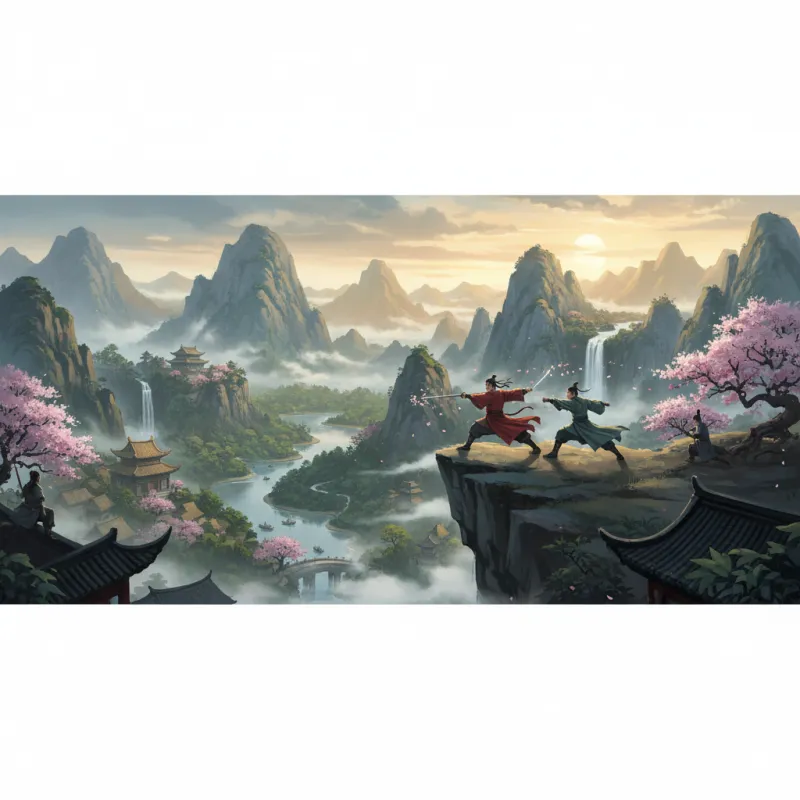
The first time you see a Shaw Brothers film, you might mistake it for camp. The garish Technicolor sets, the theatrical blood spurts, the gravity-defying wire work — it all feels deliberately artificial, like watching a stage play through a kaleidoscope. But that's exactly the point. Hong Kong's wuxia cinema never pretended to be realistic. It was building something else entirely: a visual language for martial virtue that would reshape action filmmaking worldwide.
The Shaw Brothers Machine
Shaw Brothers Studio didn't just make movies — it manufactured dreams on an industrial scale. Founded in 1958 by the Shaw family, the studio's Movietown complex in Clearwater Bay became the largest privately-owned film production facility in the world. At its 1970s peak, Shaw Brothers churned out over 40 films annually, operating with the precision of a Detroit assembly line.
The system was brutally efficient. Directors, actors, martial arts choreographers, and crew worked under exclusive contracts. Sets depicting Ming dynasty courtyards or Song dynasty taverns were repurposed across multiple productions. A typical wuxia film moved from script to screen in under three months. Lau Kar-leung (刘家良, Liú Jiāliáng) could shoot a complete fight sequence in a single day, his camera crew anticipating every angle through sheer repetition.
This factory model produced plenty of forgettable films — formulaic revenge plots and recycled choreography. But the volume created something unexpected: a laboratory for innovation. When you're making 40 films a year, you can afford to experiment. Some of those experiments changed cinema forever.
Chang Cheh and the New Wuxia
Director Chang Cheh (张彻, Zhāng Chè) understood that wuxia wasn't about realism — it was about mythology. His 1967 film "The One-Armed Swordsman" (独臂刀, Dú Bì Dāo) became the first Hong Kong film to gross over HK$1 million by embracing stylized violence as emotional expression. When the protagonist Fang Gang loses his arm, the blood doesn't just flow — it erupts in crimson fountains against stark white walls, transforming injury into operatic tragedy.
Chang Cheh's films were unapologetically masculine, focused on brotherhood, loyalty, and beautiful death. His regular collaborators — actors David Chiang and Ti Lung, choreographer Lau Kar-leung — developed a movement vocabulary that balanced balletic grace with bone-crushing impact. The fights weren't just action sequences; they were character studies conducted through violence.
But it was King Hu (胡金铨, Hú Jīnquán) who elevated wuxia to art cinema. His 1966 masterpiece "Come Drink with Me" (大醉侠, Dà Zuì Xiá) and 1971's "A Touch of Zen" (侠女, Xiá Nǚ) proved that martial arts films could be visually sophisticated and philosophically complex. Hu's camera lingered on bamboo forests and temple architecture, treating the jianghu (江湖, jiānghú) — the martial world — as a space of spiritual transformation, not just physical combat. Understanding Jianghu: The Martial World Beyond the Law explores this concept in depth.
The Golden Harvest Revolution
By the early 1970s, Shaw Brothers faced an unexpected challenger. Golden Harvest, founded in 1970 by former Shaw executive Raymond Chow, offered something radical: creative freedom. Instead of the studio contract system, Golden Harvest gave filmmakers profit participation and artistic control.
This attracted Bruce Lee. His four Golden Harvest films — "The Big Boss" (1971), "Fist of Fury" (1972), "Way of the Dragon" (1972), and "Enter the Dragon" (1973) — weren't traditional wuxia. Lee stripped away the wire work and fantasy elements, replacing them with raw, kinetic realism. His fighting style drew from Wing Chun, boxing, and fencing, creating a hybrid that felt modern and international.
Lee's global success opened Hollywood's eyes to Hong Kong cinema, but his early death in 1973 left a void. Golden Harvest filled it with Jackie Chan, whose "Drunken Master" (1978) invented a new subgenre: kung fu comedy. Chan's approach was the opposite of Bruce Lee's intensity — playful, self-deprecating, emphasizing physical comedy over martial prowess. His willingness to show failure and pain made him relatable in ways the stoic heroes of Shaw Brothers never were.
The New Wave and Beyond
The 1980s brought a generation of film school graduates who grew up watching Shaw Brothers and Golden Harvest films. Directors like Tsui Hark, John Woo, and Ringo Lam deconstructed wuxia conventions, blending them with Western genres and postmodern sensibilities.
Tsui Hark's "Zu Warriors from the Magic Mountain" (1983) pushed special effects to hallucinogenic extremes, while his production of "A Chinese Ghost Story" (1987) merged wuxia with horror and romance. John Woo applied wuxia's balletic violence to contemporary gun battles in "The Killer" (1989) and "Hard Boiled" (1992), creating what critics called "bullet ballet."
The 1990s saw wuxia's final golden age. Ang Lee's "Crouching Tiger, Hidden Dragon" (2000) brought the genre to Western art house audiences, but it was building on decades of Hong Kong innovation. The film's famous bamboo forest fight — choreographed by Yuen Wo-ping, who learned his craft at Shaw Brothers — was a direct descendant of King Hu's work thirty years earlier.
Why It Still Matters
Hong Kong wuxia cinema's influence extends far beyond martial arts films. The Wachowskis hired Yuen Wo-ping to choreograph "The Matrix" (1999), importing wire work and fight philosophy wholesale. Quentin Tarantino's "Kill Bill" films are love letters to Shaw Brothers aesthetics. Marvel's "Shang-Chi and the Legend of the Ten Rings" (2021) finally brought authentic wuxia choreography to the MCU, with fight scenes that prioritize rhythm and flow over CGI spectacle.
But the deeper legacy is conceptual. Hong Kong filmmakers proved that action sequences could be authored — that fight choreography was as important as cinematography or editing. They demonstrated that genre films could be visually innovative and emotionally complex. They showed that you could make art on a factory schedule if you had vision and discipline.
The Shaw Brothers studio system is gone now. Movietown was sold in 2003 and demolished for luxury housing. The old films survive on streaming platforms and Blu-ray, their Technicolor hues and dramatic zooms looking increasingly alien to modern eyes. But every time a contemporary action film uses wire work, every time a fight scene is edited for rhythm rather than realism, every time a director treats violence as choreography rather than chaos — that's Hong Kong wuxia cinema, still teaching the world how to dream in motion.
The Unfinished Conversation
What made Hong Kong's wuxia renaissance possible wasn't just talent or technology — it was a specific historical moment when commercial pressures, artistic ambition, and cultural identity converged. The films were made for local audiences who understood the references to classical novels like "Water Margin" and "Romance of the Three Kingdoms," who recognized the moral codes of the jianghu, who could read the symbolism in a character's weapon choice or fighting style.
That cultural specificity is what gave the films their power. They weren't trying to be universal; they were deeply, unapologetically Chinese. The irony is that this specificity made them globally influential. Filmmakers worldwide recognized something authentic in the stylization, something true in the fantasy. The Evolution of Wuxia Weapons in Cinema examines how these visual choices created meaning.
Today's action cinema owes an unpayable debt to those Hong Kong studios. Every superhero who defies gravity, every fight scene that treats combat as dance, every film that chooses beauty over brutality — they're all speaking a language invented in Clearwater Bay between 1958 and 2000. The conversation continues, even if we've forgotten where it started.
Related Reading
- Best Wuxia TV Dramas: A Streaming Guide for International Viewers
- The World of Wuxia: Exploring Chinese Martial Arts Fiction and Jianghu Culture
- The Golden Age of Hong Kong Wuxia Cinema
- Wuxia Video Games: From Chinese RPGs to Global AAA Titles
- Crouching Tiger, Hidden Dragon: How One Film Changed Everything
- Wudang vs Shaolin: Two Philosophies of Combat
- Sun Wukong: The Great Sage Who Challenged Heaven
- Mythical Plants of the Shanhaijing: Trees That Grant Immortality and Flowers That Kill
Explore Chinese Culture
- Explore Jin Yong's martial arts novels
- Explore cultivation fiction and immortal heroes
- Explore the real history behind wuxia