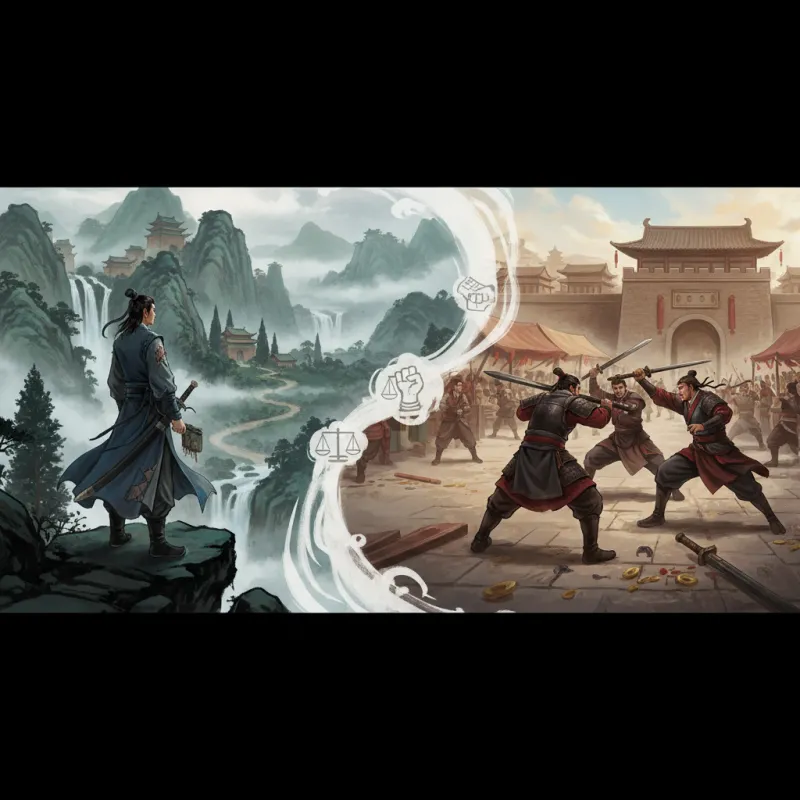
A swordsman walks into a teahouse. He's killed thirty men, mastered the Eighteen Dragon-Subduing Palms, and can leap across rooftops like they're stepping stones. Is he a 侠 (xiá)? Not necessarily. He might just be a very dangerous person with excellent qinggong.
The difference matters more than you'd think. In wuxia fiction, we throw around terms like "hero" and "martial artist" interchangeably, but the classical Chinese tradition draws a sharp line between someone who can fight and someone who should fight. That line is what separates a 侠 from everyone else in the jianghu (江湖 jiānghú) — the martial world where these stories unfold.
The Character Itself Tells the Story
Look at 侠 (xiá) closely. The radical on the left (亻) means "person." The right side (夹 jiā) suggests something held between two forces, squeezed, constrained. Some scholars read this as a person caught between conflicting loyalties — to the state, to their sect, to their personal code. Others see it as someone who stands between the powerful and the powerless, absorbing the pressure that would otherwise crush the weak.
Either way, the character itself embodies tension. A 侠 isn't someone who lives comfortably. They're defined by the uncomfortable position they occupy in society: skilled enough to serve the powerful, principled enough to refuse when that service conflicts with justice. This is why Sima Qian (司马迁) devoted an entire chapter of his Records of the Grand Historian (史记 Shǐjì, circa 94 BCE) to wandering knights (游侠 yóuxiá) — not because they were the best fighters, but because they represented a moral alternative to both state authority and criminal chaos.
What Fighters Do vs. What Xia Do
Every martial arts sect produces fighters. The Shaolin Temple (少林寺 Shàolín Sì) has trained thousands of monks in staff techniques and fist forms. The Wudang Sect (武当派 Wǔdāng Pài) produces Daoist swordsmen who can channel internal energy with devastating precision. But not every Shaolin monk or Wudang disciple becomes a 侠.
A fighter's skill serves the fighter. They train to win duels, protect their sect's reputation, or climb the hierarchy of martial achievement. There's nothing wrong with this — it's the foundation of martial arts training across every tradition. But it's self-contained. A fighter's excellence begins and ends with their own body, their own victories.
A 侠's skill serves others. Guo Jing (郭靖) from Jin Yong's The Legend of the Condor Heroes (射雕英雄传 Shèdiāo Yīngxióng Zhuàn) is the perfect example. He's not the most talented martial artist in the novel — that's probably Zhou Botong or Huang Yaoshi. He's not the smartest or the most charismatic. But he's the one who spends decades defending Xiangyang (襄阳) against the Mongol invasion, knowing he'll eventually lose, because protecting the people matters more than his own survival. That's 侠 in action.
The Moral Burden Nobody Talks About
Here's what the romanticized versions of wuxia often skip: being a 侠 is exhausting and frequently thankless. You're not just fighting villains. You're fighting the entire social structure that produces villains in the first place.
Consider the classic scenario: a corrupt magistrate is extorting a village. A fighter might kill the magistrate and move on, problem solved. A 侠 has to think about what happens next. Who replaces the magistrate? Will the new one be better or worse? Are the villagers now in danger from the magistrate's allies? Did killing him just make things worse for the people you were trying to help?
This is why so many 侠 characters in serious wuxia fiction end up disillusioned or dead. Xiao Feng (萧峰) from Demi-Gods and Semi-Devils (天龙八部 Tiānlóng Bābù) discovers he's ethnically Khitan while serving as the leader of the Beggars' Sect, a Han Chinese organization. His entire identity as a 侠 — protecting the Han people from Khitan invaders — collapses. He can't be a hero to both sides, and trying to find a middle path gets him killed. The novel doesn't present this as a failure of character. It presents it as the inevitable cost of trying to live by 侠 principles in a world that doesn't support them.
The Jianghu's Unwritten Rules
The martial world operates on codes that seem bizarre to outsiders but make perfect sense if you understand the 侠 ideal. When two swordsmen meet on a narrow bridge, they don't immediately fight. They exchange names, affiliations, and reasons for traveling. This isn't just politeness — it's a way of establishing whether the encounter requires violence or can be resolved through mutual respect.
A true 侠 never attacks someone weaker. This seems obvious until you realize how it constrains behavior. If you're the best swordsman in the jianghu and someone insults you, you can't just cut them down if they're clearly outmatched. You have to find another way to resolve the conflict, or you lose your status as a 侠 and become just another bully with a sword.
The code of the jianghu also explains why 侠 characters are often poor. They can't charge for their services — that would make them mercenaries, not heroes. They can't accumulate wealth through their martial skills because that would mean using those skills for personal gain. So they wander, they accept hospitality, they occasionally take on disciples who can support them, but they're fundamentally outside the normal economy. This is why so many wuxia novels feature scenes of heroes eating in shabby inns and sleeping in abandoned temples. It's not just atmosphere. It's the logical consequence of the 侠 lifestyle.
When the System Breaks Down
The most interesting wuxia stories happen when the 侠 ideal collides with reality and shatters. Gu Long (古龙) built his entire career on these collisions. His characters are often 侠 who've been betrayed, corrupted, or simply worn down by the impossibility of living up to the ideal.
Li Xunhuan (李寻欢) from Sentimental Swordsman, Ruthless Sword (多情剑客无情剑 Duōqíng Jiànkè Wúqíng Jiàn) is a 侠 who gave up everything — his inheritance, his love, his health — to help others. And what does he get? Tuberculosis, alcoholism, and a reputation as a washed-up has-been. Gu Long doesn't present this as a cautionary tale against being a 侠. He presents it as the truth about what the ideal costs when you actually try to live it.
This is radically different from how fighters operate. A fighter who loses their edge can retire, become a teacher, settle down. A 侠 who loses their edge is still bound by their principles. They still have to help people even when they're coughing blood and can barely hold a sword. The commitment doesn't end when it becomes inconvenient.
The Modern Confusion
Contemporary wuxia — especially in film and television — often blurs the distinction between 侠 and fighter because the visual spectacle of martial arts is easier to convey than the moral weight of the 侠 ideal. You can show someone doing a wire-fu backflip and spinning their sword. You can't easily show the internal deliberation about whether intervening in a situation will actually help or just make things worse.
This is why reading the classic novels matters. Jin Yong, Gu Long, and Liang Yusheng (梁羽生) all understood that the martial arts were the least interesting part of their stories. The interesting part was watching characters try to figure out what justice means when the law is corrupt, what loyalty means when your sect is wrong, what heroism means when heroic actions lead to tragedy.
A fighter asks: "Can I win this fight?" A 侠 asks: "Should I fight at all? Who benefits if I win? Who suffers? What happens after?" These questions don't make for good action sequences, but they make for stories that stick with you decades after you've forgotten the choreography.
Why It Still Matters
You might think this is all historical trivia, relevant only to understanding old novels. But the 侠 ideal still shapes how Chinese audiences respond to martial heroes in modern media. When a character is criticized for being "not 侠 enough," it's not about their fighting skills. It's about their moral choices.
The distinction between fighter and 侠 is ultimately about purpose. A fighter's purpose is excellence in combat. A 侠's purpose is using combat skills to create a more just world, even when — especially when — that world doesn't want to be saved. It's an impossible standard, which is precisely why it's worth having. The moment we stop distinguishing between people who can hurt others and people who use that ability responsibly, we've lost something essential.
The next time you watch a wuxia film or read a martial arts novel, pay attention to this distinction. The character who wins every fight isn't necessarily the hero. The hero is the one who fights for the right reasons, accepts the consequences, and keeps going even when the whole system is rigged against them. That's what 侠 means. That's what it's always meant.
Related Reading
- ** Unraveling the Legends of Jianghu: The Cultural Allure of Wuxia Heroes
- Xiao Feng: The Most Tragic Hero in Wuxia
- Yang Guo: The One-Armed Swordsman
- Anti-Heroes of Wuxia: The Rogues, Drunks, and Reluctant Champions
- Women Warriors of Wuxia: Breaking Boundaries in the Martial World
- Hua Mulan and Beyond: Real Women Warriors of China
- How Wuxia Heroes Train: From Waterfall Meditation to Iron Palm
- Gu Long vs. Jin Yong: Two Masters, Two Visions of Wuxia
Explore Chinese Culture
- Explore Jin Yong's martial arts novels
- Explore cultivation fiction and immortal heroes
- Explore the real history behind wuxia