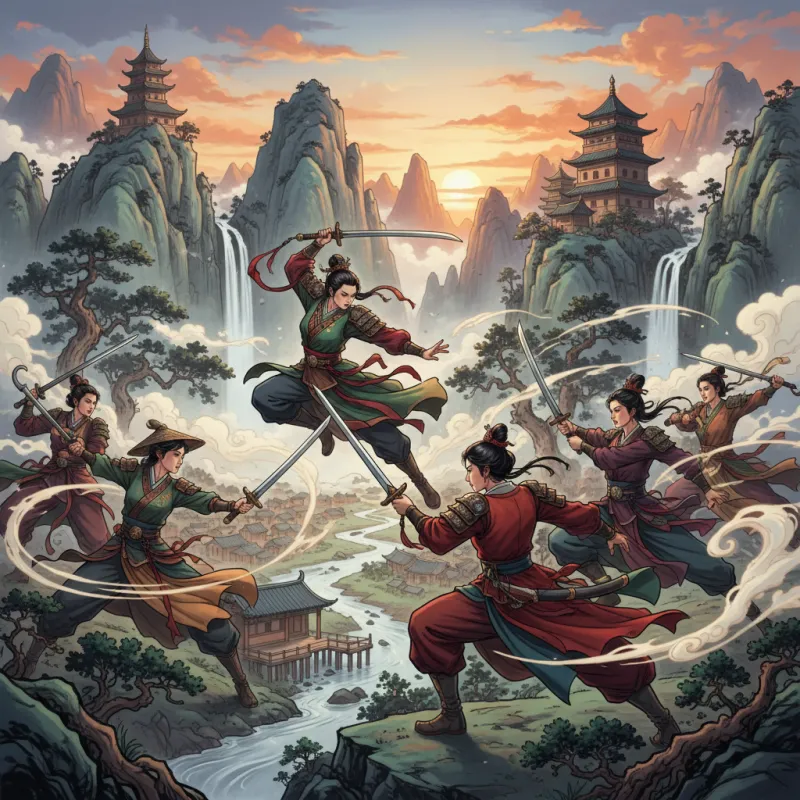
A beggar girl in tattered clothes outsmarts the greatest martial artists of her generation. A blind swordswoman defeats armies without seeing their faces. An elderly nun commands respect from warlords and emperors alike. These aren't exceptions in wuxia fiction — they're the rule. While Western fantasy spent centuries confining women to towers and supporting roles, Chinese martial arts literature was busy creating some of the most formidable warriors in all of fiction, regardless of gender.
The Historical Foundation
The tradition of women warriors in Chinese literature didn't emerge from nowhere. Real historical figures like Hua Mulan (花木蘭, Huā Mùlán) from the Northern Wei Dynasty and the Yang family's women generals established a cultural precedent that wuxia authors would later amplify. By the time Liang Yusheng (梁羽生, Liáng Yǔshēng) and Jin Yong (金庸, Jīn Yōng) revolutionized the genre in the 1950s, the idea of women as martial equals wasn't radical — it was expected.
What makes wuxia's treatment of women warriors particularly interesting is how it sidesteps the "strong female character" trap that plagues modern Western media. These women aren't just men with different pronouns. They fight differently, think differently, and occupy narrative space in ways that feel authentic to their characters rather than performative.
Intelligence as the Ultimate Weapon
Huang Rong (黃蓉, Huáng Róng) from Jin Yong's Legend of the Condor Heroes remains the gold standard for this approach. Yes, she's skilled in martial arts — her father is Huang Yaoshi (黃藥師, Huáng Yàoshī), one of the Five Greats — but her real weapon is her mind. She solves the riddles that stump Guo Jing (郭靖, Guō Jìng), outmaneuvers political enemies, and eventually becomes the leader of the Beggars' Sect (丐幫, Gàibāng) through sheer strategic brilliance.
The genius of Huang Rong's character is that Jin Yong never presents her intelligence as compensation for physical weakness. She's both brilliant and capable in combat. When she chooses to use her wits instead of her fists, it's because she's smart enough to know when violence isn't the answer — a lesson many male protagonists in wuxia take decades to learn.
Ren Yingying (任盈盈, Rèn Yíngyíng) from The Smiling, Proud Wanderer operates similarly. As the daughter of the Sun Moon Holy Cult's leader, she wields political power that most martial artists can only dream of, yet she's also a skilled fighter and musician. Her relationship with Linghu Chong (令狐沖, Línghú Chōng) works precisely because she's his intellectual equal — sometimes his superior.
The Sword Saints and Combat Masters
Then there are the women who simply fight better than everyone else. Miejue Shitai (滅絕師太, Mièjué Shītài) from The Heaven Sword and Dragon Saber is a fascinating case study. As the abbess of the Emei Sect (峨嵋派, Éméi Pài), she's ruthless, uncompromising, and absolutely terrifying in combat. Jin Yong doesn't soften her edges or give her a redemption arc. She's a zealot who happens to be one of the most skilled martial artists of her generation, and her gender is irrelevant to her capacity for both greatness and cruelty.
Li Mochou (李莫愁, Lǐ Mòchóu), the "Scarlet Serpent Deity," takes this further. Abandoned by her lover, she becomes a serial killer who murders entire families. She's not a villain because she's a woman scorned — she's a villain because she's powerful, skilled, and has chosen vengeance over redemption. The tragedy of her character isn't that she loved unwisely, but that she had the potential to be one of the greatest martial artists of her era and chose to waste it on revenge.
For a deeper look at morally complex characters, see Anti-Heroes of Wuxia: The Rogues, Drunks, and Reluctant Champions.
Breaking the Beauty Trap
Western media often can't resist making its warrior women conventionally attractive, as if competence needs to be balanced with desirability. Wuxia fiction is refreshingly indifferent to this. Miejue Shitai is described as stern and aging. Qiu Qianchi (裘千尺, Qiū Qiānchǐ) from The Return of the Condor Heroes is literally imprisoned in a valley for years, yet remains one of the most dangerous martial artists in the story despite her deteriorated appearance.
The blind swordswoman Ke Bixia (柯碧霞, Kē Bìxiá) from Gu Long's works demonstrates this perfectly. Her blindness isn't a disability to overcome or a tragic backstory to exploit — it's simply a fact of her existence that she's adapted to so completely that she's more dangerous than most sighted fighters. Gu Long (古龍, Gǔ Lóng) treats her disability with the same matter-of-fact approach he uses for any character trait.
The Sect Leader Question
One of the most interesting aspects of women in wuxia is how naturally they occupy leadership positions. The Emei Sect is traditionally led by women. The Sun Moon Holy Cult has had female leaders. Huang Rong becomes the chief of the Beggars' Sect — one of the most powerful organizations in the jianghu (江湖, jiānghú) — and nobody questions her authority based on gender.
This isn't presented as progressive or unusual within the world of the stories. It simply is. The martial world respects skill and strength, and gender is largely irrelevant to both. When characters do express sexist attitudes, they're usually portrayed as foolish or old-fashioned, quickly proven wrong by events.
Zhou Zhiruo (周芷若, Zhōu Zhǐruò) from The Heaven Sword and Dragon Saber becomes the leader of the Emei Sect through a combination of martial skill, political maneuvering, and ruthless pragmatism. Her arc is one of the most complex in all of wuxia — she transforms from an innocent girl into a calculating leader willing to commit murder to protect her sect. Jin Yong doesn't judge her for this transformation; he presents it as the logical result of the pressures placed upon her.
Love and Independence
What's particularly refreshing about wuxia's women warriors is that they're allowed to be romantic without being reduced to love interests. Huang Rong loves Guo Jing deeply, but she's never just "Guo Jing's wife." She has her own goals, her own sect to lead, her own enemies to outwit. Their relationship works because they're partners, not because she's been absorbed into his narrative.
Xiao Zhao (小昭, Xiǎo Zhāo) from The Heaven Sword and Dragon Saber falls in love with Zhang Wuji (張無忌, Zhāng Wújì) but ultimately chooses duty over romance, becoming the leader of the Persian Ming Cult. It's a bittersweet ending, but it's her choice — and the narrative respects that choice rather than punishing her for it.
Even tragic romances like Li Mochou's aren't really about the romance itself. They're about how a skilled martial artist responds to betrayal, and what happens when someone with immense power chooses the wrong path. The fact that she's a woman is incidental to the larger themes of revenge and redemption.
The Modern Evolution
Contemporary wuxia and xianxia (仙俠, xiānxiá) fiction has built on this foundation, creating even more diverse representations of women warriors. Authors like Priest and Mò Xiāng Tóng Xiù (墨香铜臭) have introduced women who are scholars, strategists, and leaders in addition to fighters. The tradition continues to evolve, but the core principle remains: in the martial world, skill matters more than gender.
This doesn't mean wuxia fiction is perfect in its representation of women. Early works sometimes fall into stereotypes, and not every female character is well-developed. But compared to most fantasy traditions, wuxia has always been remarkably progressive in allowing women to be warriors, leaders, villains, and heroes on equal footing with men.
Why It Matters
The women warriors of wuxia matter because they demonstrate that you don't need to reinvent the wheel to create compelling female characters. You just need to treat them as people first — people who happen to be skilled in martial arts, who have their own goals and motivations, who can be brilliant or foolish, kind or cruel, romantic or pragmatic.
When Huang Rong outsmarts a room full of martial arts masters, when Miejue Shitai strikes fear into the hearts of her enemies, when Ren Yingying commands the Sun Moon Holy Cult — these moments work because the characters have been developed as fully realized individuals, not as statements about gender equality.
The martial world of wuxia has always understood something that much of modern media is still learning: the best way to write strong characters of any gender is to write them as complex human beings first, and let everything else follow naturally. In the jianghu, your sword arm and your wits matter far more than whether you're wearing a dress or robes. That's not a political statement — it's just the way the martial world works.
For more on the complex moral landscape these characters navigate, explore The Code of Xia: Honor, Justice, and Righteousness in Wuxia.
Related Reading
- Huang Rong: The Smartest Heroine in Chinese Fiction
- Yang Guo: The One-Armed Swordsman
- Qu Yuan: The First Named Poet in Chinese History
- The Heroes of Wuxia: What Makes a Xia Different from a Fighter
- Women Warriors in Wuxia: Beyond the Love Interest
- Hidden Weapons: The Assassin's Arsenal
- Martial World Etiquette: The Social Rules of the Jianghu
Explore Chinese Culture
- Explore Jin Yong's martial arts novels
- Explore cultivation fiction and immortal heroes
- Explore the real history behind wuxia