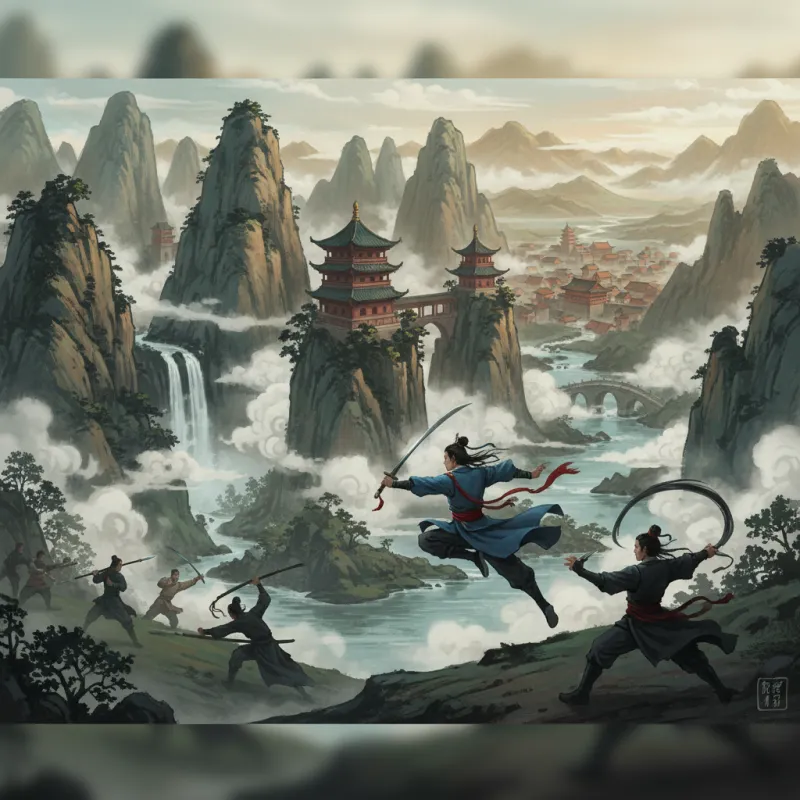
A swordsman stands at the edge of a cliff, his white robes whipping in the mountain wind. Below him, the jianghu (江湖, jiānghú) — that lawless realm of martial artists, wandering heroes, and blood feuds — stretches endlessly. He could walk away, return to the imperial court, claim his title and lands. Instead, he leaps. This moment, repeated across countless wuxia novels and films, captures something essential about why these stories have gripped Chinese imagination for over a millennium: the choice to abandon comfort and status for a life governed by personal honor rather than social hierarchy.
The Jianghu: More Than a Setting, A State of Mind
When Jin Yong (金庸, Jīn Yōng) wrote in The Legend of the Condor Heroes that "where there are people, there is jianghu," he wasn't just describing a physical space. The jianghu exists in the margins — literally "rivers and lakes" — beyond the reach of imperial law. It's where outcasts, rebels, and idealists create their own moral universe. This parallel society operates on principles that often contradict Confucian orthodoxy: loyalty to sworn brothers trumps filial piety, personal vendetta justifies violence, and a beggar with superior martial arts commands more respect than a corrupt magistrate.
The genius of wuxia lies in this tension. These stories emerged during periods when official channels for justice seemed blocked — the Song Dynasty's weakness against northern invaders, the Qing Dynasty's Manchu rule over Han Chinese, the chaos of Republican-era warlords. When the system fails, the jianghu offers an alternative: a meritocracy of skill and character where a peasant can become a legend. The martial arts sects that populate these stories function as surrogate families and governments, complete with their own laws, hierarchies, and codes of conduct.
The Xia Ideal: What Makes a True Hero
Not every skilled fighter qualifies as a xia (侠, xiá) — a true martial hero. The distinction matters enormously. Gu Long (古龙, Gǔ Lóng), whose protagonists often dwelt in moral gray zones, still insisted his heroes possessed yi (义, yì) — righteousness or a sense of justice that transcends self-interest. Li Xunhuan in Sentimental Swordsman, Ruthless Sword gives up the woman he loves to his sworn brother, then spends years perfecting his flying dagger technique not for glory but to protect the innocent. That's yi in action: painful, costly, and utterly compelling.
The classical formulation comes from Sima Qian's Records of the Grand Historian (circa 90 BCE), which devoted an entire chapter to "knight-errants" who "used martial arts to violate prohibitions" yet "their words were always sincere and trustworthy, their actions always quick and decisive." These ancient xia rescued the desperate, avenged wrongs, and asked nothing in return — often dying in the process. Two thousand years later, wuxia heroes still follow this template, though modern authors like Jin Yong added psychological complexity. His Guo Jing is almost painfully earnest in his righteousness, while Yang Guo rebels against every convention before finding his own path to heroism.
Women Warriors: Breaking and Reinforcing Boundaries
Wuxia fiction has given Chinese popular culture some of its most memorable female characters, yet their treatment reveals the genre's complicated relationship with gender. Huang Rong from Jin Yong's Condor trilogy is brilliant, manipulative, and deadly — but her story arc bends toward domesticity as she becomes a wife and mother. Ren Yingying in The Smiling, Proud Wanderer commands a demonic sect, yet ultimately supports her husband's ambitions rather than pursuing her own.
The exceptions prove more interesting. Lian Nishang, the "White-Haired Demoness" from Liang Yusheng's novel, refuses redemption through romantic love and remains gloriously, tragically uncompromising. Gu Long's female characters often possess agency that Jin Yong's lack — they choose their lovers, pursue their own vendettas, and sometimes simply walk away. The legendary weapons they wield — Xue Bing's twin swords, Shangguan Jinhong's Dragon-Phoenix Rings — symbolize power that doesn't require male validation.
Still, even progressive wuxia rarely imagines women as the ultimate martial arts masters. The genre's greatest fighters — Dugu Qiubai, Sweeping Monk, Zhang Sanfeng — are invariably male. This reflects deeper cultural assumptions about qi (气, qì) cultivation and martial achievement that wuxia inherits from Daoist and Buddhist traditions. The genre both challenges and reinforces patriarchal norms, giving women narrative prominence while keeping ultimate power just out of reach.
The Master-Disciple Bond: Transmission of More Than Technique
When Zhang Wuji finally masters the Nine Yang Divine Skill after years of suffering, he's not just learning martial arts — he's inheriting a lineage that connects him to legendary figures across generations. The shifu-tudi (师父-徒弟, shīfù-túdì) relationship in wuxia carries weight that Western "teacher-student" barely captures. A master doesn't just instruct; they shape character, test loyalty, and pass down not merely techniques but entire philosophical systems.
This transmission often involves suffering.令狐冲 (Linghu Chong) must unlearn his sect's orthodox sword techniques to master the Dugu Nine Swords. Xiao Feng discovers his greatest teacher was the beggar who raised him, not the Shaolin abbots. The lesson: true martial arts mastery requires breaking down the self before rebuilding it. It's a fundamentally Daoist and Buddhist concept dressed in sword fights and secret manuals.
The betrayal of this bond ranks among wuxia's greatest sins. When Yue Buqun in The Smiling, Proud Wanderer reveals himself as a hypocrite who castrated himself for power, the horror isn't just personal — it's cosmic. He's violated the sacred chain of transmission that gives martial arts meaning beyond mere violence. Compare this to Western martial arts films, where switching teachers or self-teaching carries no moral weight. In wuxia, lineage is destiny.
Why Wuxia Endures: The Fantasy of Earned Power
In an era of superhero films where powers come from accidents, alien biology, or inherited wealth, wuxia offers something different: the fantasy of earned transcendence. Every impossible leap, every sword technique that splits waterfalls, every master who catches arrows barehanded — all of it theoretically achievable through discipline and enlightenment. The internal energy cultivation (内功, nèigōng) that powers these feats follows logical progressions. You can't buy it, inherit it, or stumble into it. You must suffer for it.
This appeals across cultures but resonates especially in societies valuing educational achievement and self-cultivation. The Chinese imperial examination system, which theoretically let any peasant become a minister through study, created a cultural template: mastery through dedication. Wuxia transplants this to martial arts, where the secret martial arts manuals function like forbidden textbooks promising ultimate knowledge to those willing to pay the price.
Modern wuxia has evolved — Jin Yong's later novels question whether martial arts mastery brings happiness, while contemporary works like Sword Dynasty blend wuxia with political intrigue and moral ambiguity. Yet the core appeal remains: a world where personal excellence matters more than birth, where loyalty and righteousness can triumph over corruption, and where the choice to leap from that cliff leads not to death but to flight. In our cynical age, that's a fantasy worth preserving.
The Unfinished Legend
The greatest wuxia stories end with their heroes riding into the sunset, their ultimate fate unknown. Linghu Chong and Ren Yingying disappear into the jianghu. Yang Guo and Xiaolongnü vanish after their reunion. This ambiguity isn't laziness — it's recognition that the jianghu, like the heroes who inhabit it, can never be fully tamed or understood. The legends continue because they must, passed down through generations of readers who find in these tales something their own world lacks: a space where honor still means something, where skill and character matter more than connections, and where one person with a sword and a code can still change everything.
That's why we keep returning to these stories, why new adaptations appear every year, why arguments about which version of The Return of the Condor Heroes is definitive can last for hours. We're not just consuming entertainment — we're participating in a cultural conversation about what it means to be heroic that stretches back over a thousand years. The jianghu endures because we need it to, because sometimes the only way to understand our world is to imagine one that operates by different rules entirely.
Related Reading
- The Heroes of Wuxia: What Makes a Xia Different from a Fighter
- Yang Guo: The One-Armed Swordsman
- Women Warriors of Wuxia: Breaking Boundaries in the Martial World
- The Complete Guide to Jianghu Heroes in Wuxia Fiction
- Huang Rong: The Smartest Heroine in Chinese Fiction
- Wudang vs Shaolin: Two Philosophies of Combat
- Sun Wukong: The Great Sage Who Challenged Heaven
- Wuxia Training Montages: How Heroes Are Made
Explore Chinese Culture
- Explore Jin Yong's martial arts novels
- Explore cultivation fiction and immortal heroes
- Explore the real history behind wuxia