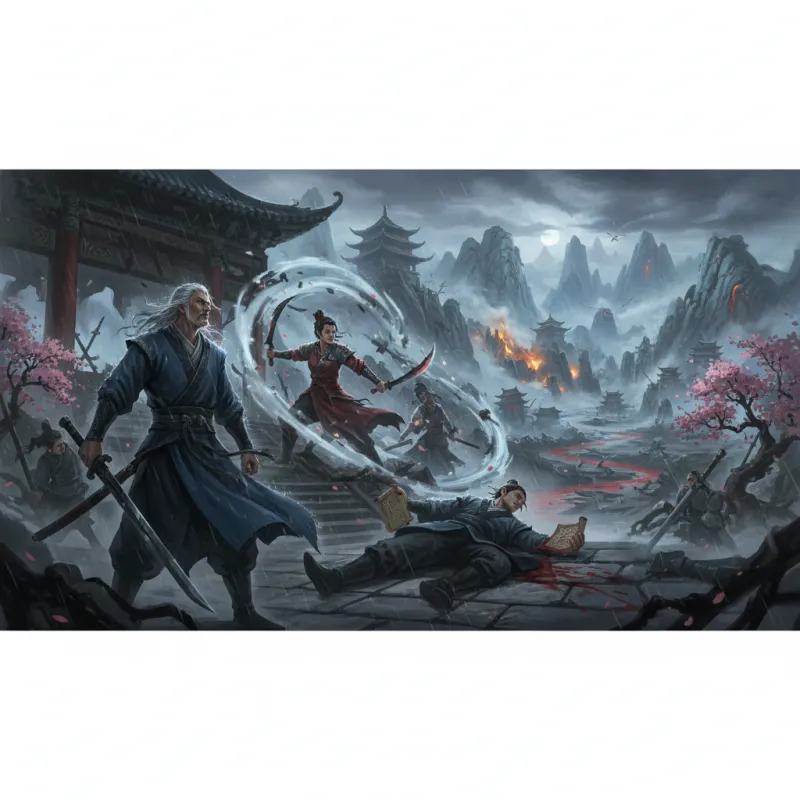
Tragic Heroes of Wuxia: Those Who Sacrificed Everything for Honor
In the moonlit courtyards of Chinese martial arts fiction, where swords sing and loyalties are tested, the most unforgettable characters are not those who triumph, but those who fall. The tragic hero—bound by 义 (yì, righteousness), shackled by 忠 (zhōng, loyalty), and ultimately consumed by their own unwavering principles—represents the beating heart of wuxia literature. These warriors choose honor over happiness, duty over desire, and principle over survival, leaving behind legacies written in blood and remembered in sorrow. Their stories remind us that in the 江湖 (jiānghú, rivers and lakes—the martial world), the highest virtue often demands the highest price.
The Philosophy of Tragic Heroism in Wuxia
The tragic hero in wuxia fiction embodies a uniquely Chinese philosophical tension. Unlike Western tragic heroes who often fall due to hamartia (a fatal flaw), wuxia's doomed warriors typically perish because of their virtues, not despite them. This paradox stems from the Confucian ideal of 仁义道德 (rén yì dào dé, benevolence, righteousness, morality, and virtue), which demands absolute adherence to moral principles regardless of personal cost.
The concept of 舍生取义 (shě shēng qǔ yì, sacrificing life to achieve righteousness), drawn from Mencius, permeates these narratives. When a hero faces the impossible choice between survival and honor, between love and duty, between personal happiness and moral obligation, the true tragic hero always chooses the path of righteousness—even when that path leads to destruction.
This creates what literary scholars call the "beautiful tragedy" of wuxia: characters who are most admirable precisely at the moment of their downfall, whose deaths illuminate rather than diminish their greatness. Their sacrifice becomes a form of transcendence, transforming personal tragedy into universal moral instruction.
Xiao Feng: The Khitan Hero Torn Between Two Worlds
Perhaps no character in wuxia literature embodies tragic heroism more completely than 萧峰 (Xiāo Fēng), the protagonist of Jin Yong's Demigods and Semi-Devils (《天龙八部》Tiānlóng Bābù). Born a Khitan but raised as Han Chinese, Xiao Feng's tragedy is written into his very identity—a man belonging fully to neither world, yet bound by duty to both.
As the leader of the 丐帮 (Gàibāng, Beggar's Sect), Xiao Feng represents the pinnacle of martial prowess and moral integrity. His signature technique, the 降龙十八掌 (Jiàng Lóng Shíbā Zhǎng, Eighteen Dragon-Subduing Palms), symbolizes not just physical power but righteous force. Yet when his Khitan heritage is revealed, he becomes an outcast—hunted by the very people he once protected, branded a barbarian spy despite his lifetime of service to the Han martial world.
Xiao Feng's tragedy deepens through a series of devastating revelations: he discovers he killed his own adoptive parents while drunk, his beloved Ah Zhu dies by his hand in a case of mistaken identity, and he learns that his biological father murdered his adoptive family. Each revelation strips away another layer of his identity, yet through it all, he maintains his moral compass with almost superhuman integrity.
The climax of Xiao Feng's story occurs at 雁门关 (Yànmén Guān, Yanmen Pass), where he stands between two armies—Khitan and Song Chinese—poised for war. Unable to betray either his blood heritage or his cultural upbringing, unable to choose between two peoples he loves, Xiao Feng makes the ultimate sacrifice. He forces the Khitan emperor to swear never to invade Song territory, then takes his own life, his suicide becoming the bridge of peace between two nations. His death is not defeat but apotheosis—the only action that honors both his identities while preventing catastrophic bloodshed.
Qiao Feng's Spiritual Successor: The Weight of Leadership
The character of 郭靖 (Guō Jìng) in Jin Yong's The Legend of the Condor Heroes (《射雕英雄传》Shè Diāo Yīngxióng Zhuàn) and The Return of the Condor Heroes (《神雕侠侣》Shén Diāo Xiá Lǚ) represents another dimension of tragic heroism—the burden of being the moral exemplar in an immoral age.
Guo Jing, simple and honest to a fault, embodies the Confucian ideal of the 君子 (jūnzǐ, superior person). His famous declaration—"侠之大者,为国为民" (Xiá zhī dà zhě, wèi guó wèi mín, "The greatest heroes serve their country and people")—becomes both his guiding principle and his doom. While others in the jianghu pursue personal glory, revenge, or martial supremacy, Guo Jing dedicates his life to defending 襄阳 (Xiāngyáng) against Mongol invasion.
The tragedy of Guo Jing unfolds slowly across decades. In The Heaven Sword and Dragon Saber (《倚天屠龙记》Yǐtiān Túlóng Jì), we learn that Guo Jing and his wife Huang Rong died defending Xiangyang when the city finally fell. For forty years, they held the line against inevitable defeat, knowing that their cause was ultimately hopeless, that the Mongol conquest of China was historically predetermined. Yet they fought anyway, because 义 (yì) demanded it.
This is the essence of tragic heroism: Guo Jing's sacrifice didn't change history—Xiangyang fell, the Song dynasty collapsed, and the Mongols conquered China. But his choice to fight a losing battle, to sacrifice everything for a doomed cause, transforms him from a mere warrior into a moral beacon. His tragedy lies not in failure but in the terrible knowledge that failure was inevitable, yet fighting was still necessary.
The Feminine Tragedy: Ah Zhu and the Cost of Love
While male heroes dominate wuxia narratives, the genre's most piercing tragedies often belong to its women. 阿朱 (Ā Zhū) from Demigods and Semi-Devils represents the tragic heroine whose love becomes her undoing—not through weakness, but through the strength of her devotion.
Ah Zhu, a servant girl with the ability to disguise herself perfectly, falls in love with Xiao Feng when he is at his lowest point—hunted, betrayed, and alone. Her love is active and sacrificial; she doesn't merely support Xiao Feng but becomes his partner in seeking truth and justice. Her martial arts may be modest, but her courage and loyalty are absolute.
The tragedy occurs when Ah Zhu, knowing that Xiao Feng has sworn to kill his parents' murderer, discovers that the killer is her own adoptive father, Duan Zhengchun. Unable to let Xiao Feng become a patricide or to betray her beloved, she disguises herself as her father and allows Xiao Feng to strike her down. She dies in his arms, her final words releasing him from guilt: she claims it was an accident, that he didn't know it was her.
Ah Zhu's death exemplifies 舍己为人 (shě jǐ wèi rén, sacrificing oneself for others) taken to its ultimate extreme. She chooses to die not to preserve her own honor, but to protect both the man she loves and her adoptive father from an impossible moral dilemma. Her tragedy is compounded by the fact that her sacrifice, while born of love, ultimately deepens Xiao Feng's suffering rather than alleviating it. When he later discovers the truth, her death becomes another weight crushing his spirit.
Yang Guo: The Anti-Hero's Tragic Path
杨过 (Yáng Guò), protagonist of The Return of the Condor Heroes, represents a different species of tragic hero—the rebel whose defiance of convention brings both greatness and suffering. Raised by the 古墓派 (Gǔmù Pài, Ancient Tomb Sect), Yang Guo falls in love with his teacher, 小龙女 (Xiǎo Lóng Nǚ, Little Dragon Maiden), violating the sacred teacher-student relationship that forms the backbone of martial arts society.
Yang Guo's tragedy is self-inflicted yet sympathetic. His love for Xiao Long Nü is genuine and pure, but it places him in permanent opposition to jianghu orthodoxy. He becomes the 神雕侠 (Shén Diāo Xiá, Divine Eagle Hero), a mysterious figure who performs righteous deeds while remaining outside respectable society—a hero who can never be fully accepted because his very existence challenges fundamental social norms.
The couple's separation—Xiao Long Nü leaves Yang Guo for sixteen years, believing herself unworthy after being violated—transforms Yang Guo's tragedy from social to existential. He spends sixteen years waiting at the place they agreed to reunite, his loyalty absolute despite having no certainty she will return. His right arm, severed in battle, becomes a physical manifestation of his incompleteness without her.
Yang Guo's tragedy lies in the gap between his moral worth and society's judgment. He is fundamentally righteous—he saves Xiangyang, defeats villains, and upholds justice—yet he can never be fully embraced by the martial world because his love transgresses social boundaries. His heroism is forever tinged with melancholy, his victories hollow without the woman he loves, his reputation forever controversial despite his virtuous deeds.
The Philosophical Dimensions of Sacrifice
These tragic heroes illuminate core tensions in Chinese philosophical thought. The conflict between 忠 (zhōng, loyalty to ruler/state) and 孝 (xiào, filial piety), between 情 (qíng, emotion/love) and 理 (lǐ, principle/propriety), between individual desire and collective duty—these are not abstract philosophical problems but lived dilemmas that tear characters apart.
The concept of 义 (yì) itself contains this tragic dimension. Often translated as "righteousness" or "justice," yì in wuxia context means doing what is morally correct regardless of personal cost. It is the virtue that demands Xiao Feng sacrifice his life for peace, that keeps Guo Jing defending a doomed city, that drives Ah Zhu to die in her lover's arms. 义 is beautiful precisely because it is costly—righteousness that requires no sacrifice is merely convenience.
This connects to the Buddhist concept of 舍 (shě, letting go/renunciation) that permeates Jin Yong's work. True heroism requires releasing attachment to life, love, reputation, and comfort. The tragic hero achieves a form of enlightenment through sacrifice, transcending the ego-driven concerns that motivate lesser characters. Their deaths are not meaningless but transformative—both for themselves and for the world they leave behind.
The Legacy of Tragic Heroism
The enduring power of wuxia's tragic heroes lies in their refusal to compromise. In a genre filled with moral ambiguity, political intrigue, and personal betrayal, these characters stand as immovable pillars of principle. They show us that some things—honor, righteousness, loyalty, love—are worth dying for, even when (perhaps especially when) dying changes nothing material about the world.
Modern readers might question this ethic. Why should Xiao Feng die when he could live and continue doing good? Why should Guo Jing waste his life defending a city that will inevitably fall? Why can't Yang Guo simply ignore society's judgment and live happily with Xiao Long Nü? These questions miss the point: these heroes don't sacrifice themselves because it's practical or effective, but because their moral code demands it. Their tragedy is that they live in a world where being truly good requires being willing to lose everything.
The tragic hero of wuxia offers a vision of heroism that is simultaneously inspiring and heartbreaking. They remind us that the highest virtues often exact the highest prices, that moral integrity sometimes demands impossible choices, and that true greatness is measured not by victory but by the willingness to sacrifice everything for what is right. In the 江湖 (jiānghú), where swords flash and loyalties shift like wind, these tragic figures stand eternal—not because they won, but because they were willing to lose everything rather than compromise their principles.
Their stories endure because they speak to something fundamental in the human experience: the tension between what we want and what we ought to do, between survival and meaning, between happiness and honor. In choosing honor, in sacrificing everything, these tragic heroes achieve a form of immortality—not in life, but in memory, not in victory, but in the beauty of their unwavering commitment to 义 (yì). They are the soul of wuxia, the characters we remember long after the plot details fade, the heroes whose deaths illuminate what it truly means to live with honor.