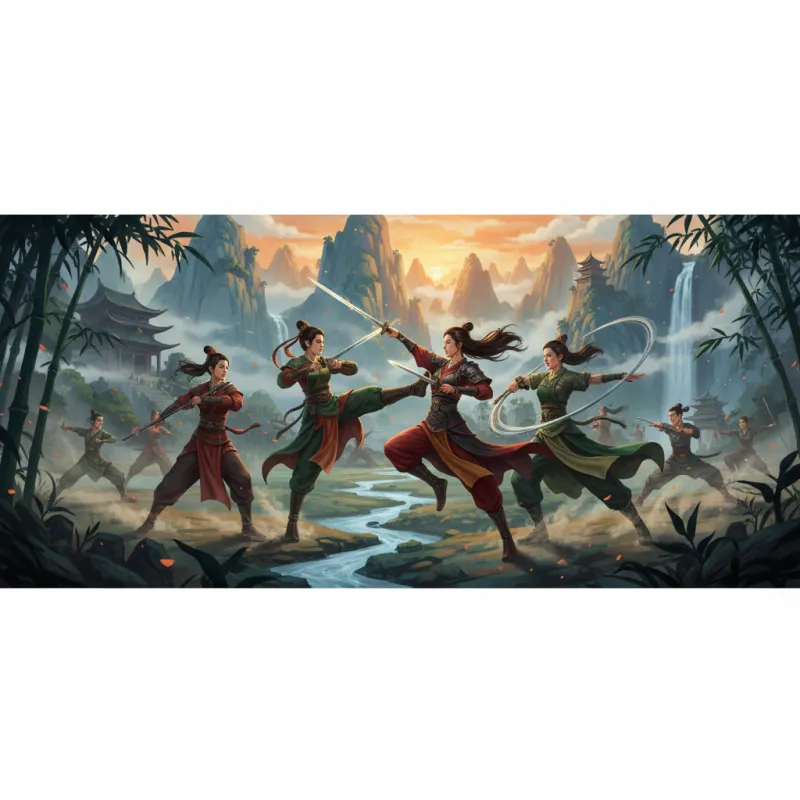
A sword flashes in moonlight, and the bandit lord crumples before he can draw breath to scream. The figure in white silk lands without a sound, and when she turns, the other thieves see not a helpless maiden but their doom. This scene—repeated across countless wuxia novels—captures something revolutionary: in the jianghu, women don't wait to be rescued. They do the rescuing.
Breaking the Willow: When Women Picked Up Swords
The presence of formidable women warriors in Chinese martial arts fiction didn't emerge from nowhere. Real history provided the template, even if Confucian scholars tried to erase it. Hua Mulan (花木兰, Huā Mùlán) disguised herself as a man to fight in her father's place during the Northern Wei Dynasty (386-534 CE). The legendary Mu Guiying (穆桂英, Mù Guìyīng) commanded armies during the Song Dynasty. These weren't just stories—they were cracks in the rigid gender hierarchy that wuxia writers would later split wide open.
But here's what makes wuxia different from historical accounts: the jianghu (江湖, jiānghú)—literally "rivers and lakes," the martial artists' world—operates by its own rules. In this space outside imperial law and Confucian propriety, a woman's skill with a sword matters more than her embroidery. The genre took historical whispers of female martial prowess and amplified them into a roar.
The Archetypes: More Than Just "Strong Female Characters"
Wuxia heroines fall into recognizable patterns, but the best writers subvert these even as they employ them. There's the vengeful daughter, training in secret to avenge her slaughtered family—think Ah Jiu from Gu Long's (古龙, Gǔ Lóng) novels, whose beauty masks a heart of ice and a blade of lightning. The sect leader's daughter who refuses arranged marriage, choosing instead to master her family's forbidden techniques. The disguised warrior who moves through the jianghu as a man, only revealing her identity at the story's climax.
Jin Yong (金庸, Jīn Yōng), the genre's undisputed master, created a spectrum of female warriors that defies simple categorization. Huang Rong (黄蓉, Huáng Róng) from The Legend of the Condor Heroes combines martial skill with strategic brilliance—she's as likely to outwit opponents as outfight them. Xiao Longnu (小龙女, Xiǎo Lóngnǚ) from The Return of the Condor Heroes embodies ethereal detachment, her Ancient Tomb Sect techniques making her nearly untouchable in combat. Meanwhile, Ren Yingying (任盈盈, Rèn Yíngyíng) from The Smiling, Proud Wanderer wields political power alongside martial prowess as the Holy Maiden of the Sun Moon Holy Cult.
What separates memorable heroines from forgettable ones? Agency. The best female warriors in wuxia make their own choices, even when those choices lead to tragedy. They're not prizes to be won or damsels to be saved—they're active participants in their own stories, with desires and ambitions that extend beyond romance.
Weapons of Choice: The Symbolism of Steel and Silk
Pay attention to what weapons wuxia heroines carry—it tells you everything about how the author views them. Swords (剑, jiàn) represent nobility and refinement, the weapon of scholars and aristocrats. When a woman wields a sword in wuxia, she's claiming intellectual and social equality. The jian isn't just sharp metal; it's a statement.
Whips and ribbons appear frequently in female warriors' arsenals, and this deserves scrutiny. On one hand, these "soft" weapons play into gender stereotypes—flexibility over strength, grace over power. On the other hand, writers like Jin Yong use them to showcase unique fighting styles that turn perceived weakness into devastating advantage. Zhou Zhiruo's (周芷若, Zhōu Zhǐruò) mastery of the Nine Yin White Bone Claw in The Heaven Sword and Dragon Saber proves that "feminine" techniques can be as lethal as any blade.
The most interesting choices come when heroines wield weapons traditionally coded as masculine. Mu Nianci (穆念慈, Mù Niàncí) with her Yang family spear techniques, or the various women who master staff fighting—these characters reject the notion that certain martial paths are closed to them. The weapons and fighting styles chosen by female characters often mirror their relationship with societal expectations: conforming, subverting, or transcending them entirely.
Love and Steel: Romance Without Surrender
Here's where wuxia gets complicated. Nearly every female warrior ends up in a romantic subplot, and critics rightfully question whether this undermines their independence. But the genre's treatment of romance is more nuanced than it first appears.
The worst examples reduce heroines to love interests who abandon their martial paths for domestic bliss. But the best wuxia novels present romance as another arena where women exercise agency and power. Huang Rong chooses Guo Jing not because he's the strongest fighter, but because his moral character matches her ideals. Xiao Longnu's relationship with Yang Guo scandalizes the jianghu precisely because she refuses to let social conventions dictate her choices.
Some heroines reject romance entirely. Miejue Shitai (灭绝师太, Mièjué Shītài), the Abbess of the Emei Sect, channels her heartbreak into becoming one of the most formidable martial artists of her generation. Her bitterness makes her a villain in The Heaven Sword and Dragon Saber, but her backstory reveals how the jianghu punishes women who dare to love and lose.
The question isn't whether wuxia heroines experience romance—it's whether they retain their identity and agency within those relationships. The answer varies wildly depending on the author and era of publication.
Evolution Across Decades: From Decoration to Protagonist
Early wuxia novels from the Republican era (1912-1949) featured women warriors, but often as supporting characters or exotic curiosities. The genre's golden age in the 1950s-1980s, dominated by Jin Yong, Gu Long, and Liang Yusheng (梁羽生, Liáng Yǔshēng), elevated female characters to co-protagonist status, though male heroes still claimed center stage.
Contemporary wuxia and its fantasy offspring (xianxia, xuanhuan) have pushed further. Novels like The Grandmaster of Demonic Cultivation feature complex female characters who drive major plot threads. Web novels have exploded with female-led martial arts stories, often written by women for women, subverting traditional tropes entirely. These modern heroines don't just participate in the jianghu—they reshape it.
The shift reflects changing social attitudes in Chinese society. As women gained educational and professional opportunities in real life, fictional heroines gained narrative space and complexity. Today's readers won't tolerate the passive beauties of earlier eras; they demand female characters with depth and agency.
The Jianghu's Double Standard: Freedom and Constraint
For all its progressive elements, wuxia still operates within cultural frameworks that constrain female characters. Heroines who are "too" powerful often face narrative punishment—they're villains, or they die tragically, or they sacrifice their abilities for love. The genre celebrates women who can fight like men but still perform femininity "correctly": beautiful, graceful, ultimately deferential to male authority.
Yet the jianghu itself represents a space of possibility. Outside the rigid hierarchies of imperial bureaucracy and family obligation, women can forge their own paths. The martial arts world offers what Confucian society denied: the chance to be judged by skill rather than gender. This tension—between the jianghu's liberating potential and the genre's conservative undertones—creates the dramatic friction that makes these characters compelling.
Legacy: Why These Heroines Still Matter
When Zhang Ziyi's character in Crouching Tiger, Hidden Dragon leapt across rooftops and fought with breathtaking ferocity, Western audiences discovered what Chinese readers had known for decades: wuxia heroines are spectacular. The film's global success proved these characters transcend cultural boundaries.
But their significance goes deeper than cinematic spectacle. In a genre built on honor, loyalty, and martial excellence, female warriors claim space in a traditionally masculine domain. They prove that heroism isn't gendered, that strength takes many forms, and that the most interesting stories emerge when characters defy expectations.
Modern adaptations continue reimagining these heroines for new generations. Each retelling asks: what does it mean to be a woman warrior in the jianghu? The answers keep evolving, but the question remains vital. These characters matter because they show young readers—especially young women—that they can be both powerful and complex, fierce and vulnerable, romantic and independent.
The women warriors of wuxia fiction aren't perfect feminist icons. They exist within a genre that sometimes celebrates and sometimes constrains them. But at their best, they're unforgettable: sword in hand, standing against impossible odds, refusing to be anything less than extraordinary. In the jianghu, as in life, that refusal changes everything.
Related Reading
- Women Warriors in Wuxia: Beyond the Love Interest
- Female Martial Artists in Wuxia Fiction
- Hua Mulan and Beyond: Real Women Warriors of China
- Romance in Wuxia: Love, Duty, and the Tragedy Between
- Hua Mulan and the Wuxia Tradition of Women Warriors
- The Heroes of Wuxia: What Makes a Xia Different from a Fighter
- Pangu and the Cosmic Egg: The Chinese Creation Myth
- The Philosophy of Wuxia: Why Martial Arts Fiction Is Really About Ethics
Explore Chinese Culture
- Explore Jin Yong's martial arts novels
- Explore cultivation fiction and immortal heroes
- Explore the real history behind wuxia