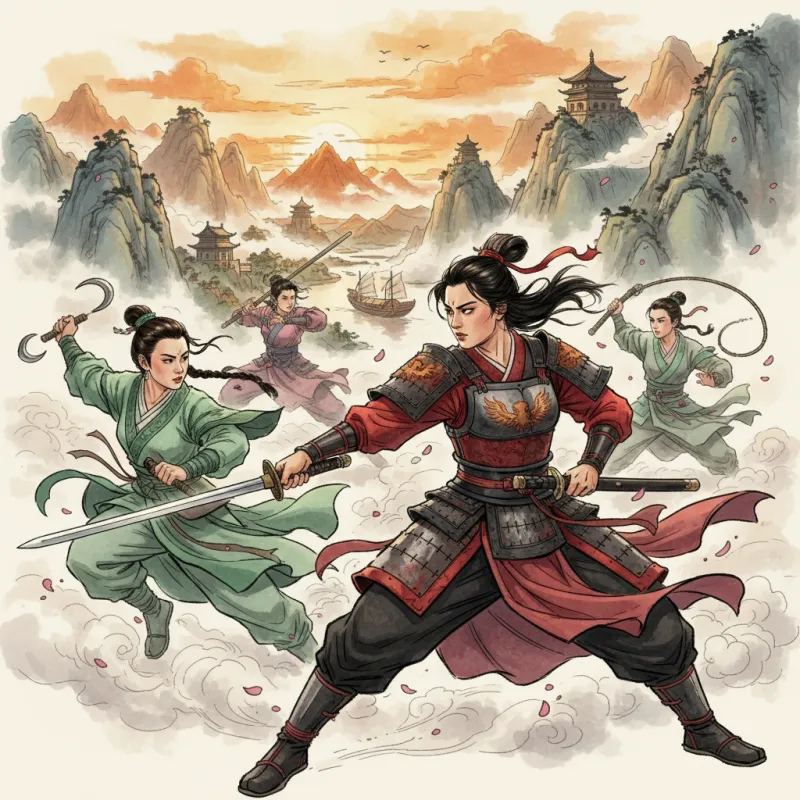
Everyone knows Mulan. Disney made sure of that. But the real story of women warriors in China is far richer, stranger, and more complicated than any animated movie could capture. Some of these women led armies of tens of thousands. Some were pirates who controlled entire coastlines. Some were martial arts masters who could genuinely fight. And some were fictional characters who became so famous that people forgot they weren't real.
Let's sort through the history.
Hua Mulan: The Legend
Let's start with what we actually know about Mulan (花木兰, Huā Mùlán). The answer is: almost nothing.
The earliest source is the Ballad of Mulan (木兰辞, Mùlán Cí), a folk poem that was probably composed during the Northern Wei dynasty (386-534 CE) and first recorded in the Musical Records of Old and New during the Tang dynasty. It's a beautiful poem—spare, moving, and completely devoid of the details historians crave. We don't know which war Mulan fought in. We don't know her family name (Hua was added centuries later). We don't even know if she was a real person.
What we do know is that the poem captured something true about Chinese military culture: the idea that martial virtue (武德, wǔdé) wasn't inherently gendered. The poem doesn't treat Mulan's military service as shocking or transgressive. Her comrades don't discover her sex for twelve years, which tells you something about how armor and military discipline worked—or at least how the poet imagined they worked.
Later dynasties couldn't leave the story alone. Ming dynasty writers gave her a surname and a hometown. Qing dynasty playwrights added romance and tragedy. By the time Xu Wei wrote his play The Female Mulan in the 16th century, she had become a full-fledged cultural icon, complete with elaborate backstory and dramatic suicide scene that doesn't appear in the original poem at all.
The real question isn't whether Mulan existed. It's why Chinese culture needed her to exist.
Fu Hao: The Warrior Queen Who Actually Lived
If you want a woman warrior with archaeological evidence, Fu Hao (妇好, Fù Hǎo) is your best bet. She was a military general and high priestess during the Shang dynasty (c. 1200 BCE), and we know she was real because her tomb was discovered intact in 1976 at Yinxu, near modern Anyang.
The oracle bone inscriptions—the earliest form of Chinese writing—mention her by name over 200 times. They record that she led military campaigns against the Qiang tribes and the Tu-Fang people. One inscription notes that she commanded an army of 13,000 soldiers, which was enormous for the Bronze Age. Another records her conducting sacrificial rituals and divinations for the king.
Her tomb contained over 130 weapons, including bronze axes and dagger-axes (戈, gē). These weren't ceremonial. They showed signs of use. Fu Hao wasn't just a symbolic leader—she fought.
What's striking is how unremarkable her military role seems to have been to her contemporaries. The oracle bones don't treat her campaigns as unusual or noteworthy because of her gender. They're recorded the same way as any other military expedition. It's only later Chinese historians, writing from the perspective of more rigidly patriarchal dynasties, who found her career surprising.
The Pirate Queen: Zheng Yi Sao
Jump forward three thousand years to the South China Sea in the early 19th century, and you'll find the most successful pirate in human history. Her name was Zheng Yi Sao (郑一嫂, Zhèng Yī Sǎo), which literally means "wife of Zheng Yi," because even pirate queens couldn't escape being defined by their husbands.
After her husband died in 1807, she took control of his pirate confederation and expanded it into a fleet of over 1,800 ships and 80,000 pirates. She didn't just raid merchant vessels—she controlled entire coastal regions, collected taxes, issued safe passage documents, and negotiated with the Qing government as an equal power.
The Qing dynasty threw everything at her: the imperial navy, Portuguese mercenaries, even amnesty offers. Nothing worked. She defeated every fleet they sent. In 1810, she negotiated a surrender on her own terms: full pardons for herself and her followers, permission to keep her wealth, and a position in the Qing military for her second husband (who had been her adopted son—it's complicated).
She retired to run a gambling house in Guangzhou and died peacefully in her 60s. The Qing government, which had spent years trying to kill her, ended up paying her a pension.
Zheng Yi Sao never appears in wuxia novels, which is a shame. She had everything: tactical genius, political cunning, and a fleet that could have conquered kingdoms. But she operated in the world of actual warfare and politics, not the romantic jianghu (江湖, jiānghú) of martial arts fiction. Real power, it turns out, is less appealing to novelists than the fantasy of wandering swordswomen.
Princess Pingyang: The General Who Saved a Dynasty
Li Xiuning (李秀宁, Lǐ Xiùníng), better known as Princess Pingyang (平阳公主, Píngyáng Gōngzhǔ), raised an army of 70,000 soldiers and helped her father establish the Tang dynasty in 617 CE. She was eighteen years old.
When the Sui dynasty collapsed into civil war, she sold her jewelry, recruited soldiers, and began capturing territory in Shaanxi province. She was so successful that the pass she defended became known as the Lady's Pass (娘子关, Niángzǐ Guān)—a name it still bears today.
What makes Princess Pingyang remarkable isn't just her military success, but how the Tang court treated her after her death. She was given a full military funeral with honor guards and battle standards, something unprecedented for a woman. When officials objected, Emperor Gaozu—her father—shut them down. She had earned it.
The Tang dynasty, for all its flaws, had a relatively flexible attitude toward women's roles. Wu Zetian would later become China's only female emperor. The dynasty produced some of China's greatest female poets. And it remembered Princess Pingyang not as an anomaly, but as a legitimate military hero.
The Fictional Warriors: Yang Family Women
Now we get to the characters who never existed but became more famous than most real generals: the women of the Yang family (杨门女将, Yángmén Nǚjiàng).
The Yang family generals were real Song dynasty military leaders who fought against the Khitan Liao dynasty in the 10th and 11th centuries. But the stories about their wives, daughters, and mothers leading armies are pure fiction, created centuries later during the Ming and Qing dynasties.
The most famous is She Taijun (佘太君, Shé Tàijūn), the matriarch who supposedly led the family after all the men died in battle. Then there's Mu Guiying (穆桂英, Mù Guìyīng), the bandit chief's daughter who married into the family and became their greatest general. These stories were performed in operas, told in teahouses, and eventually adapted into novels and films.
Why did these fictional women warriors become so popular? Partly because they filled a cultural need. The Song dynasty was seen as weak and effeminate by later Chinese historians—it lost territory to "barbarian" invasions and eventually fell to the Mongols. The Yang family women stories allowed people to imagine a different outcome: what if China had been defended by warriors so dedicated that even the women fought?
But there's something else going on. These stories always emphasize that the women only fought because the men were dead or unavailable. They're defending the family and the nation, not seeking personal glory. They return to domestic roles as soon as possible. They're acceptable women warriors because they're temporary women warriors.
Compare this to the female martial artists in wuxia fiction, who often reject marriage and family entirely to pursue martial arts mastery. The Yang family women are heroes, but they're heroes who reinforce traditional values rather than challenging them.
Qin Liangyu: The Last Real General
Qin Liangyu (秦良玉, Qín Liángyù, 1574-1648) is the only woman with a biography in the generals' section of the official Ming History, not relegated to the section on virtuous women or imperial consorts. That alone tells you she was exceptional.
She inherited her husband's military position after he died and spent decades defending China's southwestern frontier against rebellions and invasions. When the Manchus invaded from the north, she led her troops—known as the "White Pole" soldiers for their distinctive weapons—to defend Beijing. She was in her sixties.
The Ming dynasty fell anyway. The Qing dynasty took over. Qin Liangyu refused to surrender and continued fighting until her death at age 75. The Qing government, despite being her enemy, honored her memory. They recognized genuine military talent when they saw it.
What's interesting about Qin Liangyu is how she was remembered. Unlike the fictional Yang family women, she wasn't romanticized or softened. Historical accounts emphasize her tactical skill, her discipline, and her loyalty. She wasn't fighting because all the men were dead—she was fighting because she was good at it.
But she's also much less famous than Mulan or the Yang family women. Real women warriors, it seems, are less appealing than legendary ones. Reality is complicated. Legends can be shaped to fit whatever message you want to send.
What the Stories Tell Us
Here's what strikes me after looking at all these women: Chinese culture has always had space for women warriors, but only under specific conditions.
They can fight if they're defending family or nation—that's acceptable. They can fight if they're exceptional individuals in extraordinary circumstances—that's admirable. They can fight if they're fictional characters in stories that ultimately reinforce traditional values—that's entertaining.
What they can't do, historically, is fight as a normal career choice. They can't be professional soldiers or martial artists simply because they want to be. The real women warriors we know about—Fu Hao, Princess Pingyang, Qin Liangyu—were all connected to power through family relationships. They had the resources and social position to lead armies. Ordinary women didn't have that option.
This is where wuxia fiction becomes interesting. The genre creates a parallel world—the jianghu—where normal social rules don't fully apply. In that world, women can become martial arts masters, lead sects, and fight on equal terms with men. Characters like Huang Rong or Ren Yingying aren't defending their families or nations. They're pursuing their own goals in a world that values martial skill above social convention.
The jianghu is a fantasy, but it's a fantasy that reveals something true: the desire for a world where women's martial abilities are valued for their own sake, not just as emergency measures when men aren't available.
The Real Legacy
So what's the real legacy of China's women warriors?
It's not that China was secretly egalitarian or that women had equal opportunities in traditional society. They didn't. The historical record is clear about that.
But it's also not that women warriors were completely absent or unthinkable. They existed. They were remembered. Their stories were told and retold, even if those stories were often shaped to fit cultural expectations.
The real legacy is more subtle: Chinese culture maintained the idea that martial virtue wasn't inherently masculine. A woman could possess it. She could demonstrate it in battle. She could be honored for it. The conditions under which this was acceptable were narrow and restrictive, but the possibility existed.
That possibility—that small opening in the cultural imagination—is what allowed wuxia fiction to flourish. When Jin Yong or Gu Long created their female martial artists, they weren't inventing something completely new. They were expanding on a tradition that had always been there, pushing it further than history had allowed.
Mulan, whether she was real or not, represents that tradition. She's the woman who proved she could fight as well as any man, then went home and resumed her life. She's the acceptable face of female martial prowess—temporary, defensive, ultimately non-threatening to the social order.
But she's also the thin edge of the wedge. Once you admit that women can fight, can lead, can master martial arts, it becomes harder to explain why they shouldn't. The fictional women warriors of wuxia fiction are Mulan's descendants, but they've stopped going home. They've claimed the jianghu as their own space, and they're not giving it back.
That's the real story of China's women warriors: not that they were common or accepted, but that they were possible. And possibility, once established, is very hard to eliminate.
Related Reading
- Hua Mulan and the Wuxia Tradition of Women Warriors
- Women Warriors in Wuxia: Beyond the Love Interest
- Women Warriors in Chinese Martial Arts Fiction: Empowering Jianghu Heroines
- Romance in Wuxia: Love, Duty, and the Tragedy Between
- Female Martial Artists in Wuxia Fiction
- The Four Seas and the Shape of the Ancient Chinese World
- The Smiling Proud Wanderer: A Story About Freedom
- Real Chinese Martial Arts Schools That Inspired Wuxia Fiction
Explore Chinese Culture
- Explore Jin Yong's martial arts novels
- Explore cultivation fiction and immortal heroes
- Explore the real history behind wuxia