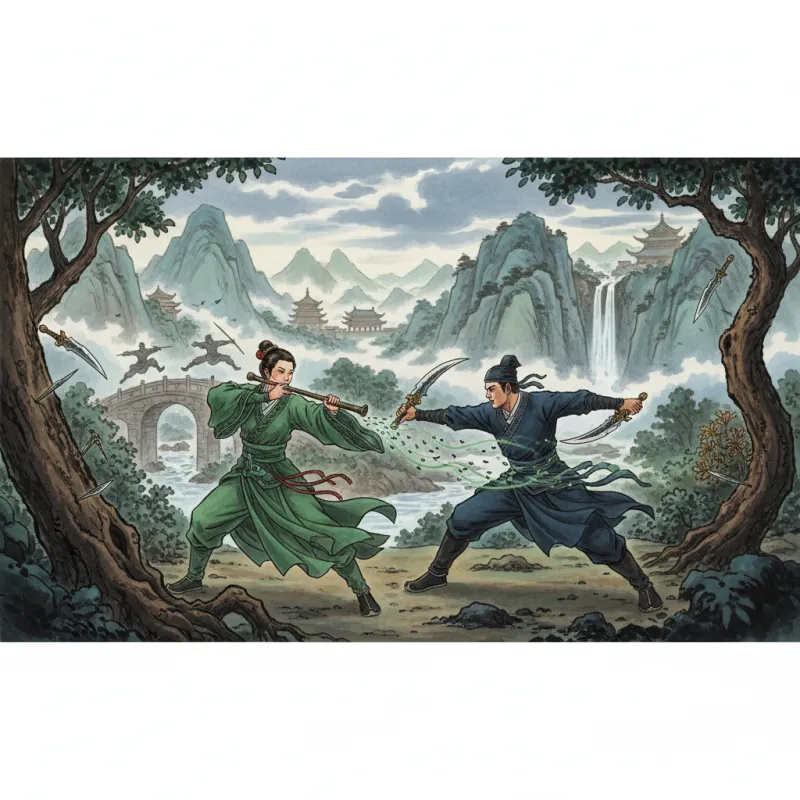
A needle no thicker than a strand of hair pierces your neck. You don't feel it enter — the Tang Sect's craftsmen have spent three centuries perfecting the angle of the bevel. By the time your hand reaches up to swat at what you assume is an insect, your fingers are already numb. You have perhaps ninety seconds before your diaphragm stops obeying your brain's commands to breathe. This is how most fights with Tang Sect disciples end: not with a dramatic final exchange of palm strikes, but with a confused stumble and the metallic taste of fear.
The Economics of Killing Without Getting Close
Hidden weapons (暗器, ànqì) represent a fundamental philosophical break from orthodox martial arts. When Shaolin monks spend twenty years conditioning their bodies to withstand spear thrusts, or when Wudang swordsmen practice ten thousand repetitions of a single draw-cut, they're investing in direct confrontation. They're saying: "I will meet you in combat and prove my superiority through skill." Hidden weapons practitioners are saying something quite different: "I will kill you from thirty feet away while you're still introducing yourself."
This is why the major orthodox sects have always maintained an uneasy relationship with hidden weapons. It's not merely that poison needles and flying daggers are "dishonorable" — though that accusation gets thrown around frequently in wuxia novels. The real issue is economic. If a mediocre martial artist with three months of throwing practice and a pouch of poison-tipped darts can kill a master who's trained for forty years, what's the point of the forty years? The entire social structure of the jianghu (江湖, jiānghú) — the martial world — depends on the assumption that skill accumulation matters.
The Tang Sect understood this threat to the established order and weaponized it. They didn't just use hidden weapons; they industrialized them.
The Tang Sect's Manufacturing Advantage
What separates the Tang Sect from random assassins with poisoned needles is scale and systematization. In Jin Yong's Demi-Gods and Semi-Devils (天龙八部, Tiānlóng Bābù), we get glimpses of the Tang family compound in Sichuan: workshops where craftsmen produce thousands of identical spring-loaded mechanisms, poison laboratories with detailed records spanning generations, training halls where children learn to palm a throwing knife before they learn to write.
This is manufacturing. The Tang Sect doesn't produce individual master craftsmen who make bespoke hidden weapons; they produce standardized, interchangeable components that any family member can deploy effectively. A Tang Sect disciple carries what amounts to a portable arsenal: sleeve arrows (袖箭, xiùjiàn) that fire on a wrist flex, flying needles (飞针, fēizhēn) concealed in hair ornaments, smoke bombs that create instant cover, and at least three types of poison matched to different tactical situations.
The genius is in the redundancy. Orthodox martial artists typically master one weapon — a sword, a saber, perhaps a staff. If you disarm them, you've significantly reduced their threat level. Disarming a Tang Sect fighter means... what, exactly? Taking away their visible weapon? They have eleven more you can't see. Destroying their poison needle launcher? They have throwing knives. Somehow neutralizing all their projectiles? They've coated their fingernails with contact poison.
The Poison Needle: Engineering Lethality
Let's focus on the signature weapon: the poison needle (毒针, dúzhēn). In Gu Long's novels, particularly the Chu Liuxiang series, poison needles appear constantly, and Gu Long — who had a better grasp of practical combat than most wuxia authors — understood what made them effective.
First, size. A proper Tang Sect poison needle is barely visible in good light. It's not a sewing needle; it's finer than that, closer to an acupuncture needle. This creates immediate problems for the target. You can't block what you can't see. Attempting to deflect a poison needle with your sword is like trying to swat a mosquito with a baseball bat — the size differential makes the defensive tool useless.
Second, velocity. These needles aren't thrown by hand; they're launched from spring-loaded devices concealed in sleeves, fans, or belt buckles. The spring provides consistent force, which means consistent accuracy. A hand-thrown needle's effectiveness depends entirely on the thrower's strength and technique in that moment. A spring-launched needle performs identically whether you're fresh or exhausted, calm or panicked.
Third, the poison itself. The Tang Sect maintains extensive records of toxins — which compounds cause paralysis versus death, which act in seconds versus hours, which leave traces versus which mimic natural death. This isn't random poisoning; it's pharmaceutical precision. In The Heaven Sword and Dragon Saber (倚天屠龙记, Yǐtiān Túlóng Jì), Jin Yong describes Tang Sect poisons that can be tailored to the target's internal energy cultivation level. A dose that would kill an ordinary person in minutes might only slow down a master with decades of neigong (内功, nèigōng) practice — but "slowing down" a master is often sufficient.
Flying Daggers and the Problem of Recovery
The flying dagger (飞刀, fēidāo) occupies a different tactical niche than the poison needle. Where needles are about invisible lethality, flying daggers are about overwhelming force at range. The most famous practitioner in wuxia literature is Li Xunhuan from Gu Long's Sentimental Swordsman, Ruthless Sword (多情剑客无情剑, Duōqíng Jiànkè Wúqíng Jiàn), whose "Little Li Flying Dagger" (小李飞刀, Xiǎo Lǐ Fēidāo) never misses.
The flying dagger's advantage over arrows is recovery time. An archer needs to nock, draw, aim, and release — a sequence that takes at least two seconds even for masters. A flying dagger can be drawn and thrown in a single motion taking perhaps half a second. In close-quarters combat, that difference is everything.
But there's a deeper tactical consideration that most wuxia novels gloss over: ammunition management. An archer carries perhaps twenty arrows in a quiver. A flying dagger specialist might carry six daggers, maximum, before weight and bulk become prohibitive. This creates an interesting psychological dynamic. Every throw is a commitment. Miss six times, and you're reduced to hand-to-hand combat against an opponent who's now extremely motivated to close distance.
The Tang Sect's solution is, again, redundancy and variety. They don't rely solely on flying daggers. They use them as part of a layered defense: flying daggers for medium range, poison needles for long range, smoke bombs and caltrops to control space, and hand-to-hand techniques as a last resort. Each layer compensates for the weaknesses of the others.
The Psychological Warfare Component
Here's what the wuxia novels get right about hidden weapons: the fear factor is often more valuable than the weapons themselves. In Demi-Gods and Semi-Devils, when characters learn they're facing Tang Sect disciples, their entire tactical approach changes. They stop thinking about winning and start thinking about not getting poisoned.
This is rational. A sword wound, even a serious one, can be treated. You might lose the fight, but you'll probably survive. A Tang Sect poison needle wound is a different calculation entirely. Even if you win the immediate confrontation, you might die three hours later when the poison reaches your heart. Or you might survive but lose the use of your legs. Or you might need to spend the next six months tracking down the antidote, which the Tang Sect will happily sell you at an extortionate price.
The Tang Sect has effectively weaponized uncertainty. You don't know which of their needles are poisoned and which are just steel. You don't know if that scratch on your arm is going to kill you. You don't know if they've already deployed a contact poison on a surface you touched five minutes ago. This cognitive load — the constant threat assessment — degrades your combat effectiveness even before the actual fighting starts.
Why Orthodox Sects Can't Replicate This
The major orthodox sects — Shaolin, Wudang, Emei, Kunlun — all know about hidden weapons and poisons. Some of their members use them occasionally. But none have achieved the Tang Sect's level of systematic integration, and the reason is cultural, not technical.
Orthodox sects are built around the master-disciple transmission model. A master takes on a few disciples, teaches them over decades, and those disciples eventually become masters who take on their own disciples. This model works brilliantly for transmitting complex, embodied skills like sword techniques or internal energy cultivation. It works poorly for manufacturing and logistics.
The Tang Sect operates more like a family business — which it literally is. Knowledge isn't transmitted vertically from master to disciple; it's transmitted horizontally across the family and systematically documented. When a Tang craftsman develops a new spring mechanism for sleeve arrows, that innovation gets recorded, standardized, and distributed to the entire family. When a Tang poisoner discovers a new toxin, the recipe goes into the family archives where any member can access it.
This is why, in most wuxia novels, the Tang Sect remains consistently dangerous across generations while other sects rise and fall based on whether they happen to produce a genius in any given generation. The Tang Sect has effectively removed individual genius from the equation. They don't need a once-in-a-century master; they need competent family members who can follow documented procedures.
The Modern Relevance
Reading wuxia novels in 2024, the Tang Sect's approach feels oddly contemporary. They're essentially running a tech startup in a world of traditional craftsmen. They've identified a market inefficiency — the fact that martial arts mastery takes decades to achieve — and developed a product that delivers similar results with dramatically less training time. They've built a moat around their business through proprietary knowledge (poison formulas) and manufacturing expertise (hidden weapon mechanisms). They've even figured out recurring revenue through antidote sales.
The orthodox sects, meanwhile, are like traditional universities insisting that everyone needs a four-year degree when online courses can teach the same material in six months. They're not wrong that deep mastery has value, but they're losing the argument in the marketplace of violence.
This is probably why the Tang Sect remains one of the most memorable factions in wuxia literature despite rarely being the protagonists' home sect. They represent a uncomfortable truth: in any competitive domain, systematization and tooling eventually beat raw talent and traditional training. The martial world doesn't want to admit this, which is why Tang Sect disciples are always portrayed as slightly sinister, slightly outside the bounds of proper jianghu behavior.
But they're also the ones who keep winning fights.
Related Reading
- Throwing Knives, Needles, and Darts: The Hidden Weapon Arsenal
- Unveiling Hidden Weapons in Wuxia: The Intrigue of Jianghu Culture
- Hidden Weapons in Wuxia: The Deadly Art of Surprise
- The Tang Clan: Masters of Hidden Weapons and Poison
- The Concealed Weapon Arsenal: Every Hidden Weapon in the Jianghu
- Tea, Wine, and Food: The Culinary Culture of Wuxia
- Crouching Tiger, Hidden Dragon: How One Film Changed Everything
- Shanhai Jing Creatures in Modern Video Games
Explore Chinese Culture
- Explore Jin Yong's martial arts novels
- Explore cultivation fiction and immortal heroes
- Explore the real history behind wuxia