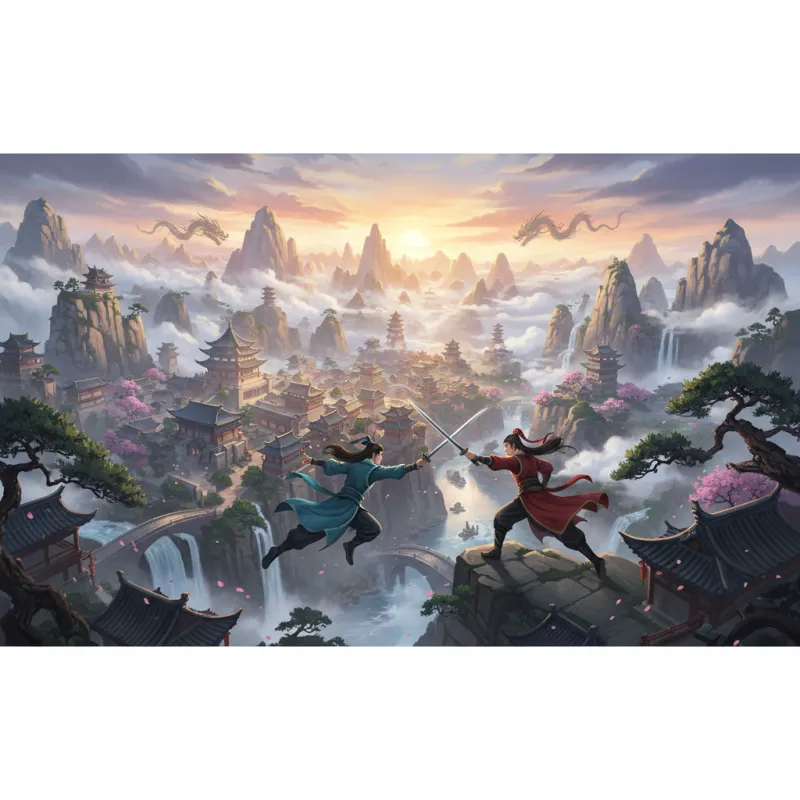
The first time you boot up The Legend of Sword and Fairy (仙剑奇侠传, Xiānjiàn Qíxiá Zhuàn) in 1995, you're not just starting a video game — you're stepping into a digital 江湖 (jiānghú) that would define Chinese RPG aesthetics for the next three decades. That pixelated opening scene, with its melancholic flute melody and rain-soaked courtyard, did something Western fantasy RPGs rarely attempted: it made loneliness beautiful, made wandering feel like destiny rather than a gameplay mechanic.
The DOS Revolution: When Taiwan Built the Foundation
The story of wuxia video games begins not in mainland China, but in Taiwan's underground computer cafes of the early 1990s. While American gamers were exploring Ultima and Wizardry, Taiwanese developers at Softstar Entertainment were asking a different question: what if we built an RPG around the emotional beats of a Jin Yong novel instead of Tolkien?
The Legend of Sword and Fairy (1995) was the answer. Designer Yao Zhuangxian (姚壮宪) created something that felt less like a dungeon crawler and more like an interactive wuxia television series. The turn-based combat borrowed from Japanese RPGs, yes, but the narrative structure — tragic romance, impossible choices, the weight of destiny — came straight from the 武侠 (wǔxiá) literary tradition. When the protagonist Li Xiaoyao's love interest dies in his arms two-thirds through the game, players weren't just losing a party member. They were experiencing the kind of heartbreak that Jin Yong had been inflicting on readers since the 1950s.
Softstar wasn't alone. The Swordsman (金庸群侠传, Jīnyōng Qúnxiá Zhuàn, 1996) took a different approach: what if you could meet every major character from Jin Yong's novels in a single game? It was fan service elevated to art form, letting players recruit Guo Jing, Yang Guo, and Linghu Chong into the same party. The game understood something crucial about wuxia fandom — we don't just want to read about these heroes, we want to be them, to master the Eighteen Dragon-Subduing Palms ourselves.
Mainland China Enters the Arena (Late 1990s-2000s)
When mainland Chinese developers finally entered the market in the late 1990s, they brought a different sensibility. Swordsman Love (剑侠情缘, Jiànxiá Qíngyuán, 1997) from Kingsoft felt grittier, more grounded in historical detail. Set during the Southern Song Dynasty, it didn't just use history as window dressing — it made you feel the weight of the Mongol invasion, the desperation of a civilization fighting for survival.
The sequel, Swordsman Love II (2001), pushed technical boundaries that seemed impossible for a Chinese studio at the time. Real-time combat replaced turn-based systems. The 轻功 (qīnggōng) movement system let you leap across rooftops with a fluidity that Western games wouldn't match until Assassin's Creed. Most importantly, it introduced the 门派 (ménpài) system — choosing between different martial arts sects that fundamentally changed your playstyle. A Shaolin monk played nothing like a Wudang swordsman, which played nothing like a Tangmen poison specialist.
The MMO Explosion: When Jianghu Went Online
The transition to MMORPGs in the mid-2000s should have been disastrous for wuxia games. The genre's strength had always been intimate, story-driven experiences — how do you preserve that when thousands of players are running around the same world?
Swordsman Online (剑侠情缘网络版, 2003) and Age of Wushu (九阴真经, Jiǔyīn Zhēnjīng, 2012) found an answer: make the social systems themselves feel like wuxia. Joining a sect wasn't just picking a class, it was pledging loyalty to a master and fellow disciples. The 师徒 (shītú) mentor system created genuine relationships between veteran and new players. Server-wide events like sect wars and martial arts tournaments recreated the grand gatherings that punctuate every Jin Yong novel.
Age of Wushu went further, implementing a "school kidnapping" system where rival sects could literally abduct your disciples for ransom. It sounds absurd until you remember that this exact scenario happens in Demi-Gods and Semi-Devils. The game understood that jianghu isn't just about individual heroism — it's about complex webs of loyalty, betrayal, and revenge that span years.
The Action Game Renaissance (2010s)
By the 2010s, Chinese developers were looking beyond RPGs. Jade Empire (2005) had shown that Western studios could make wuxia-inspired action games, but BioWare's version felt like a tourist's interpretation — beautiful but somehow missing the soul.
The indie scene provided the correction. Tale of Wuxia (侠客风云传, Xiákè Fēngyún Zhuàn, 2015) returned to the genre's narrative roots with a branching story that actually understood moral ambiguity. Your choices didn't fall into neat "good" or "evil" categories. Sometimes helping one person meant betraying another. Sometimes the righteous path led to tragedy. It felt like playing through a Gu Long novel, where heroes are flawed and villains have their reasons.
Wuxia (2018) took a different approach: pure, unfiltered martial arts combat stripped of RPG systems. No experience points, no level grinding — just you, your sword, and enemies who would kill you in two hits if you mistimed a parry. It was brutally difficult and absolutely authentic to the genre's spirit. In wuxia literature, mastery comes from understanding, not from accumulating stats.
Black Myth: Wukong and the Global Breakthrough
When Black Myth: Wukong (黑神话:悟空, Hēi Shénhuà: Wùkōng) released in August 2024, it wasn't just a commercial success — it was a cultural earthquake. Over 10 million copies sold in the first three days. Concurrent player counts that rivaled Elden Ring. Suddenly, Western gamers who had never heard of Journey to the West were debating the finer points of Sun Wukong's character arc.
Game Science's achievement wasn't just technical (though the Unreal Engine 5 visuals were stunning). It was that they made Chinese mythology accessible without diluting it. The game didn't explain every reference or hold your hand through the cultural context. It trusted players to be curious, to look up who the Yellow-Robed Demon was, to understand why the Buddha's palm is significant. That confidence paid off — forums filled with Western players discovering Chinese mythology for the first time, not as exotic curiosity but as genuinely compelling storytelling.
The combat system deserves special mention. It borrowed the Soulslike framework but infused it with wuxia sensibilities. The focus system encouraged aggressive, flowing combat rather than defensive play. The transformation abilities — becoming different versions of Wukong with distinct movesets — captured the Monkey King's trickster nature. Most crucially, it made you feel powerful in the way wuxia protagonists are powerful: not through grinding stats, but through mastering techniques and understanding enemy patterns.
The Indie Wave and Future Directions
Black Myth's success has emboldened a new generation of Chinese developers. Where Winds Meet (2024) promises an open-world wuxia experience with dynamic weather affecting combat and traversal. Phantom Blade Zero (2025) is pushing for a darker, more stylized aesthetic that draws from both wuxia and Chinese horror traditions.
The indie scene is equally vibrant. Wandering Sword (2023) proved that turn-based wuxia RPGs still have an audience, selling over 500,000 copies with its deep cultivation system and branching narrative. Sword and Fairy 7 (2021) brought the venerable series into the modern era with real-time combat while preserving the emotional storytelling that made the original special.
What's emerging is a maturation of the genre. Early wuxia games often felt like they were apologizing for their Chinese-ness, adding English voice acting and toning down cultural references for potential Western audiences. Modern developers have realized that authenticity is the selling point. Players don't want a watered-down version of Chinese culture — they want the real thing, presented with confidence and craft.
Why Wuxia and Gaming Work So Well Together
The synergy between wuxia and video games runs deeper than shared power fantasies. Both mediums understand that mastery is a journey, not a destination. The cultivation arc — starting as a nobody, finding a master, learning techniques, eventually surpassing your teacher — is the narrative backbone of both wuxia novels and RPG progression systems.
More subtly, both mediums excel at creating a sense of place. The 江湖 (jiānghú) isn't just a setting, it's a living ecosystem of competing factions, hidden masters, and ancient grudges. Video games, with their ability to create persistent worlds and emergent narratives, can capture this complexity in ways that film and television struggle with. When you spend 60 hours in a game's jianghu, you start to understand its rhythms, recognize its landmarks, remember its stories. You become part of it.
The best wuxia games also understand the genre's melancholic undercurrent. For all the spectacular sword fights and superhuman abilities, wuxia is fundamentally about loneliness — the loneliness of the wanderer, the weight of living by a code that the rest of the world has abandoned. Games like Sword and Fairy and Tale of Wuxia capture this beautifully, creating moments of quiet reflection between the action set pieces.
The Road Ahead
The next frontier for wuxia games isn't just better graphics or bigger worlds — it's deeper systemic integration of wuxia philosophy. Imagine a game where your reputation in the jianghu actually matters, where breaking your word has lasting consequences, where the choice between 正 (zhèng, righteousness) and 邪 (xié, heterodoxy) isn't a binary morality meter but a complex web of competing values.
We're starting to see glimpses of this. Justice Online (逆水寒, Nìshuǐ Hán) has a dynamic reputation system where your actions ripple through the game world. Moonlight Blade (天涯明月刀, Tiānyá Míngyuè Dāo) lets you pursue non-combat paths like being a musician or scholar, recognizing that jianghu encompasses more than just fighting.
The global success of Black Myth: Wukong has proven that Chinese game developers no longer need to chase Western trends or apologize for their cultural roots. The world is ready for authentic Chinese storytelling in game form. After three decades of evolution, wuxia video games have finally achieved what their protagonists always sought: mastery of their art, recognition from the wider world, and the confidence to walk their own path through the digital jianghu.
Related Reading
- Wire-Fu: The Art of Flying Swordsmen in Action Cinema
- The Golden Age of Hong Kong Wuxia Cinema
- The World of Wuxia: Exploring Chinese Martial Arts Fiction and Jianghu Culture
- Best Wuxia TV Dramas: A Streaming Guide for International Viewers
- Crouching Tiger, Hidden Dragon: How One Film Changed Everything
- Confucianism and Daoism in Wuxia: The Philosophical Heart of Martial Fiction
- Tea Houses and Wine Shops: The Social Hubs of the Martial World
- Magical Plants of the Shanhai Jing: Trees That Grant Immortality
Explore Chinese Culture
- Explore Jin Yong's martial arts novels
- Explore cultivation fiction and immortal heroes
- Explore the real history behind wuxia