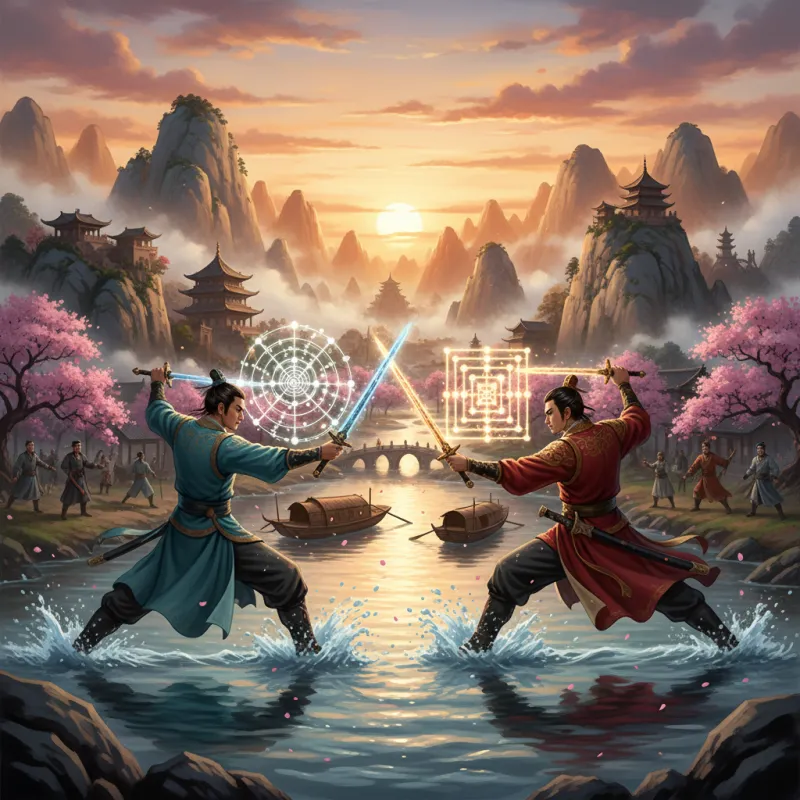
A dragon-horse emerges from the Yellow River, water streaming from its scales, and on its back swirls a pattern of dots that will shape three thousand years of Chinese cosmology, martial arts theory, and strategic thinking. This is not fantasy — or rather, it is fantasy that became foundational truth. The Hetu (河图 Hétú, "River Chart") and Luoshu (洛书 Luòshū, "Luo River Writing") are mathematical diagrams that ancient sages claimed were delivered by mythical creatures, yet they remain embedded in everything from Taiji philosophy to the tactical formations described in wuxia novels.
The Dragon-Horse and the Divine Turtle
The legend places us in the reign of Fu Xi (伏羲 Fú Xī), the mythical first emperor, somewhere around 3000 BCE. As Fu Xi stood on the banks of the Yellow River contemplating the patterns of heaven and earth, a dragon-horse — a creature with the body of a horse and the scales of a dragon — rose from the waters. On its back was a pattern of dots, arranged in a specific numerical configuration. Fu Xi studied this pattern and from it derived the eight trigrams (八卦 bāguà) that form the foundation of the Yijing.
Centuries later, during the reign of the legendary Emperor Yu (大禹 Dà Yǔ), who tamed the great floods around 2200 BCE, a giant turtle emerged from the Luo River. On its shell was inscribed another numerical pattern — the Luoshu. Yu used this diagram to divide the empire into nine provinces and establish the principles of governance that would echo through Chinese political philosophy.
These are origin myths, yes, but they reveal something crucial: the ancient Chinese believed that mathematical order was not invented by humans but discovered in nature, delivered by the cosmos itself through supernatural messengers. This is why these diagrams carry such weight in martial arts fiction — they represent a direct transmission of universal law.
The Mathematics of Heaven and Earth
The Hetu is arranged as a cross-shaped pattern using numbers one through ten, represented by black and white dots. The odd numbers (yang) are white, the even numbers (yin) are black. The pattern places one and six at the bottom (north), two and seven at the top (south), three and eight at the east, four and nine at the west, with five and ten at the center. Each direction pairs a generating number (one through five) with its completion number (six through ten).
The Luoshu, by contrast, is a three-by-three magic square using only the numbers one through nine. Every row, column, and diagonal adds up to fifteen. The arrangement is: 4-9-2 across the top, 3-5-7 in the middle, 8-1-6 on the bottom. This is the oldest known magic square in human history, and it appears in Chinese texts at least a thousand years before similar constructs show up in other civilizations.
What makes these diagrams "magical" is not just their mathematical elegance but their claimed correspondence to natural phenomena. The Hetu represents the generative cycle of the five elements (五行 wǔxíng) — wood, fire, earth, metal, water — and their interactions. The Luoshu maps onto the eight trigrams plus the center, creating a spatial-temporal model that practitioners use for everything from feng shui to military strategy.
From Ancient Cosmology to Martial Arts
By the Song Dynasty (960-1279 CE), Neo-Confucian scholars like Shao Yong (邵雍 Shào Yōng) had elaborated these diagrams into comprehensive cosmological systems. But it is in martial arts tradition that they found their most dynamic expression. The Luoshu in particular became the theoretical foundation for the Bagua Zhang (八卦掌 Bāguà Zhǎng), the "Eight Trigram Palm" style, where practitioners walk in circles corresponding to the eight outer positions of the diagram, with the center representing the practitioner's core.
In wuxia novels, these diagrams frequently appear as the secret behind powerful formations or mysterious techniques. Jin Yong's (金庸 Jīn Yōng) works reference them repeatedly — the Quanzhen Sect's (全真派 Quánzhēn Pài) Tiangang Beidou Formation (天罡北斗阵 Tiāngāng Běidǒu Zhèn) in The Legend of the Condor Heroes draws directly from Luoshu principles, with seven martial artists taking positions that correspond to the Big Dipper constellation overlaid on the magic square pattern.
The genius of using these diagrams in martial arts is that they provide both a practical tactical framework and a philosophical justification. When seven fighters arrange themselves according to Luoshu positions, they are not just creating a defensive formation — they are aligning themselves with cosmic order, channeling the same patterns that govern the movement of stars and the cycle of seasons.
The Diagrams as Strategic Weapons
The military applications go beyond fiction. The classic text Liutao (六韬 Liùtāo, "Six Secret Teachings"), attributed to Jiang Ziya (姜子牙 Jiāng Zǐyá), the legendary strategist of the Zhou Dynasty, explicitly discusses formations based on these numerical patterns. The idea is that by positioning troops according to the Hetu or Luoshu, a commander creates a formation that is inherently balanced and adaptable, capable of transforming from defense to offense as smoothly as yin transforms into yang.
In Gu Long's (古龙 Gǔ Lóng) novels, these diagrams often appear as the key to breaking seemingly invincible formations. The protagonist must recognize the underlying pattern — realize that the enemy's positions correspond to Luoshu numbers, for instance — and then exploit the mathematical relationships to find the weak point. This is not just dramatic license; it reflects a genuine Chinese strategic tradition of viewing warfare as applied mathematics and cosmology.
The Zhuge Liang's Eight Formations described in Romance of the Three Kingdoms are perhaps the most famous example. These formations, which supposedly could trap and destroy armies many times larger than the defending force, were said to be based on Bagua principles derived from the Hetu and Luoshu. Whether Zhuge Liang actually used such formations is debatable, but the legend demonstrates how deeply these diagrams penetrated Chinese military thinking.
Hidden Meanings and Esoteric Interpretations
The diagrams have accumulated layers of interpretation over millennia. Daoist alchemists saw in them the formula for internal cultivation — the Luoshu's center position representing the dantian (丹田 dāntián), the energy center in the lower abdomen, with qi (气 qì) circulating through the eight outer positions like a practitioner walking the Bagua circle. The numbers themselves were believed to encode the timing of alchemical transformations.
Buddhist interpreters, particularly in the Chan (禅 Chán, Zen) tradition, saw the diagrams as representations of emptiness and form. The Luoshu's magic square property — all lines summing to the same total — became a metaphor for the equality of all phenomena in their essential nature. The Hetu's pairing of numbers suggested the non-duality of opposites.
In wuxia fiction, this esoteric dimension often manifests as secret manuals or hidden techniques. A character might discover that a seemingly ordinary martial arts manual is actually encoded using Luoshu positions — each move corresponding to a number in the square, and the true sequence revealed only by following the magic square's mathematical properties. This is not just plot device; it reflects the historical reality that Chinese martial arts manuals often used symbolic and numerical codes to protect their secrets.
The Diagrams in Contemporary Practice
Walk into any serious Taiji or Bagua school today, and you will likely see the Luoshu diagram on the wall. Practitioners still use it as a training tool, walking the pattern to internalize its spatial relationships. The diagram serves as a mnemonic device, a meditation focus, and a tactical template all at once.
Modern scholars debate whether the diagrams have any objective mathematical significance or whether their power lies entirely in their function as organizing metaphors. The truth is probably both. The Luoshu is objectively a magic square with interesting mathematical properties. But its real power in Chinese culture comes from its role as a unifying symbol — a pattern that connects cosmology, strategy, medicine, architecture, and martial arts into a single coherent system.
In contemporary wuxia novels and films, the diagrams continue to appear, though often with creative elaborations. Some authors have imagined three-dimensional versions of the Luoshu, or dynamic formations where the numbers shift positions according to time of day or season. These innovations stay true to the spirit of the original diagrams — the idea that there are hidden patterns in reality, and that understanding these patterns grants power.
The Enduring Mystery
What is remarkable about the Hetu and Luoshu is not whether they were actually delivered by mythical creatures — they obviously were not — but that Chinese civilization chose to frame fundamental mathematical concepts as divine revelations from nature. This is a culture that saw mathematics not as human invention but as cosmic discovery, not as abstract symbol manipulation but as the literal structure of reality.
For the wuxia reader, these diagrams represent something essential to the genre: the belief that there are secret patterns underlying martial skill, that mastery comes not just from physical training but from understanding the deep structure of things. When a character in a Jin Yong novel suddenly realizes that their opponent's technique follows a Luoshu pattern, they are experiencing a moment of enlightenment — seeing through surface appearances to the mathematical truth beneath.
The diagrams remind us that in the Chinese martial arts tradition, fighting is never just fighting. It is applied philosophy, embodied mathematics, moving meditation. The dragon-horse and the divine turtle may be myths, but the patterns they carried continue to shape how practitioners think about movement, strategy, and the relationship between human action and cosmic order. In that sense, the creatures delivered exactly what the legends promised: a way of seeing the world that has endured for three thousand years.
Related Reading
- Exploring the Cultural Depth of Wuxia: The Art of Chinese Martial Arts Fiction
- Sacred Objects of Chinese Mythology: Seals, Mirrors, and Cauldrons
- The Jade Palace of Kunlun: Home of the Queen Mother of the West
- Shaolin Temple: The Birthplace of Chinese Martial Arts
- The Smiling Proud Wanderer: A Story About Freedom
- Kunlun Mountain: The Paradise at the Center of the World
Explore Chinese Culture
- Explore Jin Yong's martial arts novels
- Explore cultivation fiction and immortal heroes
- Explore the real history behind wuxia