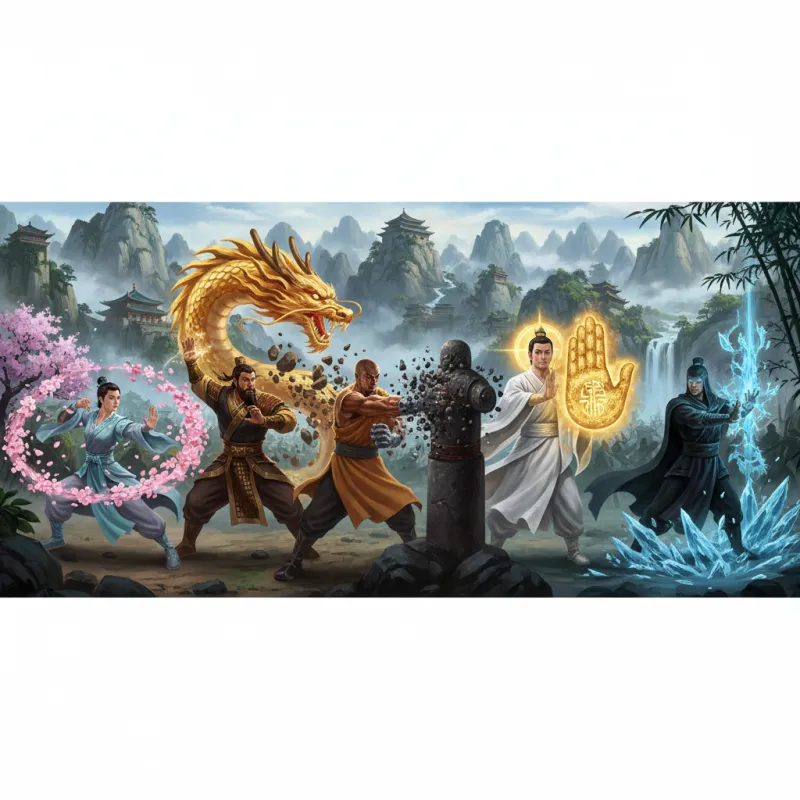
Imagine standing ten feet from your opponent, palms raised, and watching them collapse as invisible force ruptures their internal organs. No blade touched them. No fist connected. Just the projection of pure qi (气 qì) through empty air. This is the terrifying reality of master-level palm techniques in wuxia fiction — and why they consistently outrank even the most legendary sword forms in raw destructive potential.
The Internal Logic of Palm Supremacy
Swords dominate the popular imagination of martial arts fiction. They have poetic names, tragic histories, entire novels built around their inheritance. But ask any character who's reached the pinnacle of martial cultivation, and they'll tell you the same thing: at the highest levels, palms beat swords every time.
The reasoning is elegant. A sword, no matter how perfectly forged, remains an external tool. It amplifies physical force, yes, but it's still bound by material limitations. Metal can chip, break, or be knocked from your hand. A palm strike, by contrast, channels internal energy (内功 nèigōng) directly through the practitioner's body. At master level, palm techniques don't just strike — they project concentrated qi through flesh and bone, creating impacts that transcend physical contact. Your palms are always with you, can never be disarmed, and grow stronger as your internal cultivation deepens. This is why the most feared figures in the jianghu (江湖 jiānghú) — the martial world — are almost always palm technique specialists.
The Eighteen Dragon-Subduing Palms: The Gold Standard
When Jin Yong (金庸 Jīn Yōng) created the Eighteen Dragon-Subduing Palms (降龙十八掌 Jiàng Lóng Shíbā Zhǎng) for his 1963 novel Demi-Gods and Semi-Devils, he established the benchmark against which all other palm techniques would be measured. This isn't just another martial art — it's the signature technique of the Beggars' Sect (丐帮 Gàibāng), passed down through generations of sect leaders, and it embodies everything that makes palm techniques superior to weapon-based combat.
Each of the eighteen forms draws its name from the I Ching (易经 Yìjīng), lending philosophical weight to devastating physical force. "Haughty Dragon Repents" (亢龙有悔 Kàng Lóng Yǒu Huǐ) doesn't just sound impressive — it represents the principle that maximum force must be tempered with restraint, or it rebounds on the user. When Hong Qigong (洪七公 Hóng Qīgōng) teaches these techniques to Guo Jing (郭靖 Guō Jìng), he's not just passing on combat moves. He's transmitting a complete martial philosophy that combines overwhelming yang energy with strategic wisdom.
What makes the Eighteen Dragon-Subduing Palms truly supreme is their versatility. They work at any range — close quarters, mid-range, or projected across distances. They can be executed with one palm or two, standing or in motion, and they scale with the user's internal cultivation. A novice using these forms is formidable. A master like Qiao Feng (萧峰 Xiāo Fēng) becomes essentially unstoppable, capable of fighting dozens of opponents simultaneously. The techniques don't just damage the body — they disrupt qi flow, making them particularly effective against other internal martial artists.
The Nine Yin White Bone Claw: Beauty and Horror
Not all legendary palm techniques come from righteous sects. The Nine Yin White Bone Claw (九阴白骨爪 Jiǔ Yīn Bái Gǔ Zhǎo), also from Jin Yong's works, represents the dark side of palm mastery — and it's arguably even more terrifying than the Dragon-Subduing Palms precisely because of its specificity.
This technique appears in the Nine Yin Manual (九阴真经 Jiǔ Yīn Zhēnjīng), one of the most coveted martial arts texts in Jin Yong's universe. Where the Dragon-Subduing Palms emphasize overwhelming force, the White Bone Claw focuses on precision and penetration. Practitioners train by thrusting their fingers into progressively harder materials — sand, gravel, stone — until their fingertips can pierce flesh and bone as easily as chopsticks entering tofu. The "white bone" in the name isn't metaphorical. Masters of this technique can literally strip flesh from bone with a single grab, leaving behind skeletal remains.
What makes this technique particularly insidious is its yin (阴 yīn) nature. While yang-based palm strikes like the Dragon-Subduing Palms announce themselves with visible force and sound, the White Bone Claw works through cold, penetrating energy that invades the victim's body and destroys from within. It's the difference between being hit by a hammer and being injected with poison. Both kill, but one leaves you wondering what happened until it's too late. The psychological impact of facing an opponent whose mere touch can reduce you to a skeleton cannot be overstated — which is exactly why so many villains in Jin Yong's novels covet this technique.
The Flipping Sky Seal: Shaolin's Answer
The Shaolin Temple (少林寺 Shàolín Sì) couldn't let the Beggars' Sect monopolize palm technique supremacy, so they developed the Flipping Sky Seal (翻天印 Fān Tiān Yìn), sometimes called the Great Strength Vajra Palm (大力金刚掌 Dàlì Jīngāng Zhǎng). This technique appears across multiple wuxia novels and represents the Buddhist approach to palm combat: overwhelming, righteous force that doesn't rely on trickery or deception.
The Flipping Sky Seal is exactly what it sounds like — a palm strike with enough force to flip the sky itself. Practitioners channel their entire body's internal energy into a single devastating blow, creating a palm-shaped imprint of pure force that can shatter stone, bend metal, or send opponents flying dozens of feet. Unlike the Dragon-Subduing Palms' eighteen varied forms, the Flipping Sky Seal is essentially one perfect technique refined to absolute mastery. It's the martial arts equivalent of a master calligrapher who spends decades perfecting a single character.
What distinguishes this technique from other powerful palm strikes is its emphasis on righteous qi (正气 zhèngqì). Shaolin monks cultivate their internal energy through Buddhist meditation and moral discipline, which gives their techniques a purifying quality. The Flipping Sky Seal doesn't just damage — it can dispel evil qi, break through demonic techniques, and even heal internal injuries when applied with proper intent. This dual nature makes it particularly effective against practitioners of unorthodox martial arts (邪派武功 xiépài wǔgōng), whose techniques often rely on corrupted or stolen internal energy. For more on Shaolin's martial philosophy, see Wudang vs Shaolin: Two Philosophies of Combat.
The Toad Stance and Toad Skill: Unconventional Mastery
Ouyang Feng (欧阳锋 Ōuyáng Fēng), the Western Venom from Jin Yong's Legend of the Condor Heroes, proves that palm techniques don't need to follow conventional forms to achieve legendary status. His Toad Stance (蛤蟆功 Hámá Gōng) looks ridiculous — practitioners squat like toads, hands positioned awkwardly, making croaking sounds — but it's devastatingly effective.
The genius of the Toad Stance lies in its biomechanics. By adopting this low, compressed posture, practitioners store enormous potential energy in their legs and core, which can be explosively released through palm strikes. The technique also makes the user incredibly difficult to knock down or unbalance, since their center of gravity is so low. When Ouyang Feng executes the Toad Skill palm strike from this stance, he generates force comparable to the Dragon-Subduing Palms, but from a position where most martial artists would be completely vulnerable.
What really elevates this technique is its psychological warfare component. Opponents see a grown man squatting like an amphibian, making frog noises, and they can't help but underestimate him. By the time they realize their mistake, they're already flying backward with shattered ribs. The Toad Stance also serves as a complete defensive system — the compressed posture protects vital points, and the stored energy can be released instantly in any direction. It's simultaneously the most ridiculous-looking and most practical palm technique in wuxia fiction, which is exactly why it deserves recognition among the greatest.
The Sunflower Manual's Techniques: The Price of Power
The Sunflower Manual (葵花宝典 Kuíhuā Bǎodiǎn) from Jin Yong's The Smiling, Proud Wanderer contains palm techniques so powerful that they've driven multiple characters to self-mutilation in pursuit of mastery. The manual's most famous requirement — "To practice this skill, one must first castrate oneself" (欲练神功,必先自宫 Yù liàn shéngōng, bì xiān zìgōng) — has become one of wuxia's most infamous lines.
The palm techniques in the Sunflower Manual achieve their legendary status through speed rather than raw power. Practitioners move so fast that they appear to teleport, striking from impossible angles before opponents can react. Dongfang Bubai (东方不败 Dōngfāng Bùbài), who masters the manual, can execute hundreds of palm strikes in seconds, each one precisely targeted at vital acupoints. This isn't the overwhelming force of the Dragon-Subduing Palms or the penetrating horror of the White Bone Claw — it's death by a thousand cuts, each one delivered faster than thought.
The manual's techniques also demonstrate an important principle in wuxia fiction: the greatest martial arts often demand terrible sacrifices. The castration requirement isn't arbitrary cruelty — it's based on the theory that sexual energy (精 jīng) can be redirected into martial cultivation, dramatically accelerating progress. Whether this theory holds any validity is debatable, but the narrative function is clear: ultimate power requires ultimate commitment. The Sunflower Manual's palm techniques represent the extreme end of martial arts philosophy, where the pursuit of strength consumes everything else, including one's humanity.
The Ranking Paradox: Context Matters
Here's the uncomfortable truth that most "greatest palm techniques" lists ignore: ranking these techniques definitively is impossible because their effectiveness depends entirely on context. The Eighteen Dragon-Subduing Palms might be the most versatile and powerful in direct combat, but they're useless if your opponent is faster than you can execute them. The Nine Yin White Bone Claw is terrifying in close quarters but requires physical contact. The Flipping Sky Seal's righteous qi makes it supreme against evil techniques but less effective against morally neutral opponents.
The real lesson from wuxia fiction's greatest palm techniques isn't which one is "best" — it's that mastery transcends technique. Qiao Feng with the Dragon-Subduing Palms defeats opponents who theoretically know more powerful techniques because his execution is perfect, his timing is flawless, and his martial heart is unshakeable. Ouyang Feng's Toad Stance works because he's adapted it to his personality and fighting style, not because the technique itself is inherently superior.
This is why the most memorable palm technique battles in wuxia fiction aren't about comparing raw power levels. They're about philosophy, character, and the choices martial artists make about how to cultivate their skills. When Hong Qigong fights Ouyang Feng, it's not just Dragon-Subduing Palms versus Toad Stance — it's righteousness versus amorality, orthodox versus unorthodox, northern versus southern martial traditions. The techniques are vehicles for exploring deeper questions about what it means to pursue martial excellence.
The Enduring Appeal of Palm Techniques
Palm techniques dominate wuxia fiction's highest levels because they represent the genre's core fantasy: that human cultivation can transcend physical limitations. A sword, no matter how legendary, is still just metal. A palm channeling decades of internal cultivation becomes something more — a weapon that grows with you, that can never be taken away, that represents the perfect union of body, mind, and spirit.
This is why readers remember the Eighteen Dragon-Subduing Palms decades after reading Jin Yong's novels, why the Nine Yin White Bone Claw has become shorthand for terrifying martial arts, why even the ridiculous Toad Stance commands respect. These techniques aren't just combat moves — they're expressions of martial philosophy, character development made physical, the visible manifestation of years of disciplined cultivation. In a genre built on the idea that dedicated practice can achieve the impossible, palm techniques are the ultimate proof of concept. For more on how internal cultivation shapes martial arts mastery, explore Internal Energy Cultivation Methods.
Related Reading
- Acupoint Striking (Dianxue): The Deadly Art of Pressure Points
- Exploring the Intricate World of Wuxia: Legends, Culture, and Kung Fu Novels
- External vs. Internal Martial Arts: The Great Divide in Wuxia
- Martial Arts Systems in Wuxia: Internal vs External, Orthodox vs Unorthodox
- Jianghu Slang: The Secret Language of the Martial World
- Magical Plants of the Shanhai Jing: Trees That Grant Immortality
- The Beggar Sect: The Largest and Most Unlikely Martial Arts Organization
Explore Chinese Culture
- Explore Jin Yong's martial arts novels
- Explore cultivation fiction and immortal heroes
- Explore the real history behind wuxia