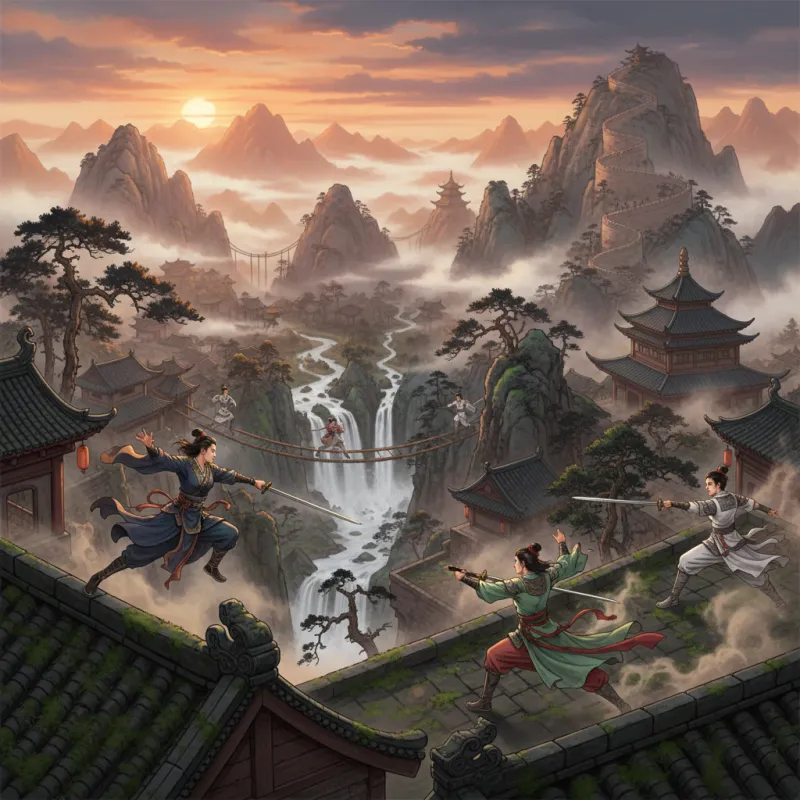
The first time Huang Rong appears in The Legend of the Condor Heroes, she's disguised as a filthy beggar boy, and she's already three steps ahead of everyone in the room. She's not waiting to be discovered as beautiful — she's busy manipulating a tavern full of martial artists while mentally calculating the exact pressure points she'd need to strike if things go wrong. This is wuxia's approach to female characters in a nutshell: competence first, romance maybe later, and rescue? Not necessary.
The women of wuxia fiction occupy a strange and fascinating space in Chinese literature. They emerged from a tradition where women were expected to embody the "three obediences and four virtues" (三从四德 sān cóng sì dé), yet somehow these novels produced characters who lead sects, develop original martial arts techniques, and regularly outfight their male counterparts. It's not that wuxia abandoned gender expectations entirely — it didn't — but it found ways to let women be dangerous, brilliant, and central to the story while still operating within a recognizably Chinese cultural framework.
The Archetypes That Define the Genre
The Brilliant Strategist: Huang Rong (黄蓉)
Huang Rong from Jin Yong's (金庸) The Legend of the Condor Heroes (射雕英雄传 Shè Diāo Yīngxióng Zhuàn, 1957) remains the template for the intellectually superior female lead. She's the daughter of Huang Yaoshi, master of Peach Blossom Island, and she inherited his genius for strategy, medicine, music, and the Yijing (易经 Book of Changes). What makes her remarkable isn't just that she's smart — it's that the narrative never punishes her for it.
Guo Jing, the male protagonist, is famously slow-witted. He succeeds through persistence and moral clarity, but Huang Rong is the one solving problems, seeing through deceptions, and keeping him alive. Their relationship works precisely because the story doesn't require her to diminish herself. She's smarter, and everyone knows it, and that's fine. This dynamic — the brilliant woman paired with the earnest but less clever man — appears repeatedly in wuxia, and it's surprisingly progressive for a genre that began in the 1950s.
The Tragic Swordswoman: Ah Qing (阿青)
Jin Yong's The Book and the Sword (书剑恩仇录 Shū Jiàn Ēnchóu Lù, 1955) gave us characters like Huo Qingtong, but if you want the archetype of the woman whose martial skill becomes inseparable from her tragedy, look at Ah Qing from The Sword of the Yue Maiden (越女剑 Yuè Nǚ Jiàn). She's a shepherdess who develops a sword technique so perfect that she defeats thousands of soldiers alone. The King of Yue asks her to train his army, and her technique becomes the foundation of an entire martial tradition.
Then she's forgotten. The technique survives, but her name doesn't. This is the dark side of the female martial artist narrative: exceptional skill doesn't guarantee recognition, and sometimes the woman who changes everything is erased from the story she created. Gu Long (古龙) explored this theme repeatedly — his female characters are often more skilled than his male leads, but they're also more likely to die, disappear, or sacrifice themselves for someone else's journey.
The Sect Leader: Abbess Miejue (灭绝师太)
Not all powerful women in wuxia are sympathetic. Abbess Miejue from The Heaven Sword and Dragon Saber (倚天屠龙记 Yǐtiān Túlóng Jì, 1961) leads the Emei Sect (峨眉派 Éméi Pài) with absolute authority, and she's one of the most formidable martial artists in the jianghu (江湖). She's also rigid, vengeful, and willing to kill her own disciples for perceived betrayals.
What's interesting is that her authority is never questioned on the basis of gender. The other sect leaders treat her as an equal threat. Her cruelty isn't gendered — it's personal, rooted in a romantic betrayal from her youth. The narrative criticizes her choices, not her position. This matters because it establishes that women can hold institutional power in wuxia's martial world, even if individual characters abuse that power.
The Historical Context Nobody Talks About
Wuxia's treatment of female martial artists didn't emerge from nowhere. The genre draws on a long tradition of women warriors in Chinese history and legend — figures like Hua Mulan (花木兰), the woman who disguised herself as a man to fight in her father's place, or the Yang Family women generals (杨门女将 Yángmén Nǚjiàng) who defended the Song Dynasty when the men of their family fell in battle.
But there's a crucial difference: those historical and legendary women were celebrated for stepping into male roles during emergencies. They were exceptional because they acted like men when men weren't available. Wuxia's female martial artists don't need that excuse. They're not temporary substitutes — they're permanent fixtures of the martial world, with their own techniques, their own schools, and their own authority.
This shift happened largely in the 20th century, as wuxia evolved from oral storytelling traditions into modern novels. Writers like Jin Yong and Gu Long were creating these stories in the 1950s-1980s, a period when Chinese society was actively renegotiating gender roles. The Communist revolution had officially promoted gender equality, even if practice lagged behind policy. Wuxia novels, especially those published in Hong Kong and Taiwan, reflected these tensions — they created spaces where women could be powerful while still maintaining connections to traditional Chinese culture.
The Techniques They Master
Female martial artists in wuxia often practice specific styles associated with grace, precision, or internal cultivation rather than raw strength. The Emei Sect's techniques emphasize flexibility and speed. The Ancient Tomb Sect (古墓派 Gǔmù Pài) from The Return of the Condor Heroes (神雕侠侣 Shén Diāo Xiá Lǚ) was founded by a woman and specifically designed to allow female practitioners to defeat stronger male opponents through superior technique.
This isn't just narrative convenience — it reflects real Chinese martial arts philosophy. Internal styles like Taijiquan (太极拳) have always emphasized that proper technique can overcome superior strength. By associating female characters with these approaches, wuxia novels make their combat prowess believable within the genre's logic while also reinforcing certain gender assumptions about how men and women fight differently.
The problem is when this becomes limiting. Ren Yingying from The Smiling, Proud Wanderer (笑傲江湖 Xiào Ào Jiānghú, 1967) is brilliant at strategy and internal cultivation, but she's not a front-line fighter. Yue Lingshan from the same novel is competent but not exceptional. For every Huang Rong or Abbess Miejue, there are several female characters whose martial skills are respectable but clearly secondary to the male protagonist's journey.
The Romance Problem
Here's where wuxia's progressive elements collide with its conservative ones: almost every major female martial artist ends up defined by her romantic relationship. Huang Rong's brilliance is always in service of Guo Jing's mission. Xiao Longnu (小龙女) from The Return of the Condor Heroes is one of the most powerful martial artists in the jianghu, but her entire character arc revolves around her relationship with Yang Guo.
Even characters who start independent — like Ren Yingying, who leads the Sun Moon Holy Cult (日月神教 Rìyuè Shénjiào) before she meets Linghu Chong — tend to step back once the romance begins. The pattern is consistent enough to be frustrating: women can be brilliant, powerful, and central to the plot, but they rarely get to be the protagonist of their own story.
There are exceptions. Lian Nishang (练霓裳) from Liang Yusheng's (梁羽生) The White-Haired Maiden (白发魔女传 Báifà Mónǚ Zhuàn, 1957) is the title character and drives the narrative. But even she's defined largely by her doomed romance with Zhuo Yihang. The genre has struggled to imagine what a female martial artist's story looks like when it's not primarily a love story.
What Modern Wuxia Gets Right (and Wrong)
Contemporary wuxia novels and adaptations have pushed these boundaries further. Priest's (Priest) Faraway Wanderers (天涯客 Tiānyá Kè, 2010) includes female martial artists who exist independently of romantic plots. Cang Yue's (沧月) Blood Rose series features women who lead armies and sects without needing male validation.
But there's also been pushback. Some modern wuxia has overcorrected, creating female characters who are powerful but lack the complexity of earlier examples. They're skilled fighters, but they're not necessarily interesting people. The best female martial artists in wuxia — Huang Rong, Ren Yingying, even the villainous Abbess Miejue — are compelling because they're fully realized characters who happen to be martially skilled, not because they're primarily defined by their combat abilities.
The genre is still evolving. Recent adaptations have experimented with giving female characters more agency, more screen time, and more narrative independence. Whether this represents a genuine shift or just surface-level changes remains to be seen. The test will be whether wuxia can create female martial artists who are central protagonists of their own stories, not just brilliant supporting characters in someone else's journey.
Why This Matters Beyond the Genre
Wuxia's female martial artists matter because they've shaped how millions of Chinese readers imagine women's capabilities. These aren't Western feminist texts — they're working within Chinese cultural frameworks, negotiating between tradition and change. They've created a space where women can be powerful, intelligent, and martially skilled while still being recognizably Chinese characters operating in recognizably Chinese settings.
That's harder than it sounds. It's easy to import Western feminist frameworks and declare traditional Chinese gender roles entirely oppressive. It's much more difficult to work within a culture's existing structures and find spaces for women's agency, power, and complexity. Wuxia doesn't always succeed, and it often reinforces the same gender expectations it's trying to subvert. But at its best, it's created some of the most memorable female characters in Chinese popular fiction — women who don't need rescuing, who solve their own problems, and who are just as likely to save the male protagonist as he is to save them.
For readers interested in how these characters connect to broader themes of women warriors in Chinese tradition, or how female sect leaders navigate jianghu politics, wuxia offers a rich and complicated landscape. These aren't simple stories about empowerment or oppression — they're negotiations between competing values, and the female martial artists who populate them are all the more interesting for existing in that tension.
Related Reading
- Romance in Wuxia: Love, Duty, and the Tragedy Between
- Women Warriors in Wuxia: Beyond the Love Interest
- Hua Mulan and the Wuxia Tradition of Women Warriors
- Women Warriors in Chinese Martial Arts Fiction: Empowering Jianghu Heroines
- Hua Mulan and Beyond: Real Women Warriors of China
- Lingzhi: The Mushroom of Immortality from Myth to Medicine
- Daoist Poetry: Finding the Way Through Nature
- The Green Destiny: Most Famous Sword in Wuxia Cinema
Explore Chinese Culture
- Explore Jin Yong's martial arts novels
- Explore cultivation fiction and immortal heroes
- Explore the real history behind wuxia