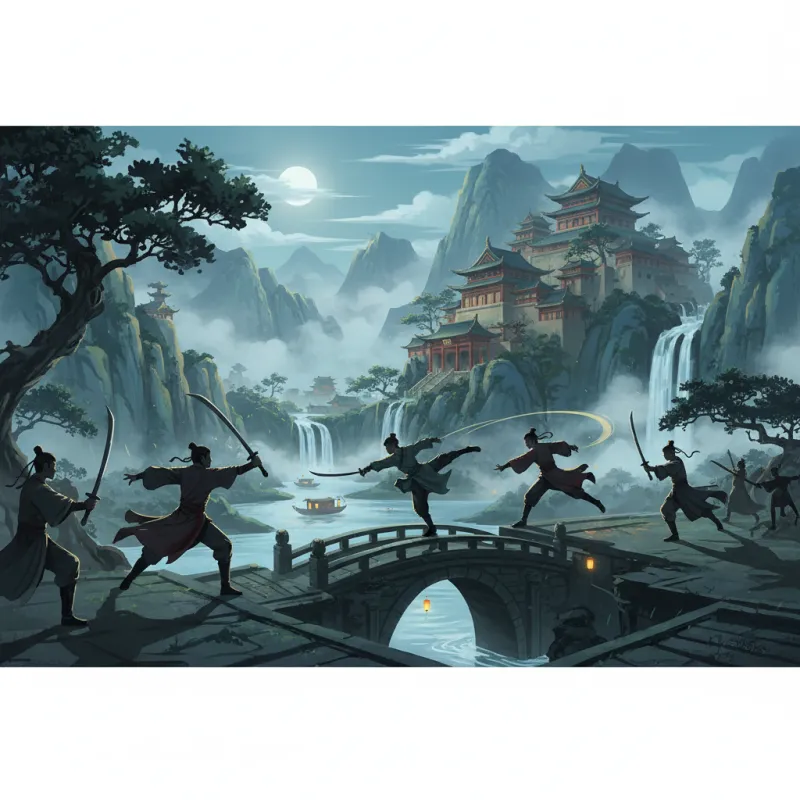
The abbot of Shaolin Temple once told a journalist that if his monks could really fly across rooftops and punch through walls, they wouldn't need to charge admission. He was joking, but he had a point. The real martial arts schools of China — Shaolin, Wudang, Emei, and dozens of others — exist in a strange limbo between historical fact and wuxia fantasy. Jin Yong didn't invent these places. He just made them infinitely cooler than they actually are.
Shaolin: From Buddhist Refuge to Martial Arts Brand
The Shaolin Temple (少林寺 Shàolín Sì) was founded in 495 CE on Mount Song in Henan Province. The monks there did practice martial arts, but not because they were training to become wandering heroes. They needed to defend themselves from bandits, protect their property, and stay physically fit during long meditation sessions. The famous "Shaolin staff fighting" that appears in every wuxia novel? That came from monks using their walking sticks as weapons when local warlords tried to raid the monastery.
The temple's reputation exploded during the Tang Dynasty when thirteen Shaolin monks supposedly helped Li Shimin (the future Emperor Taizong) win a crucial battle in 621 CE. The emperor rewarded them with land and official recognition. This is historical fact. What's not fact: the monks didn't have supernatural powers, they couldn't generate internal energy blasts, and they definitely weren't leaping over palace walls in a single bound.
By the time Jin Yong wrote Demi-Gods and Semi-Devils (天龙八部 Tiānlóng Bābù), Shaolin had become a repository for every cool martial arts concept he could imagine. The Seventy-Two Arts, the易筋经 (Yìjīn Jīng, Muscle-Tendon Change Classic), the mysterious sweeping monk who could defeat anyone — none of this matches the historical record. Real Shaolin kung fu is impressive, but it's a physical discipline, not magic.
The modern Shaolin Temple is essentially a theme park. After being nearly destroyed during the Cultural Revolution, it was rebuilt in the 1980s and turned into a tourist attraction. The "monks" performing for crowds are often professional wushu athletes, not ordained Buddhists. The real martial lineage was broken decades ago.
Wudang: The Taoist Mountain That Never Had a Zhang Sanfeng
Here's where it gets interesting. Wudang Mountain (武当山 Wǔdāng Shān) in Hubei Province is real. The Taoist temples there are real. Wudang martial arts are real. But Zhang Sanfeng (张三丰 Zhāng Sānfēng), the legendary founder who appears in The Heaven Sword and Dragon Saber and countless other novels? Probably not real.
Historical records mention several people named Zhang Sanfeng across different dynasties, but none of them match the wuxia version — the immortal Taoist master who invented Tai Chi and founded an entire martial arts system to rival Shaolin. The earliest references to a Zhang Sanfeng appear in Ming Dynasty texts, hundreds of years after he supposedly lived. Most historians think he's a composite figure, a collection of stories about various Taoist martial artists merged into one mythical person.
The actual Wudang martial arts tradition emphasizes internal cultivation (内功 nèigōng) and soft, flowing movements. This is real and documented. Wudang practitioners did develop fighting systems based on Taoist principles of yielding and redirecting force. But the idea that Wudang and Shaolin represent two opposing philosophies — external versus internal, Buddhist versus Taoist, hard versus soft — is mostly a wuxia invention. Real martial artists borrowed techniques from everywhere. The rigid sect boundaries only exist in novels.
What Wudang does have is spectacular scenery. The mountain temples, built during the Ming Dynasty, are architectural marvels. The Golden Hall at the summit is a genuine historical treasure. And yes, there are still Taoist priests who practice martial arts there. But they're not preparing for the next Sword Meet at Mount Hua (华山论剑 Huàshān Lùnjiàn). They're mostly teaching tourists and running schools.
Emei: The Women's Sect That Wasn't
The Emei Sect (峨眉派 Éméi Pài) in wuxia fiction is famous for being led by women, particularly the stern and powerful abbess Miejue Shitai in The Heaven Sword and Dragon Saber. Mount Emei in Sichuan Province is real, it has Buddhist temples, and there is an Emei martial arts tradition. But it was never a women-only sect, and it certainly wasn't led by sword-wielding nuns who held grudges for decades.
The historical Emei martial arts are associated with a monk named Bai Mei (白眉 Bái Méi, White Eyebrow) during the Qing Dynasty. The style emphasizes close-range combat and quick strikes. That's about where the facts end. Jin Yong took the name, the location, and the general concept of a Buddhist martial arts school, then invented everything else. The result is one of the most memorable sects in wuxia fiction, but it has almost nothing to do with the actual martial arts practiced on Mount Emei.
This pattern repeats across the genre. The Kunlun Sect (昆仑派 Kūnlún Pài), the Kongtong Sect (崆峒派 Kōngtóng Pài), the Huashan Sect (华山派 Huàshān Pài) — all named after real mountains, all associated with real martial arts traditions, all wildly exaggerated in fiction. The mountains exist. The martial arts exist. The elaborate hierarchies, secret techniques, and century-long feuds? Pure invention.
The Five Great Sword Sects and Other Convenient Fictions
In The Smiling, Proud Wanderer (笑傲江湖 Xiào'ào Jiānghú), Jin Yong introduces the Five Great Sword Sects: Huashan, Hengshan (衡山 Héngshān), Hengshan (恒山 Héngshān, different character), Songshan (嵩山 Sōngshān), and Taishan (泰山 Tàishān). Notice anything? They're all named after China's Five Great Mountains (五岳 Wǔyuè), a traditional grouping of sacred peaks.
This is Jin Yong being clever. He's taking a well-known cultural reference and turning it into a martial arts alliance. It sounds authentic because the mountains are real and important in Chinese culture. But there was never a historical alliance of sword sects based on these mountains. He made it up because it sounded cool and gave his story structure.
The same goes for the "Nine Sects and Ten Schools" (九门十派 Jiǔmén Shípài) that appear in various wuxia novels. These elaborate taxonomies of martial arts organizations are fictional frameworks imposed on a much messier historical reality. Real martial arts schools were family businesses, temple traditions, or military training systems. They didn't organize themselves into neat hierarchies with official rankings and alliance meetings.
What Real Martial Arts Schools Actually Looked Like
So what were historical Chinese martial arts schools actually like? Smaller, more practical, and far less dramatic than wuxia fiction suggests.
Most martial arts were taught within families or small groups. A master would take on a handful of disciples, teach them a specific style, and that was it. There were no massive temple complexes with hundreds of students training in synchronized formations. The famous "martial arts sects" were really just loose networks of practitioners who learned from the same lineage.
The techniques themselves were designed for real combat, not performance. Historical martial artists were often soldiers, bodyguards, or security escorts protecting merchant caravans. They needed skills that worked in actual fights, not elaborate forms that looked impressive. The flowery names for techniques in wuxia novels — "Eighteen Dragon-Subduing Palms" (降龙十八掌 Jiàng Lóng Shíbā Zhǎng), "Six Meridian Divine Sword" (六脉神剑 Liù Mài Shén Jiàn) — are pure fiction. Real techniques had boring names like "straight punch" or "low sweep."
The concept of internal energy cultivation (内功 nèigōng) is real, but it's not what wuxia novels describe. Historical martial artists did practice breathing exercises, meditation, and conditioning drills to improve their physical and mental state. They didn't generate glowing energy balls or heal fatal wounds by circulating their qi. The exaggerated version of internal energy in wuxia fiction comes from Taoist alchemy texts and traditional Chinese medicine, filtered through decades of storytelling and embellishment.
Why the Gap Matters
The distance between real martial arts schools and their wuxia counterparts isn't a flaw in the genre. It's the entire point. Wuxia fiction takes the kernel of historical truth — yes, there were martial artists, yes, they trained in temples and mountains, yes, they had codes of honor — and expands it into mythology.
Jin Yong knew exactly what he was doing. He researched historical martial arts, visited the actual locations, and then deliberately exaggerated everything to create a more compelling story. The result is a genre that feels rooted in Chinese history and culture while being completely fantastical. It's the same impulse that turned King Arthur's knights into legends or made Robin Hood a folk hero. The historical basis gives the fantasy weight and authenticity.
Modern readers and viewers sometimes get confused about what's real and what's invented. Chinese tourists visit Shaolin Temple expecting to see monks flying through the air. They're disappointed when they find a commercialized attraction instead. But that disappointment comes from taking wuxia fiction too literally. The genre was never meant to be a documentary.
The real martial arts schools of China have their own fascinating history, separate from wuxia fiction. They represent centuries of combat experience, philosophical development, and cultural tradition. They deserve to be understood on their own terms, not as failed versions of their fictional counterparts. At the same time, the wuxia versions of these schools have become part of Chinese cultural identity in their own right. They're not real, but they're true in a different way — true to the aspirations, values, and imagination of the culture that created them.
The Legacy: When Fiction Reshapes Reality
Here's the strange twist: wuxia fiction has become so influential that it's actually changing the real martial arts schools. Modern Shaolin monks study Jin Yong novels. Wudang martial arts schools advertise themselves using wuxia terminology. The line between fact and fiction has blurred so much that even practitioners sometimes can't tell where history ends and storytelling begins.
This isn't unique to Chinese martial arts. The same thing happened with Japanese samurai culture, European knights, and American cowboys. The fictional version becomes more culturally powerful than the historical reality. People want the myth, not the mundane truth.
The real martial arts schools that inspired wuxia fiction are still there, still teaching, still evolving. They're just not what Jin Yong described. And that's fine. We can appreciate both the historical reality and the fictional enhancement without confusing the two. The gap between them isn't a problem to be solved. It's the creative space where great stories live.
Related Reading
- The Origins of Wuxia: From Sima Qian to Jin Yong
- The Enigmatic World of Jianghu: A Deep Dive into Wuxia Fiction and Kung Fu Novels
- The Knight-Errant (游侠): Real Warriors Who Inspired Wuxia
- The Real History Behind Wuxia: Knight-Errants of Ancient China
- Pangu and the Cosmic Egg: The Chinese Creation Myth
- How Wuxia Heroes Train: From Waterfall Meditation to Iron Palm
- Animal Spirits and the Path to Becoming Yaoguai
- Tea, Wine, and Food: The Culinary Culture of Wuxia
Explore Chinese Culture
- Explore Jin Yong's martial arts novels
- Explore cultivation fiction and immortal heroes
- Explore the real history behind wuxia