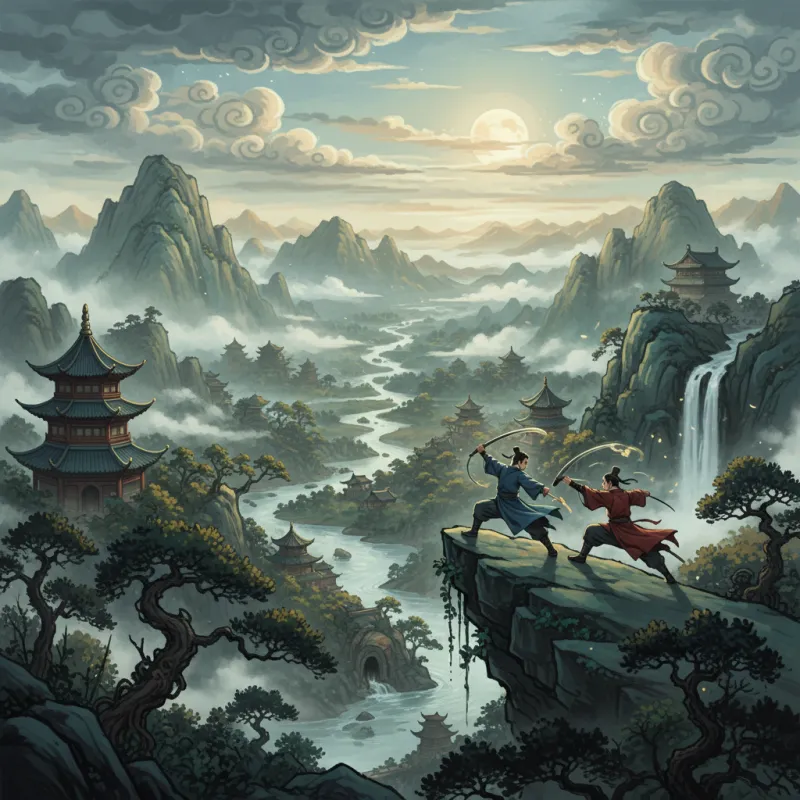
A young disciple kneels in the snow for three days outside the mountain gate, waiting for a master who may never accept him. Inside, the sect leader watches from a window, testing not the boy's martial potential but his xin (心)—his heart-mind, the fusion of will and spirit that no amount of physical training can forge. This scene, repeated across countless wuxia novels from Jin Yong to Gu Long, reveals a truth that Western readers often miss: in Chinese martial arts fiction, the real training begins long before the first punch is thrown.
The Philosophy of Suffering: Why Wuxia Masters Make Students Miserable
The training sequences in wuxia novels follow a pattern that would horrify modern educators. In Jin Yong's The Legend of the Condor Heroes (射雕英雄传, 1957-1959), Guo Jing spends years performing seemingly pointless tasks for the Seven Freaks of Jiangnan before learning actual martial arts. This isn't narrative padding—it's a deliberate reflection of traditional Chinese pedagogy rooted in Confucian and Buddhist thought. The concept of chi ku (吃苦), literally "eating bitterness," positions suffering as the essential ingredient for transformation.
Consider the contrast with Western training montages, where Rocky Balboa runs up stairs to triumphant music. In wuxia, the equivalent scene involves a protagonist standing in horse stance for hours while their master ignores them, or worse, actively torments them. Linghu Chong in The Smiling, Proud Wanderer (笑傲江湖) learns the Dugu Nine Swords not through systematic instruction but through cryptic hints and life-threatening situations. The master-disciple relationship operates on the assumption that true understanding cannot be taught—only discovered through ordeal.
This approach connects to the Daoist concept of wu wei (无为), often mistranslated as "non-action." In training contexts, it means the master creates conditions for learning rather than directly transmitting knowledge. The student must develop wu (悟), sudden enlightenment, which arrives not through logical progression but through accumulated experience breaking through mental barriers. It's why so many wuxia breakthroughs happen during moments of crisis rather than peaceful practice.
Internal vs. External: The Two Paths of Martial Cultivation
Wuxia fiction distinguishes sharply between neigong (内功, internal cultivation) and waigong (外功, external techniques), a division that mirrors actual Chinese martial arts philosophy but amplifies it to fantastical extremes. External martial arts focus on physical conditioning, weapon mastery, and combat techniques—the visible, demonstrable skills. Internal cultivation develops qi (气), the vital energy that flows through meridians and can be weaponized in ways that defy physics.
The Shaolin Temple, appearing in virtually every wuxia novel, represents the external path taken to its apex. Monks spend decades conditioning their bodies until they can shatter stone with bare hands or withstand sword strikes. Yet even Shaolin acknowledges the superiority of internal arts—their most powerful techniques, like the Yi Jin Jing (易筋经, Muscle-Tendon Change Classic), are actually internal cultivation methods disguised as physical training.
The Wudang School, by contrast, embodies pure internal cultivation through Daoist principles. Zhang Sanfeng, the legendary founder appearing in The Heaven Sword and Dragon Saber, creates Taijiquan as the ultimate expression of rou ke gang (柔克刚)—softness overcoming hardness. His disciples don't build massive muscles; they cultivate qi until they can redirect an opponent's force with minimal movement. This philosophical divide creates endless narrative tension: the hard-training Shaolin monk versus the seemingly effortless Wudang priest.
What makes this compelling isn't just the fight choreography but the underlying question: is mastery achieved through relentless physical discipline or through understanding fundamental principles? Most wuxia novels answer "both," but the journey to that synthesis drives the plot. Characters who focus solely on external techniques hit plateaus; those who pursue only internal cultivation lack practical combat experience. The greatest martial artists, like Dugu Qiubai (whose name literally means "Seeking Defeat Alone"), transcend the dichotomy entirely.
The Secret Manual: Knowledge as Forbidden Fruit
No wuxia trope is more recognizable than the miji (秘籍), the secret martial arts manual that everyone kills to possess. These texts—the Nine Yin Manual, the Sunflower Manual, the Divine Skill of the Northern Darkness—function as MacGuffins, but they also reveal Chinese attitudes toward knowledge transmission. Unlike Western fantasy's spell books, which anyone can theoretically use, wuxia manuals are dangerous precisely because they contain genuine wisdom.
The Sunflower Manual (Kuihua Baodian, 葵花宝典) from The Smiling, Proud Wanderer makes this explicit: its opening line warns that practitioners must first castrate themselves. This isn't gratuitous shock value—it's a metaphor for the sacrifices required to obtain power and the dangers of pursuing advanced techniques without proper foundation. Yue Buqun, who practices the manual in secret, becomes physically powerful but spiritually corrupted, his obsession destroying everything he claimed to protect.
The structure of these manuals reflects actual Chinese martial arts texts, which are notoriously cryptic. Real documents like the Taiji Classics use poetic language and metaphor rather than step-by-step instructions. They assume the reader already has a master to decode the text—written knowledge supplements oral transmission but cannot replace it. Wuxia novels exaggerate this by making manuals literally incomprehensible without the right interpretive key, whether that's a companion text, a specific cultivation level, or pure enlightenment.
This creates a recurring plot device: the protagonist discovers a manual but cannot understand it until they've undergone sufficient training or life experience. Wei Xiaobao in The Deer and the Cauldron possesses the Forty-Two Chapter Sutra containing martial arts secrets, but his inability to read classical Chinese means he never learns them—a deliberate joke by Jin Yong about the gap between possessing knowledge and understanding it. The manual becomes a symbol of how wisdom cannot be stolen, only earned through proper preparation.
Breaking Through: The Cultivation Bottleneck
Wuxia training follows a progression system that modern readers recognize from video games, but the genre established these conventions decades earlier. Martial artists advance through ranks—third-rate, second-rate, first-rate, and finally chaojue (超绝, super-class)—with each level requiring exponentially more effort. The crucial moments come at bottlenecks where normal training fails and breakthrough requires either enlightenment or catastrophe.
The most dramatic breakthroughs involve zou huo ru mo (走火入魔), literally "fire deviation entering demon"—a cultivation accident where qi goes berserk, threatening death or insanity. This happens when practitioners rush their training, practice incompatible techniques simultaneously, or attempt methods beyond their level. In Demi-Gods and Semi-Devils, Duan Yu accidentally absorbs decades of qi from others, nearly dying multiple times before his body adapts. These near-death experiences aren't setbacks but necessary trials that forge stronger foundations.
The concept parallels Daoist neidan (内丹, internal alchemy) practices, where practitioners circulate qi through specific pathways to refine it into higher forms. Blockages in meridians, impurities in qi, or imbalances between yin and yang create bottlenecks. Breaking through requires either dissolving the blockage through patient cultivation or shattering it through intense experience—the difference between meditation and combat as training methods.
What distinguishes wuxia from Western progression fantasy is the emphasis on foundation (jichu, 基础). Characters who advance too quickly become powerful but unstable, like buildings on weak foundations. The protagonist who spent years in basic training ultimately surpasses the genius who rushed ahead, because their foundation allows them to reach higher peaks. This reflects traditional Chinese education philosophy: master the fundamentals completely before advancing, even if it seems tediously slow.
The Unorthodox Path: Learning from Enemies and Accidents
While orthodox sects emphasize systematic training under qualified masters, wuxia's most interesting protagonists learn through chaotic, unorthodox means. Yang Guo in The Return of the Condor Heroes gets expelled from orthodox sects and learns from a variety of questionable sources: a giant condor, his aunt-turned-lover, and even enemies who try to kill him. His martial arts become a patchwork of stolen techniques, self-taught innovations, and desperate improvisations—yet he becomes one of the era's greatest masters.
This pattern reflects the jianghu reality that formal training is a luxury. Most wandering martial artists learn by observing others, stealing techniques during fights, or discovering lost manuals in caves. The protagonist of The Book and the Sword learns the Boundless Falling Wood technique by watching leaves fall and understanding the principle of natural movement. Such moments of spontaneous enlightenment (dunwu, 顿悟) are considered more profound than years of rote practice.
The unorthodox path also includes learning from enemies, a concept foreign to Western martial traditions. When Linghu Chong fights opponents using techniques he's never seen, he doesn't just defend—he analyzes, memorizes, and later incorporates their moves into his own style. This reflects the Chinese martial arts principle that there are no truly secret techniques; everything can be understood through observation and practice. The real secret is the understanding behind the technique, which cannot be stolen.
Even injuries become training opportunities. Characters who suffer severe wounds often emerge stronger, having used their recovery period to refine internal cultivation or rethink their approach to martial arts. Zhang Wuji in The Heaven Sword and Dragon Saber gets poisoned with xuan ming shen zhang (玄冥神掌, Mysterious Dark Divine Palm), a cold-element injury that should kill him. Instead, it creates a yin-yang balance when he later learns the jiu yang shen gong (九阳神功, Nine Yang Divine Skill), making him more powerful than if he'd never been injured. Suffering becomes not just character development but literal power-up mechanics.
The Master's Final Lesson: Surpassing the Teacher
The ultimate goal of wuxia training isn't to equal the master but to surpass them—a Confucian ideal expressed in the phrase qing chu yu lan (青出于蓝), "blue comes from indigo but is bluer than indigo." Masters actively work toward their own obsolescence, considering it their greatest success when disciples exceed them. This creates poignant moments where aged masters face their students in combat, not as enemies but as final examinations.
The most profound version appears in The Smiling, Proud Wanderer when Feng Qingyang, the reclusive Huashan master, teaches Linghu Chong the Dugu Nine Swords. He explicitly tells Linghu Chong to forget everything and develop his own understanding. The technique has no fixed forms—it's a principle of exploiting weaknesses that each practitioner must interpret personally. Feng Qingyang's teaching method is to show the principle once, then disappear, forcing Linghu Chong to develop it through actual combat. The master's absence becomes the final lesson.
This contrasts sharply with Western fantasy's tendency toward legacy preservation. Wuxia masters don't want their techniques passed down unchanged; they want disciples to evolve them into something better. When Zhang Sanfeng creates Taijiquan, he doesn't establish rigid forms but principles that each generation reinterprets. The art stays alive by changing, not by faithful reproduction. Disciples who merely copy their masters are considered failures, regardless of technical proficiency.
The tradition of chuangpai (创派, founding a new sect) represents the ultimate graduation. A true master doesn't just learn existing martial arts but synthesizes their knowledge into something original, then attracts disciples to continue the evolution. This explains why wuxia novels feature hundreds of sects with distinct styles—each represents a master's unique interpretation of martial principles. The jianghu hierarchy isn't just about power but about philosophical lineages, each sect a living argument about the nature of martial arts.
Training as Transformation: The Real Martial Art
What separates wuxia training sequences from mere power-up mechanics is their insistence that martial arts training transforms the whole person, not just their combat ability. The Chinese term wuxue (武学) means "martial learning" or "martial studies," positioning martial arts as a scholarly discipline equivalent to literature or philosophy. Characters don't just get stronger—they become different people, their personalities reshaped by the philosophies embedded in their techniques.
This is why internal cultivation methods often require specific personality traits or moral alignments. The Beiming Shengong (北冥神功, Divine Skill of the Northern Darkness) absorbs others' qi, tempting practitioners toward ruthless power-seeking. The Yijin Jing requires Buddhist detachment to practice safely. Techniques aren't morally neutral tools but expressions of worldviews that reshape practitioners toward their underlying philosophy.
The training montages that Western readers might skim are, for Chinese audiences, the heart of the story. They show not just how a character becomes powerful but how they become themselves—how the shy farm boy transforms into a righteous hero, how the arrogant young master learns humility, how the revenge-obsessed warrior finds peace. The martial arts are the vehicle for this transformation, their physical demands forcing psychological growth.
In the end, wuxia training sequences argue that mastery of any discipline requires the same elements: patient foundation-building, willingness to suffer, openness to unorthodox learning, and ultimately transcending what you were taught to create something new. The martial arts are just the most dramatic way to illustrate this universal truth. When a master tells their disciple that the real training is only beginning, they're not talking about learning new techniques—they're talking about the lifelong work of becoming fully human.
Related Reading
- Internal Energy (Neigong): The Hidden Power Behind Every Martial Art
- Wuxia Training Montages: How Heroes Are Made
- The Poison Arts: Wuxia Fiction's Most Feared Discipline
- How Wuxia Heroes Train: From Waterfall Meditation to Iron Palm
- The Wuxia Training Montage: How Heroes Are Made
- Qu Yuan: The First Named Poet in Chinese History
- Wire-Fu: The Art of Flying Swordsmen in Action Cinema
- Women Warriors in Chinese Martial Arts Fiction: Empowering Jianghu Heroines
Explore Chinese Culture
- Explore Jin Yong's martial arts novels
- Explore cultivation fiction and immortal heroes
- Explore the real history behind wuxia