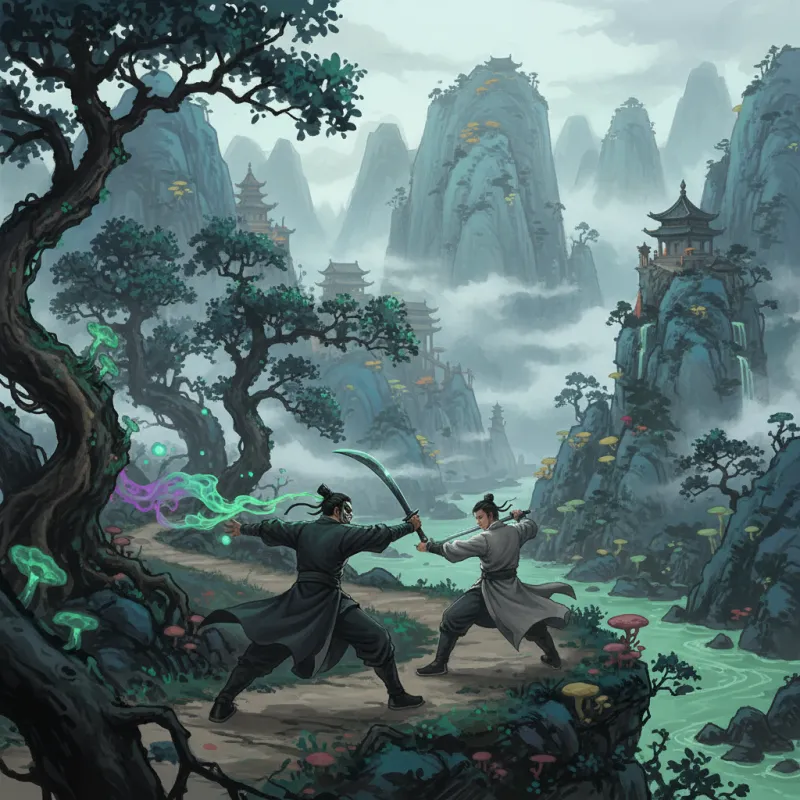
A grandmother in Jin Yong's The Deer and the Cauldron keeps a room full of snakes that could kill a man in minutes. She feeds them, talks to them, sleeps near them. When asked if she's afraid, she laughs. "Fear? These are my children." That's the poison master's paradox — what terrifies everyone else becomes intimate, almost tender. In wuxia fiction, poison arts (用毒术 yòngdú shù) represent the ultimate shortcut to power, and the ultimate moral compromise.
The Five Poisons Aren't Just Story Elements
The Five Poisons (五毒 wǔdú) existed in Chinese consciousness centuries before novelists borrowed them. Snake (蛇 shé), scorpion (蝎 xiē), centipede (蜈蚣 wúgōng), toad (蟾蜍 chánchú), and spider (蜘蛛 zhīzhū) — these creatures dominated folk medicine and protective rituals during the Tang Dynasty. Households hung images of them during the Dragon Boat Festival (端午节 Duānwǔ Jié) not to celebrate poison, but to neutralize it through symbolic confrontation.
Traditional Chinese medicine operated on a principle: poison fights poison (以毒攻毒 yǐdú gōngdú). Doctors prescribed carefully measured toxins to treat everything from tumors to paralysis. This wasn't superstition — modern pharmacology has validated compounds from several of these creatures. The toad secretion known as chansu contains bufotoxins that affect heart rhythm. Centipede venom has genuine analgesic properties.
Wuxia authors didn't invent the Five Poisons tradition. They weaponized it. Gu Long's Juedai Shuangjiao (1966) features the Valley of Evil, where the Five Poisons Sect breeds creatures in concentrated darkness, feeding them on each other until only the strongest survive. That's fiction, but it draws on real practices from Miao and Yao minority cultures in southern China, where gu poison (蛊毒 gǔdú) rituals involved sealing venomous creatures in jars.
Why Poison Masters Are Always Outsiders
Every major wuxia novel positions poison users at the margins. They live in swamps, valleys, or remote mountains — never in the respectable martial world's central plains. This geographic isolation mirrors their moral status. The orthodox sects practice internal energy cultivation and sword techniques that take decades to master. Poison requires different virtues: patience, secrecy, and a willingness to kill without looking your opponent in the eye.
Jin Yong understood this better than anyone. In The Heaven Sword and Dragon Saber, the Butterfly Valley Medicine King lives alone, surrounded by poisonous plants and insects. He's brilliant, possibly the best physician in the jianghu (江湖 jiānghu, the martial world), but other martial artists visit him only when desperate. His knowledge makes him useful. His methods make him untouchable.
The gender dynamics matter too. Poison arts attract more female practitioners than any other discipline in wuxia fiction. Partly this reflects historical reality — women had limited access to formal martial training but could study medicine and herbalism. Partly it's narrative convenience — a beautiful woman offering tea becomes infinitely more dangerous than a sword-wielding warrior. Ouyang Feng's sister-in-law in The Legend of the Condor Heroes never throws a punch, but her poison nearly kills Guo Jing multiple times.
The Technical Reality Behind Fictional Poisons
Wuxia novels describe poisons that kill in three breaths, change a victim's face, or cause madness with a single touch. Pure fantasy, right? Mostly. But the gap between fiction and historical toxicology is narrower than you'd think.
The "Intestine Severing Powder" (断肠散 duàncháng sǎn) that appears in dozens of novels probably references aconite, a plant from the buttercup family. Chinese physicians documented aconite poisoning as early as the Han Dynasty. Symptoms include severe abdominal pain — hence "intestine severing" — followed by cardiac arrest. Death could occur within hours.
The "Corpse Transforming Powder" (化尸粉 huàshī fěn) that dissolves bodies in Gu Long's novels? Exaggerated, but based on something real. Quicklime (生石灰 shēng shíhuī) was used in ancient China for rapid decomposition of bodies during plagues. Mix it with certain acids, and you get a substance that could theoretically accelerate tissue breakdown, though not at the speed fiction suggests.
What about the "Ten Fragrance Soft Tendon Powder" (十香软筋散 shíxiāng ruǎnjīn sǎn) that paralyzes victims without killing them? Curare-like compounds from plants in southern China could produce similar effects. The Miao people used them on hunting arrows. The "fragrance" part is pure invention — most real poisons smell terrible or have no scent at all, which is precisely what makes them dangerous.
The Moral Calculus of Poison Use
Orthodox martial artists in wuxia fiction love to proclaim that poison is dishonorable. Then they get poisoned and suddenly they're very interested in antidotes. This hypocrisy runs through the entire genre. Righteous sects claim moral superiority while practicing techniques that crush internal organs or shatter bones. Somehow that's more honorable than poison because it requires "skill."
Jin Yong plays with this constantly. In The Smiling, Proud Wanderer, the Five Poisons Sect isn't particularly evil — they're just honest about their methods. Meanwhile, the supposedly righteous Mount Hua Sect schemes, betrays, and murders with conventional weapons while maintaining moral superiority. The novel asks: what's the real difference between killing someone with a sword thrust to the heart versus a poison that stops the heart?
Gu Long takes a darker view. His poison masters are often tragic figures who chose this path because conventional martial arts were closed to them — due to gender, social class, or physical disability. In The Eleventh Son, the poison master Xiao Shiyi Lang uses toxins not from preference but necessity. He's too poor to afford a good sword, too weak to train in hard styles. Poison levels the playing field.
The most interesting moral question isn't whether poison is dishonorable. It's whether the martial world's obsession with "honorable" combat is itself a form of privilege. If you're born into a wealthy sect with access to master teachers and legendary weapons, you can afford to be honorable. If you're not, poison might be your only option.
Antidotes and the Economics of Fear
Every poison in wuxia fiction has an antidote, usually rare and difficult to obtain. This isn't just plot convenience — it reflects traditional Chinese medical theory. The concept of mutual generation and mutual overcoming (相生相克 xiāngshēng xiāngkè) from Five Elements philosophy suggests that every poison has a natural counter.
But antidotes create power dynamics. In The Return of the Condor Heroes, Qiu Qianchi controls her daughter by feeding her a slow-acting poison that requires monthly antidotes. The poison isn't meant to kill — it's meant to bind. This appears repeatedly in wuxia: poison as contract, poison as leash, poison as the ultimate form of control.
The rarest antidotes come from the same Five Poisons that create the deadliest toxins. Snake venom treated with snake bile. Scorpion poison countered by scorpion eggs. This circular logic appears in novels because it appeared first in medical texts. The Bencao Gangmu (Compendium of Materia Medica), compiled by Li Shizhen in 1578, documents dozens of these poison-antidote pairs.
Smart poison masters in fiction always keep their antidote formulas secret. Ouyang Feng in The Legend of the Condor Heroes is nearly invincible not because his poisons are the deadliest, but because no one else can cure them. Knowledge becomes the real weapon. The poison is just delivery mechanism.
Why Modern Wuxia Softened the Poison Arts
Early wuxia novels from the 1920s and 30s featured poison much more prominently. Xiang Kairan's Strange Tales of Chivalry includes detailed descriptions of poison preparation that read like actual recipes. By the 1960s, when Jin Yong and Gu Long dominated the genre, poison had become more stylized, less technical.
Partly this reflects changing censorship standards. Detailed poison recipes in popular fiction made authorities nervous. Partly it reflects the genre's evolution toward fantasy. As wuxia incorporated more supernatural elements — flying techniques, energy blasts, magical swords — realistic toxicology felt out of place.
Contemporary wuxia novels and adaptations often reduce poison to a plot device. Someone gets poisoned, someone else provides an antidote, the story moves on. The intimate knowledge of toxins, the careful cultivation of venomous creatures, the moral ambiguity — all that gets streamlined for faster pacing.
But the best modern wuxia still understands what makes poison arts compelling. They represent knowledge as power, patience as strategy, and the uncomfortable truth that in a fight to the death, honor is a luxury not everyone can afford. The grandmother with her room full of snakes knows something the sword masters don't: fear is just unfamiliarity. Get close enough to anything, even death, and it stops being frightening.
Related Reading
- Exploring Chinese Martial Arts Fiction: Training and Tradition in Wuxia Novels
- Wuxia Training Montages: How Heroes Are Made
- Internal Energy (Neigong): The Hidden Power Behind Every Martial Art
- How Wuxia Heroes Train: From Waterfall Meditation to Iron Palm
- The Wuxia Training Montage: How Heroes Are Made
- The Hetu and Luoshu: Magical Diagrams from the Rivers
- The Jianghu Code: Honor Among Martial Artists
- The Tang Clan: Masters of Hidden Weapons and Poison
Explore Chinese Culture
- Explore Jin Yong's martial arts novels
- Explore cultivation fiction and immortal heroes
- Explore the real history behind wuxia