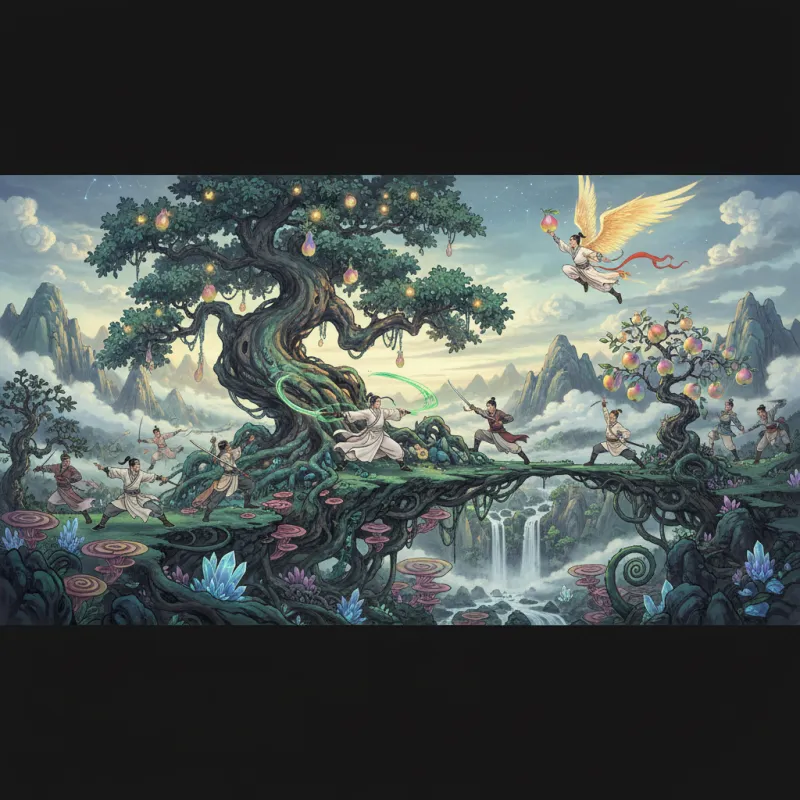
The tree stands alone on Mount Kunlun, its bark the color of jade, its leaves dripping with a sap that looks disturbingly like human blood. According to the Shanhaijing (山海经 Shānhǎi Jīng, "Classic of Mountains and Seas"), eating its fruit will prevent you from drowning. The text doesn't explain why. It doesn't need to. In the cosmology of ancient China's strangest geographical treatise, the world simply works this way — plants have powers, mountains have personalities, and the line between the botanical and the supernatural doesn't exist.
While martial artists in wuxia novels chase after legendary medicinal herbs that can heal internal injuries or extend life, the Shanhaijing operates on a different scale entirely. These aren't herbs that make you stronger. They're plants that fundamentally break the rules of reality.
The Geography of Impossible Botany
The Shanhaijing was compiled between the 4th and 1st centuries BCE, though parts may be older. It's structured as a travel guide to a world that never quite existed — or perhaps existed in a China where myth and geography hadn't yet separated into distinct categories. The text catalogs 204 mountains, 258 creatures, and dozens of plants across its eighteen sections, each more improbable than the last.
What makes the botanical entries particularly fascinating is their clinical tone. The text describes the Jianmu tree (建木 Jiànmù), which connects heaven and earth and has no shadow at noon, with the same bureaucratic precision it uses to note that a certain mountain contains copper deposits. There's no sense of wonder, no poetic flourishing. Just: this tree exists, here's what it does, moving on.
This matter-of-fact approach creates an unsettling effect. When a text treats the impossible as mundane, you start to wonder if the authors actually believed these plants existed — or if they were encoding something else entirely.
Trees That Resurrect the Dead
The most audacious claim in the entire Shanhaijing might be the Xunmu tree (寻木 Xúnmù), which grows on Mount Duguang. The text states plainly: if you eat its fruit, you will not die. Not "you will live longer" or "you will be healthier." You will not die.
Other trees offer more specific resurrections. The Fusang tree (扶桑 Fúsāng), growing in the eastern sea where the sun rises, is associated with solar mythology and immortality. The Ruomu tree (若木 Ruòmù) in the west performs a similar function for the setting sun. These aren't just mythological set dressing — they're part of a cosmological system where plants serve as the infrastructure of reality itself.
Compare this to the spiritual herbs of Daoist cultivation that appear in later wuxia fiction. Those herbs might grant you a breakthrough in your martial arts or heal a deadly poison, but they work within a system of internal energy and cultivation. The Shanhaijing plants don't care about your cultivation level. They simply rewrite the rules.
Fruits of Flight and Invisibility
The Jiaoshu tree (蛟树 Jiāoshù) produces a fruit that, when eaten, allows you to fly. Not glide, not leap great distances like a qinggong master — actually fly. The text provides no mechanism, no explanation of how this works. You eat the fruit, you fly. Done.
The Migu grass (靡谷 Mígǔ) renders you invisible. The Zhuyu plant (朱萸 Zhūyú) protects against plague. The Shizhi grass (视肉 Shìròu) — literally "meat that can be seen" — regenerates itself after being eaten, providing infinite food.
What's striking is how these properties don't follow any consistent logic. Some plants affect your body, some affect your perception, some affect reality around you. There's no underlying system of correspondences, no five-element theory organizing the chaos. The Shanhaijing predates those systematizing impulses. It's pure catalog, pure inventory of the impossible.
Blood Sap and Jade Leaves
The aesthetic details of these plants are often more disturbing than their magical properties. Multiple trees are described as having sap that resembles blood — not red sap, but specifically blood-like sap. The Danzhu tree (丹朱 Dānzhū) has red bark and leaves, and its sap is explicitly compared to blood.
Other plants blur the line between vegetable and mineral. Trees with jade-colored bark, leaves that shine like metal, fruits that look like pearls. The Shanhaijing world is one where categories haven't solidified yet, where a tree might be part mineral, part plant, part something else entirely.
This aesthetic carries through into later Chinese fantasy literature, but usually in a more controlled way. The ice lotus that grows only on the highest peaks, the fire-attribute ginseng that burns to the touch — these follow rules. The Shanhaijing plants don't. They're genuinely alien, genuinely other.
The Problem of Belief
Did anyone actually believe these plants existed? The question is more complicated than it seems. The Shanhaijing was treated as a legitimate geographical text for centuries. Commentators wrote serious annotations. Scholars debated the locations of specific mountains.
But there's also evidence of skepticism. The Tang Dynasty scholar Duan Chengshi (段成式 Duàn Chéngshì, 803-863 CE) collected strange tales in his Youyang Zazu (酉阳杂俎 Yǒuyáng Zázǔ) and clearly distinguished between "things that might be true" and "obvious nonsense." He placed many Shanhaijing entries in the latter category.
Perhaps the better question is: what were these plant descriptions doing? Some scholars argue they're encoded astronomical or geographical information. Others suggest they're remnants of shamanistic traditions, where plants served as vehicles for spiritual transformation. Still others think they're simply imaginative literature, early fantasy writing that later generations mistook for fact.
The Legacy in Wuxia Fiction
Modern wuxia novels have thoroughly domesticated the Shanhaijing tradition. When Jin Yong (金庸 Jīn Yōng) writes about the Vermillion Fruit that can increase internal energy, or when Gu Long (古龙 Gǔ Lóng) mentions rare herbs that cure poison, they're working in a tradition that traces back to these ancient texts — but with the chaos systematized, the impossibility made manageable.
The plants in wuxia fiction follow rules. They're rare but findable. They're powerful but not reality-breaking. They fit into a world where martial arts masters can leap over walls but not actually fly, where poisons can be cured but death remains final.
The Shanhaijing plants don't play by these rules. They're genuinely transgressive, genuinely impossible. A fruit that lets you fly isn't a metaphor for advanced qinggong. It's literal flight. A tree that prevents death isn't extending your lifespan — it's breaking the fundamental rule of mortality.
Reading the Impossible
What do you do with a text that describes the impossible in the language of the mundane? The Shanhaijing offers no guidance. It simply presents its catalog of bizarre plants and moves on, leaving readers to figure out what to make of trees that bleed, fruits that grant flight, and grasses that render you invisible.
Perhaps that's the point. In a world before the categories of "real" and "mythical" had fully separated, before botany and mythology went their separate ways, these descriptions served a different function. They mapped not just physical geography but conceptual space — the realm of what might be possible, what the world could contain if it were stranger and more generous than it appears.
The Shanhaijing plants remind us that there was a time when the world was still being cataloged, when the inventory of reality wasn't yet complete. They're fossils of a more open cosmology, one where a tree that cures death could simply exist on a mountain somewhere, waiting to be found. The text doesn't ask you to believe. It just asks you to consider: what if the world were this strange? What if botany could be this generous? What if plants could do this?
The questions remain unanswered. The trees, presumably, are still waiting on their mountains.
Related Reading
- Magical Plants of the Shanhai Jing: Trees That Grant Immortality
- The Peaches of Immortality: The Most Famous Fruit in Chinese Mythology
- Mythical Plants of the Shanhaijing: Trees That Grant Immortality and Flowers That Kill
- Lingzhi: The Mushroom of Immortality from Myth to Medicine
- Unraveling the Mystique of Wuxia: A Dive into Jianghu Culture and Kung Fu Novels
- Exploring Chinese Martial Arts Fiction and Jianghu Culture in Kung Fu Novels
- How Wuxia Heroes Train: From Waterfall Meditation to Iron Palm
- Gu Long vs. Jin Yong: Two Masters, Two Visions of Wuxia
Explore Chinese Culture
- Explore Jin Yong's martial arts novels
- Explore cultivation fiction and immortal heroes
- Explore the real history behind wuxia