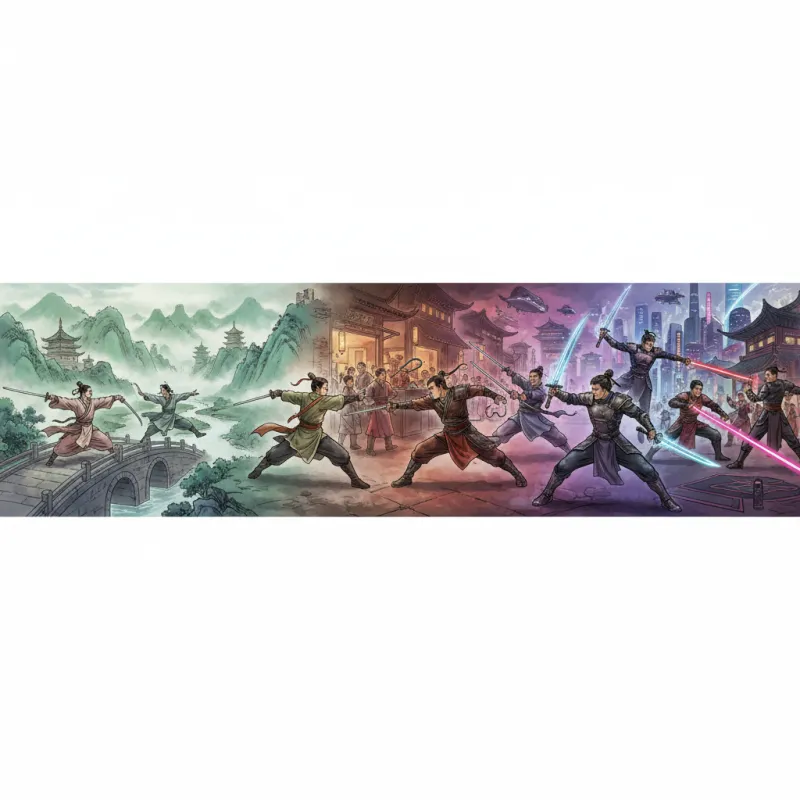
Picture this: A young swordsman in a sleek black suit deflects bullets with his blade while parkour-vaulting across Shanghai rooftops, his movements captured in slow-motion as electronic music pulses through the scene. This isn't your grandfather's wuxia—but somehow, it still is. The genre that gave us flying warriors and righteous wanderers has shape-shifted through the centuries, absorbing everything from Hong Kong cinema to video game mechanics, yet the heart beating beneath all that chrome and CGI remains unmistakably wuxia.
From Teahouse Storytellers to Netflix Queues
The transformation of wuxia didn't happen overnight, and it certainly didn't happen in a vacuum. When Jin Yong (金庸, Jīn Yōng) serialized The Legend of the Condor Heroes in 1957, he was already modernizing the genre—tightening narrative structures, developing psychological depth, creating female characters who could hold their own against any male hero. But Jin Yong was still writing for newspaper readers who understood the classical references, who knew what it meant when someone practiced the Eighteen Dragon-Subduing Palms (降龍十八掌, Jiàng Lóng Shíbā Zhǎng).
Fast forward to 2000, and Ang Lee's Crouching Tiger, Hidden Dragon introduced wuxia to audiences who'd never heard the term. Suddenly, the genre had to explain itself to people who didn't grow up with these stories. The film's success proved that wuxia's core appeals—the fantasy of mastery, the romance of the wandering life, the moral clarity of the jianghu (江湖, jiānghú)—transcended cultural boundaries. But it also marked a turning point: wuxia would now be in constant conversation with global audiences and their expectations.
The Video Game Revolution and Interactive Jianghu
Nothing has reshaped modern wuxia quite like video games. When Sword and Fairy (仙劍奇俠傳, Xiānjiàn Qíxiá Zhuàn) launched in 1995, it translated wuxia into a medium where players could be the wandering hero, making choices about which sect to join, which martial arts to master, which romantic subplot to pursue. The genre's inherent gamification—leveling up through training, collecting legendary weapons, defeating increasingly powerful opponents—turned out to be perfectly suited for RPG mechanics.
But here's where it gets interesting: the games started influencing the literature. Contemporary wuxia novels, especially web serials, now feature explicit "power systems" with numbered levels and ranked techniques. Characters discuss their cultivation stages (修為, xiūwéi) with the precision of game stats. Some purists hate this trend, arguing it reduces the poetic ambiguity of classical wuxia to mere number-crunching. Others see it as a natural evolution—after all, wasn't Jin Yong already doing something similar when he carefully calibrated his heroes' abilities to create dramatic tension?
The cultivation novel (修真小說, xiūzhēn xiǎoshuō) subgenre takes this even further, blending wuxia with fantasy elements and explicit progression systems. Works like Coiling Dragon and I Shall Seal the Heavens have massive international followings, their protagonists grinding through cultivation realms like players in an MMORPG. This is wuxia filtered through gaming culture, and it's arguably the most popular form of the genre among readers under thirty.
Urban Wuxia and the Concrete Jianghu
The jianghu used to mean misty mountains, remote temples, and villages where everyone knew the local martial arts master. Modern wuxia has dragged this mythical space into the city. In works like City of Darkness and the Ip Man film series, the jianghu exists in Hong Kong's Kowloon Walled City, in underground fight clubs, in the territories controlled by rival martial arts schools operating as street gangs.
This urban transplantation forces wuxia to confront modernity head-on. What happens to the wandering swordsman when there are security cameras everywhere? How do secret martial arts techniques survive in an age of YouTube tutorials? Some stories treat this tension as tragedy—the last practitioners of authentic kung fu struggling against a world that no longer values their skills. Others embrace the absurdity: imagine a qinggong (輕功, qīnggōng) master using his lightness technique to parkour between skyscrapers, or a poison expert working as a pharmacist.
The best urban wuxia doesn't just relocate the tropes; it interrogates them. What does xia (俠, xiá)—that untranslatable concept of righteous heroism—mean in a modern legal system? Can you be a wandering hero when everyone has a smartphone and a permanent digital footprint? These questions give contemporary wuxia a philosophical depth that complements rather than replaces the genre's traditional concerns with honor and loyalty.
Western Fantasy Meets Eastern Martial Arts
The cross-pollination between wuxia and Western fantasy has produced some genuinely weird and wonderful hybrids. The Poppy War by R.F. Kuang grafts wuxia-style martial arts onto a grimdark fantasy framework inspired by Chinese history. Jade City by Fonda Lee reimagines wuxia clans as mafia families in a setting that feels like Hong Kong meets The Godfather. These aren't just wuxia stories with Western elements sprinkled on top—they're genuine fusions that create something new.
Meanwhile, Western fantasy has been quietly absorbing wuxia techniques for years. The magic systems in Brandon Sanderson's novels, with their emphasis on training, progression, and internal energy manipulation, owe a clear debt to cultivation fiction. The popularity of progression fantasy as a subgenre demonstrates how wuxia's approach to power development has influenced global fantasy literature.
This cultural exchange runs both ways. Chinese web novels now routinely incorporate Western fantasy elements—magic systems, dungeon crawling, even isekai-style transportation to other worlds. The result is a global fantasy ecosystem where a Chinese reader might follow a cultivation novel featuring a protagonist who gets transported to a Western-style fantasy world, while an American reader devours a progression fantasy clearly inspired by wuxia training montages.
The Streaming Era and Wuxia's Global Moment
Netflix's investment in Chinese dramas like The Untamed and Word of Honor has introduced wuxia to audiences who would never have sought it out otherwise. These productions represent a fascinating compromise: they're made primarily for Chinese audiences but with an awareness of international viewers. The result is wuxia that's more accessible than classical adaptations but less radically modernized than some contemporary web novels.
The Untamed, adapted from the web novel Grandmaster of Demonic Cultivation, became a global phenomenon despite—or perhaps because of—its unapologetic wuxia-ness. It didn't dumb down the genre conventions or over-explain the cultural context. Instead, it trusted viewers to follow along, to pick up the meaning of terms like cultivation and core formation through context. The show's success suggests that modern audiences are willing to meet wuxia on its own terms, provided the storytelling is compelling enough.
Streaming platforms have also enabled a new kind of wuxia production: high-budget series that can afford the wire work, CGI, and fight choreography that the genre demands. Shows like The Longest Day in Chang'an demonstrate how historical drama can incorporate wuxia elements without fully committing to the genre's more fantastical aspects. This middle ground—call it "wuxia-adjacent"—might be where the genre finds its largest modern audience.
The Eternal Return: What Stays, What Changes
For all the evolution, certain elements remain non-negotiable. The master-disciple relationship still anchors most wuxia narratives, whether it's a traditional shifu teaching sword forms or a cultivation novel's protagonist learning from an ancient spirit trapped in a ring. The tension between orthodox and unorthodox paths (正邪, zhèng xié) persists, even when "orthodox" means a corporate martial arts academy and "unorthodox" means underground fight clubs.
The concept of wulin (武林, wǔlín)—the martial arts community with its own rules and hierarchies—adapts but endures. Modern wuxia might replace sect rankings with tournament brackets or social media follower counts, but the fundamental idea remains: there's a world within the world, a community of practitioners who understand things outsiders cannot.
What's genuinely new is the self-awareness. Contemporary wuxia often plays with genre conventions, acknowledging and subverting reader expectations. A protagonist might recognize they're in a typical "revenge against the sect that betrayed them" storyline and try to short-circuit it. This meta-textual quality, borrowed from postmodern literature and internet culture, gives modern wuxia a playful quality that coexists with—rather than undermines—its earnest emotional core.
The Future Is Already Here
The next evolution of wuxia is happening right now in web serials, mobile games, and international collaborations. Virtual reality promises to make the jianghu fully immersive—imagine actually performing sword forms, feeling the flow of qi (氣, qì) through your virtual meridians. AI-generated stories are already producing wuxia narratives, though they tend toward the formulaic (then again, so do many human-written web novels).
What won't change is the fundamental appeal: the fantasy of transcendence through discipline, the romance of a life unbound by conventional society, the moral clarity of a world where skill and character matter more than birth or wealth. These desires are human universals, which is why wuxia keeps finding new audiences even as it transforms to meet them.
The genre that began with Tang Dynasty tales of knight-errants has survived imperial dynasties, communist revolution, and globalization. It's absorbed influences from Japanese manga, Korean manhwa, Western fantasy, and video game design. Through it all, wuxia remains recognizably itself—a testament to the genre's core strength and flexibility. The wandering hero might now carry a smartphone instead of a sword, but they're still wandering, still seeking, still embodying that untranslatable ideal of xia. And that, ultimately, is what makes wuxia eternal.
Related Reading
- Shanhai Jing Creatures in Modern Video Games
- Chinese Mythology in Hollywood: From Mulan to Shang-Chi
- Shanhai Jing in Modern Art: Contemporary Illustrations of Ancient Beasts
- The Complete Guide to Wuxia: China's Martial Arts Fiction Tradition
- Exploring the Intricate World of Wuxia: Legends, Culture, and Kung Fu Novels
- Lingzhi: The Mushroom of Immortality from Myth to Medicine
Explore Chinese Culture
- Explore Jin Yong's martial arts novels
- Explore cultivation fiction and immortal heroes
- Explore the real history behind wuxia