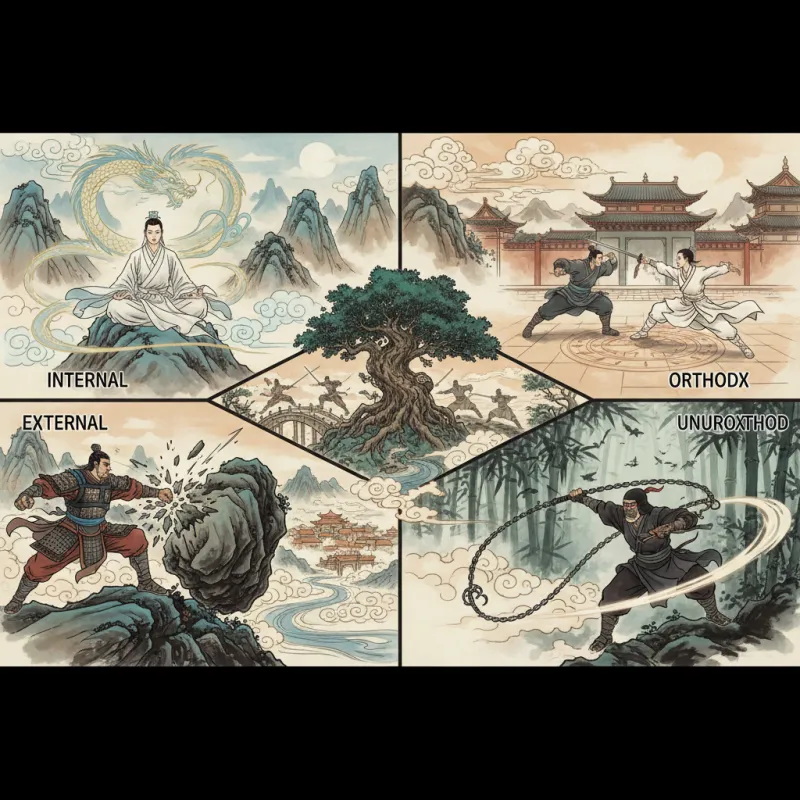
Every wuxia hero faces the same choice: punch harder or breathe deeper. Zhang Wuji spends years mastering the Nine Yang Divine Skill before he throws a single proper strike. Xiao Feng needs no meditation—his Eighteen Dragon-Subduing Palms are pure, devastating technique. Both become legends, but they walk fundamentally different paths through the martial world.
The Foundation: Internal Power vs External Technique
The distinction between internal cultivation (内功, nèigōng) and external technique (外功, wàigōng) isn't just philosophical window dressing—it's the engine that drives every fight scene, training montage, and power-up moment in wuxia fiction. Internal power is the cultivation of qi (气, qì), that vital energy flowing through your body's meridians like electricity through copper wire. External technique is everything else: the forms, the strikes, the footwork, the weapons mastery.
Here's what matters: internal power is a multiplier. A martial artist with deep internal cultivation can amplify ordinary techniques into extraordinary ones. They heal faster, resist poisons, project force without touching their opponent, and—most importantly—they keep getting stronger as they age while external practitioners peak and decline. The Condor Heroes' Zhou Botong is still a menace in his seventies precisely because his internal foundation never erodes.
External techniques, meanwhile, are about precision and application. You can have bottomless internal power, but without proper technique, you're just a battery with no device to plug into. This is why Guo Jing, despite his legendary internal strength from the Nine Yin Manual, still needed to master the Eighteen Dragon-Subduing Palms to become truly formidable. The technique gives the power somewhere to go.
Orthodox vs Unorthodox: More Than Good and Evil
The orthodox (正派, zhèngpài) versus unorthodox (邪派, xiépài) divide is wuxia's most misunderstood dichotomy. Western readers often map it onto "good versus evil," but that's not quite right. Orthodox sects like Shaolin, Wudang, and the Kunlun School represent establishment power—they're the Harvard and Yale of the martial world, with centuries of accumulated prestige and political influence. Unorthodox sects are the outsiders, the innovators, the ones who don't play by Confucian rules.
The Ming Cult in The Heaven Sword and Dragon Saber is the perfect example. They're branded as unorthodox demons by the establishment, but their actual ethics are often more principled than their orthodox opponents. They're unorthodox because they challenge the social order, not because they're inherently evil. Meanwhile, plenty of orthodox sect members are petty, corrupt, or outright villainous—they just have better PR.
What really separates orthodox from unorthodox is methodology and philosophy. Orthodox martial arts emphasize gradual cultivation, respect for tradition, and techniques that align with Confucian and Buddhist principles. They're the slow, steady path. Unorthodox methods are faster, riskier, and often involve shortcuts that orthodox practitioners consider dangerous or improper. The Sunflower Manual requires self-castration. The Star-Absorbing Great Technique lets you steal others' internal power but risks qi deviation. These aren't "evil" techniques—they're just techniques the establishment won't touch.
The Hybrid Path: Why the Best Heroes Mix Both
Jin Yong understood something crucial: the most interesting characters transcend these categories. Linghu Chong learns the unorthodox Star-Absorbing Great Technique despite being from the orthodox Huashan Sect. Yang Guo combines orthodox Quanzhen techniques with the unorthodox Toad Stance he learned from Ouyang Feng. Duan Yu accidentally cultivates the Beiming Divine Skill (unorthodox power absorption) while trying to be a pacifist Buddhist scholar.
This mixing isn't just narrative convenience—it reflects a deeper truth about martial arts philosophy. The rigid categorization is a social construct, not a natural law. Qi is qi, whether you cultivate it through Taoist meditation or demonic absorption techniques. A palm strike is a palm strike, whether it comes from Shaolin or the Demon Cult. The labels matter for politics and sect identity, but in actual combat, what matters is effectiveness.
The greatest martial artists in wuxia are almost always synthesizers. They take the best from multiple traditions and forge something new. This is why Dugu Qiubai's Nine Swords of Dugu, which has no fixed forms and adapts to counter any technique, represents the pinnacle of martial achievement. It transcends the orthodox-unorthodox divide entirely by rejecting rigid categorization in favor of pure principle.
Cultivation Methods: The Slow Burn vs The Quick Fix
Orthodox internal cultivation follows a predictable path: sit in meditation, circulate your qi through the meridians, gradually expand your dantian (丹田, dāntián—the energy center below your navel), and after a decade or three, you might achieve something impressive. It's safe, it's stable, and it's boring as hell to read about, which is why Jin Yong's heroes almost never follow this path.
Unorthodox methods offer shortcuts, and shortcuts make for better stories. Find a mysterious manual in a cave. Absorb the internal power of defeated enemies. Consume a thousand-year-old ginseng root. Get thrown into a valley full of bodhi snakes whose venom somehow supercharges your meridians. These methods are faster but riskier—qi deviation (走火入魔, zǒuhuǒ rùmó) is always lurking, ready to scramble your meridians and turn you into a drooling vegetable if you push too hard.
The risk-reward calculation is what makes these systems dramatically interesting. When Wei Xiaobao stumbles into power through sheer dumb luck, it's comedy. When Xiao Feng refuses to take shortcuts despite his tragic circumstances, it's heroic. When Yue Buqun secretly practices the evil-warding sword manual to gain power, it's a corruption arc. The cultivation method reveals character.
Combat Applications: Theory Meets Practice
All this internal-external, orthodox-unorthodox philosophy means nothing if you can't win fights. In actual combat, wuxia martial arts systems create a rock-paper-scissors dynamic that's more complex than simple power levels.
Deep internal power beats pure external technique in wars of attrition—the internal practitioner simply outlasts their opponent. But refined external technique can defeat raw internal power through precision and efficiency—why use a sledgehammer when a scalpel works better? Unorthodox methods often counter orthodox ones through sheer unpredictability, but orthodox foundations provide stability that unorthodox practitioners lack in extended campaigns.
This is why the best fight scenes in wuxia aren't just about who has more power—they're about style matchups and tactical adaptation. When Linghu Chong faces Zuo Lengchan, he wins not through superior power but by using the Dugu Nine Swords to exploit the weaknesses in Zuo's orthodox Songshan techniques. When Zhang Wuji fights the Six Major Sects, his Nine Yang internal power lets him tank their attacks while he figures out their patterns. Different problems require different solutions.
The Meta-System: Why These Rules Matter
Understanding wuxia martial arts systems isn't just about following fight choreography—it's about understanding the genre's core values and tensions. The internal-external divide reflects the Taoist principle that inner cultivation matters more than outer achievement. The orthodox-unorthodox split mirrors Chinese society's eternal tension between Confucian order and individual freedom. The hybrid path represents the synthesis that Chinese philosophy always seeks.
These systems also create narrative possibility space. When you establish that internal power takes decades to cultivate, finding a shortcut becomes a plot event. When you establish that orthodox and unorthodox sects hate each other, a romance between their members becomes forbidden and therefore interesting. When you establish that certain techniques require terrible sacrifices, choosing whether to learn them becomes a character-defining moment.
Modern wuxia and xianxia fiction has expanded these systems into increasingly elaborate cultivation hierarchies—Foundation Establishment, Golden Core, Nascent Soul, and so on. But the fundamental dynamics remain the same: internal versus external, orthodox versus unorthodox, slow cultivation versus dangerous shortcuts, and the eternal question of whether the ends justify the means. These aren't just martial arts systems—they're frameworks for exploring what it means to pursue power, mastery, and transcendence in a world where the impossible is merely difficult.
The next time you read about a hero choosing between a safe orthodox technique and a dangerous unorthodox manual, remember: they're not just choosing a fighting style. They're choosing who they want to become. And in the jianghu, that choice echoes through every battle, every alliance, and every legend that follows.
Related Reading
- Wudang vs Shaolin: Two Philosophies of Combat
- The Greatest Palm Techniques in Wuxia Fiction, Ranked
- Acupoint Striking (Dianxue): The Deadly Art of Pressure Points
- External vs. Internal Martial Arts: The Great Divide in Wuxia
- Exploring the Intricate World of Wuxia: Legends, Culture, and Kung Fu Novels
- Legendary Weapons of Wuxia: The Swords That Have Names
- Animal Spirits and the Path to Becoming Yaoguai
- Unraveling the Mystique of Wuxia: The Philosophy Behind Jianghu Culture and Kung Fu Novels
Explore Chinese Culture
- Explore Jin Yong's martial arts novels
- Explore cultivation fiction and immortal heroes
- Explore the real history behind wuxia