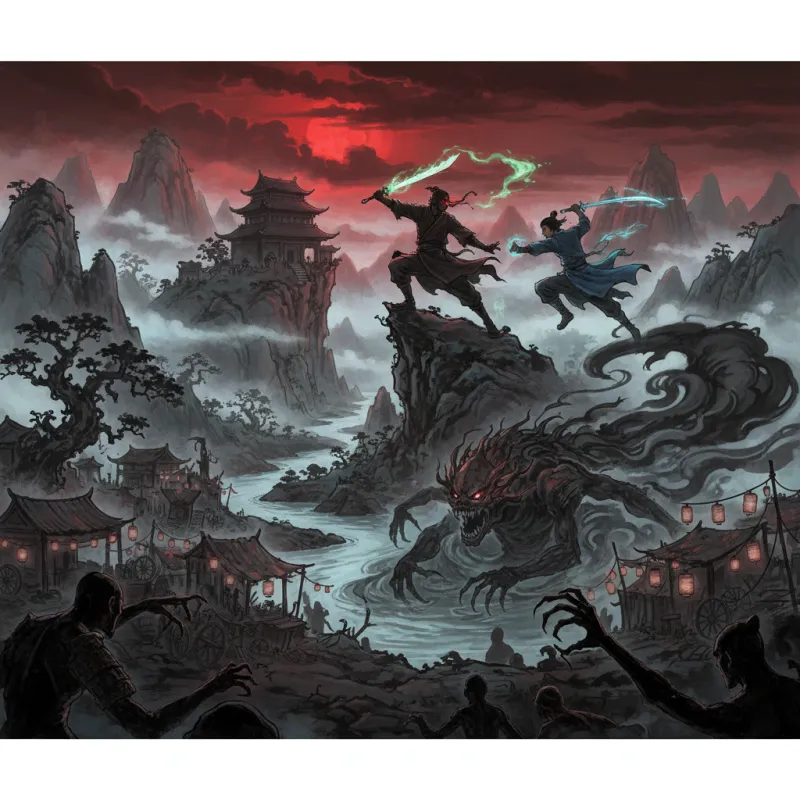
The ghost in A Chinese Ghost Story (1987) doesn't just want to scare you — she wants to be saved. That single detail reveals everything about why Chinese horror cinema operates on a completely different wavelength than its Western counterparts. While Hollywood churns out masked killers and demonic possessions, Chinese horror filmmakers draw from a 2,000-year-old tradition where ghosts are bureaucrats in the afterlife, love transcends death, and the scariest thing isn't a jump scare but the cosmic consequences of dishonoring the dead.
The Foundation: Ghost Lore and the Underworld Bureaucracy
Chinese horror films don't invent their supernatural rules — they inherit them from Strange Tales from a Chinese Studio (聊斋志异 Liáozhāi Zhìyì), Pu Songling's 18th-century collection of ghost stories that established the template. In this tradition, the afterlife operates like an imperial government, complete with judges, clerks, and endless red tape. The Ten Courts of Hell (十殿阎罗 shí diàn yánluó) process souls based on their earthly deeds, which means ghosts aren't random monsters — they're individuals with grievances, unfinished business, or administrative errors in their death records.
This framework gives Chinese horror its distinctive emotional texture. The Eye (2002) by the Pang Brothers doesn't just show a woman seeing ghosts after a cornea transplant — it explores the Buddhist concept that sight itself can be a curse when it reveals the suffering of trapped spirits. The protagonist isn't fighting demons; she's witnessing the cosmic machinery of karma grinding away at souls who can't move forward. That's existential dread on a level that machetes and chainsaws can't touch.
The Golden Age: 1980s Hong Kong and the Jiangshi Renaissance
The 1980s Hong Kong film industry turned the hopping vampire (僵尸 jiāngshī) into a cultural phenomenon that blended horror with martial arts choreography and slapstick comedy. Mr. Vampire (1985) remains the definitive example — a film where Daoist priests (道士 dàoshì) battle reanimated corpses using yellow talismans (符咒 fúzhòu), sticky rice, and impeccable wu xia fight choreography. The jiangshi itself is a uniquely Chinese monster: a corpse that hops because rigor mortis has locked its joints, dressed in Qing Dynasty official robes, and animated by residual qi (气 qì) rather than demonic possession.
What makes this era remarkable is how it weaponized Chinese metaphysical concepts as literal plot devices. In Encounters of the Spooky Kind (1980), Sammo Hung's character survives supernatural attacks through martial arts training that doubles as spiritual cultivation. The film treats internal energy cultivation (内功 nèigōng) as both a fighting technique and ghost-repelling force — a concept that wuxia readers will recognize from novels like The Legend of the Condor Heroes, where advanced martial artists can sense and resist supernatural threats. This cross-pollination between martial arts philosophy and horror created a subgenre that no other cinema tradition could replicate.
The Art House Turn: Atmospheric Dread and Historical Trauma
While Hong Kong perfected the action-horror hybrid, mainland Chinese and Taiwanese directors took horror into more psychologically complex territory. A Chinese Ghost Story (1987) remains the touchstone — a film that wraps a tragic love story in layers of Daoist cosmology, swordplay, and genuinely unsettling imagery. The ghost Nie Xiaoqian (聂小倩 Niè Xiǎoqiàn) isn't evil; she's enslaved by a tree demon and forced to seduce men to their deaths. The scholar Ning Caichen (宁采臣 Níng Cǎichén) falls in love with her anyway, and the film becomes a meditation on whether love can survive the bureaucratic machinery of the underworld.
This emotional complexity reached its peak in films like Rouge (1987), where a 1930s courtesan ghost returns to modern Hong Kong searching for her lost love. The horror isn't supernatural — it's the realization that the man she died for has forgotten her, choosing survival over romantic ideals. Director Stanley Kwan uses the ghost story framework to explore how Hong Kong's rapid modernization erased its own history, making the past itself a kind of haunting presence.
The Eye (2002) and Inner Senses (2002) continued this tradition of using horror to process collective trauma. Both films feature protagonists who see ghosts everywhere in modern Hong Kong — a metaphor for a city haunted by its colonial past and uncertain future after the 1997 handover to China. The ghosts aren't the real horror; it's the living characters' inability to escape their own psychological prisons.
The New Wave: J-Horror Influence and Technical Innovation
The early 2000s saw Chinese horror filmmakers absorbing techniques from Japanese horror cinema while maintaining distinctly Chinese supernatural logic. The Pang Brothers' The Eye borrowed J-horror's slow-burn dread and long-haired ghost imagery but grounded it in Buddhist philosophy about sight and suffering. Dumplings (2004) by Fruit Chan took body horror to extremes with a story about a woman eating fetus-filled dumplings to regain youth — a grotesque literalization of traditional Chinese medicine's more controversial practices.
This era also produced Re-cycle (2006), the Pang Brothers' most ambitious film, which sends a writer into a literal underworld made of abandoned ideas and aborted fetuses. The film's second half abandons horror entirely for a surreal journey through Buddhist hell realms, complete with CGI landscapes that visualize the concept of karmic consequences in ways that traditional ghost stories could only describe.
Regional Variations: Thai-Chinese Horror and the Southeast Asian Connection
The Thai film industry's embrace of Chinese supernatural traditions created a fascinating hybrid. Shutter (2004), while technically Thai, draws heavily on Chinese ghost lore about vengeful spirits who appear in photographs — a modern update of the traditional belief that cameras can capture spiritual energy. The film's twist ending, where the ghost has been literally weighing down the protagonist's shoulders, visualizes the Chinese concept of karmic debt (业障 yèzhàng) as physical burden.
The Maid (2005), a Singaporean-Chinese production, uses the Hungry Ghost Festival (中元节 Zhōngyuán Jié) as its framework — the seventh lunar month when the gates of hell open and spirits roam freely. The film treats this not as superstition but as observable reality, with specific rules about offerings, incense, and proper respect for the dead. Breaking these rules has immediate, terrifying consequences, making the horror feel culturally specific rather than universally applicable.
Contemporary Masters: Psychological Horror and Social Commentary
Recent Chinese horror has moved away from overt supernatural elements toward psychological dread rooted in social anxieties. The Looming Storm (2017) uses noir aesthetics and mounting paranoia to create horror from surveillance state mechanisms rather than ghosts. The Sleep Curse (2017) returns to Category III exploitation roots with a story about Japanese war crimes and intergenerational trauma, using extreme violence to force audiences to confront historical atrocities.
Detention (2019), adapted from a Taiwanese video game, sets its horror during the White Terror period of martial law, where the real monsters are government informants and political persecution. The ghosts that haunt the school are victims of state violence, and the protagonist's journey through supernatural trials becomes a metaphor for Taiwan's struggle to process its authoritarian past. This approach — using supernatural horror as political allegory — has deep roots in Chinese literature, where ghost stories often critiqued imperial corruption when direct criticism was dangerous.
Why It Still Matters: The Emotional Architecture of Chinese Horror
Chinese horror films succeed because they're built on an emotional architecture that Western audiences often miss. The ghosts aren't random threats — they're family members, lovers, or victims of injustice who cannot rest until cosmic balance is restored. This connects directly to Confucian values about filial piety (孝 xiào) and ancestor veneration, where neglecting the dead is both a moral failure and a supernatural danger.
When A Chinese Ghost Story shows Ning Caichen risking his life to free Xiaoqian from demonic slavery, it's not just romantic heroism — it's a scholar-warrior embodying the Confucian ideal of righteousness (义 yì) that wuxia novels celebrate. The film works as horror, romance, and martial arts epic simultaneously because all three genres draw from the same cultural well.
The best Chinese horror films understand that true terror comes not from what jumps out of the darkness, but from the realization that the darkness has rules, hierarchies, and bureaucratic procedures — and you've just violated all of them. That's a fear that transcends culture, even if its specific manifestations are uniquely Chinese.
Related Reading
- Chinese Internet Ghost Stories: The Creepypasta of the East
- Unraveling the Mystique of Wuxia: Horror Elements in Chinese Martial Arts Fiction
- Chinese Horror Novels That Will Keep You Up at Night
- Legend of the Condor Heroes: A Complete Reading Guide
- Sun Wukong: The Great Sage Who Challenged Heaven
- The Enigmatic World of Jianghu: A Deep Dive into Wuxia Fiction and Kung Fu Novels
Explore Chinese Culture
- Explore Jin Yong's martial arts novels
- Explore cultivation fiction and immortal heroes
- Explore the real history behind wuxia