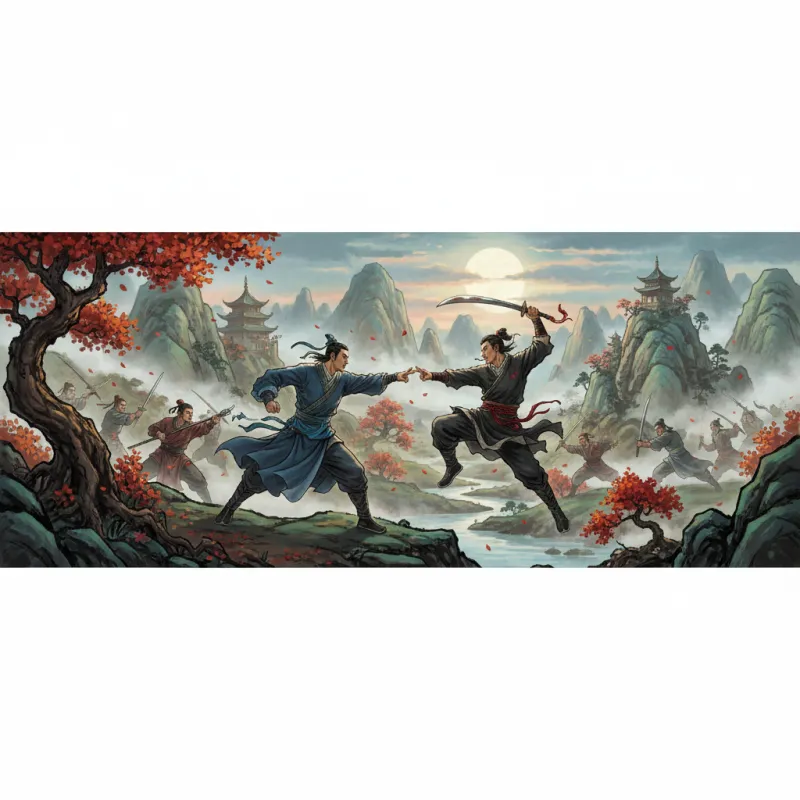
A master's finger hovers an inch from your chest. You can't see the strike coming — it's too fast, too precise. One tap, and your arm drops uselessly to your side. Another, and your voice dies in your throat. A third touch, and you collapse, fully conscious but unable to move a muscle. This isn't magic. In the world of wuxia, this is 点穴 (diǎnxué) — acupoint striking — and it's the martial art that turns the human body into a battlefield of invisible vulnerabilities.
The Medical Foundation Behind the Fiction
Acupoint striking didn't emerge from a novelist's imagination. It's rooted in Traditional Chinese Medicine's map of the human body: 361 acupuncture points (穴位 xuéwèi) distributed along fourteen meridian channels (经络 jīngluò) that supposedly carry 气 (qì) — vital energy — throughout the body. Ancient physicians used needles to stimulate these points for healing. Martial artists asked a darker question: what happens if you strike them instead?
The logic is brutally simple. If acupuncture can regulate qi flow, then a precisely delivered blow can disrupt it. Block the wrong meridian, and you cut off energy circulation to a limb. Strike a major confluence point, and you can trigger paralysis, unconsciousness, or — in the most dramatic fictional interpretations — delayed death. The medical theory provides just enough plausibility to make the martial application feel real, even when wuxia authors push it far beyond anything a real acupuncturist would recognize.
This fusion of medicine and martial arts isn't unique to pressure point techniques, but diǎnxué takes it further than most. Where Internal Energy Cultivation focuses on building and circulating qi, acupoint striking is about weaponizing anatomical knowledge. It's the difference between being a mechanic and being a saboteur.
The Mechanics of a Perfect Strike
Not every poke is diǎnxué. The technique demands three elements working in concert: precision, timing, and internal force. Miss the exact location by half an inch, and you've just jabbed someone ineffectively. Strike at the wrong moment in the body's natural qi cycle, and the effect dissipates. Apply force without proper 内功 (nèigōng) backing it, and you might as well be tapping someone's shoulder.
The precision requirement is what makes acupoint striking such an elite skill in wuxia fiction. Characters need encyclopedic knowledge of human anatomy — not just where the points are, but how they connect, which meridians they govern, and what effects result from striking them in combination. In Jin Yong's The Smiling, Proud Wanderer, the character Peach Valley's Six Immortals are comedically incompetent at diǎnxué precisely because they memorized point locations without understanding the underlying meridian theory. They seal the wrong points, or seal them in the wrong order, creating bizarre effects instead of clean paralysis.
Timing adds another layer of complexity. Traditional Chinese Medicine teaches that qi flows through different meridians at different times of day, following a two-hour cycle through all twelve primary channels. A true diǎnxué master accounts for this. The Tiantu point (天突 tiāntū) on the throat might be most vulnerable between 3-5 AM when qi flows through the lung meridian. Strike it at noon, and the effect is diminished. This temporal dimension rarely gets detailed attention in wuxia novels — it would slow the action to a crawl — but it's implied in scenes where masters comment on "the hour being right" for certain techniques.
The Signature Techniques
Wuxia fiction has developed a rich vocabulary of specific diǎnxué applications, each with its own dramatic purpose. The most common is simple immobilization — the 定身法 (dìngshēnfǎ) or "body-fixing technique" that freezes an opponent in place. This is the go-to move for capturing enemies alive, stopping fights without killing, or setting up dramatic confrontations where the hero must talk their way out of danger while paralyzed.
Then there's the mute point — sealing the Yamen acupoint (哑门 yǎmén) at the base of the skull to rob someone of speech. Villains love this one. It's perfect for silencing witnesses, preventing martial artists from shouting warnings, or creating tension when the hero knows crucial information but can't communicate it. Gu Long uses this technique repeatedly in his novels, often with a sadistic twist where the victim can still scream but can't form words.
The most feared application is delayed death — striking points that won't kill immediately but set a timer on the victim's life. The classic scenario involves a villain sealing someone's acupoints in a pattern that will cause death in seven days, or when the next full moon rises, or when the victim experiences strong emotion. This creates narrative urgency and gives heroes a deadline to find the antidote or the master who can unseal the points. In Demi-Gods and Semi-Devils, Jiumozhi uses a variation of this against Duan Yu, sealing points that will gradually drain his internal energy unless released.
The Unsealing Problem
Every sealed acupoint creates a puzzle: how do you undo it? This is where wuxia authors get creative with their rules. The simplest solution is that acupoints unseal themselves after a set time — usually two hours, corresponding to one complete cycle through a meridian. This is convenient for plots where the hero needs to be temporarily disabled but not permanently.
More complex sealings require active intervention. Someone with superior diǎnxué knowledge must strike the same points in reverse order, or strike complementary points that restore qi flow. This creates a hierarchy of expertise — not everyone who can seal points can unseal them, and some masters specialize in one or the other. In Jin Yong's works, the Peach Blossom Island school is renowned for both sealing and unsealing techniques, making them valuable allies and dangerous enemies.
The most dramatic unsealing scenarios involve Internal Energy Cultivation breakthroughs. A character with sufficient nèigōng can force qi through blocked meridians, essentially overwhelming the seal with raw power. This is the martial arts equivalent of rebooting a computer — crude but effective. It also serves as a plot device for demonstrating a character's growth. When someone who was previously helpless against diǎnxué can suddenly break through seals with internal force, readers know they've reached a new level.
Historical Reality vs. Wuxia Fantasy
Let's be clear: the diǎnxué of wuxia novels is fantasy. Real martial arts do include strikes to vulnerable anatomical points — nerve clusters, blood vessels, joints — and these can cause pain, temporary dysfunction, or unconsciousness. But the instant paralysis, the precise meridian manipulation, the delayed death effects? Those are literary inventions built on a foundation of medical theory.
That said, the fantasy isn't entirely baseless. Dim Mak (点脉 diǎnmài), the "death touch" of Chinese martial arts legend, has been discussed in martial arts circles for centuries. Some traditional kung fu styles teach strikes to specific body points with claimed effects ranging from pain compliance to organ damage. The disconnect is in precision and reliability. Real pressure point strikes are probabilistic — they might work, they might not, depending on individual anatomy, pain tolerance, and a dozen other factors. Wuxia diǎnxué is deterministic — strike the right point correctly, and the effect is guaranteed.
The medical community's view is skeptical but not entirely dismissive. Acupuncture's effectiveness for pain management has some clinical support, even if the mechanism isn't what traditional theory claims. Neurologists acknowledge that certain nerve strikes can cause temporary paralysis or pain. But the idea of sealing qi flow through meridians? That's where modern medicine and traditional theory part ways. Qi itself remains undetectable by scientific instruments, making any martial technique based on manipulating it impossible to verify.
The Narrative Power of Pressure Points
Why has diǎnxué become such a staple of wuxia fiction? Because it's narratively perfect. It allows for non-lethal combat in a genre that could otherwise devolve into endless killing. It creates instant power hierarchies — the master who can seal your acupoints is clearly superior, no lengthy fight scene needed. It generates tension through vulnerability — even the mightiest warrior can be defeated by a single precise strike if they're caught off guard.
More subtly, acupoint striking embodies a very Chinese approach to conflict: knowledge and precision over brute force. The diǎnxué master wins through understanding the body's hidden architecture, not through superior strength or speed. This aligns with broader themes in Chinese philosophy about working with natural patterns rather than against them. It's the martial equivalent of the Daoist concept of 无为 (wúwéi) — effortless action achieved through deep understanding.
Compare this to how Sword Techniques function in wuxia. Swordsmanship is about grace, speed, and the extension of the warrior's will through a weapon. Diǎnxué is about intimate knowledge of the opponent's body, turning their own physiology against them. Both are elegant, but diǎnxué has an intellectual quality that makes it particularly suited to wise masters and cunning strategists rather than pure warriors.
Learning the Art
In wuxia novels, learning diǎnxué is never quick. It requires years of study — first memorizing the locations of all 361 acupoints, then understanding the meridian connections, then developing the finger strength and internal force to strike effectively. Many characters know the theory but lack the practical skill. Others have the physical ability but insufficient anatomical knowledge.
The training often involves striking practice on wooden dummies marked with acupoint locations, or on fellow students (carefully, one hopes). Some schools use meditation and visualization to internalize the meridian map until it becomes second nature. The most dedicated practitioners study actual medical texts, learning acupuncture theory alongside their martial training. In The Heaven Sword and Dragon Saber, Zhang Wuji's medical knowledge from studying the Hu Qing Jing (胡青经) directly enhances his ability to both seal and unseal acupoints.
The physical conditioning is equally demanding. Diǎnxué typically uses finger strikes — one finger, two fingers, or sometimes the whole hand depending on the point and desired effect. This requires developing 指力 (zhǐlì) — finger strength — through exercises like finger push-ups, striking sand bags, or the classic training method of repeatedly jabbing fingers into containers of beans, then sand, then eventually iron pellets. The goal is fingers that can deliver focused force without injury to the striker.
The Counter-Game
As with any martial technique, diǎnxué spawned counter-techniques. The most straightforward defense is protective internal energy — maintaining a constant circulation of qi through the meridians so that external strikes can't disrupt the flow. This is why characters with profound nèigōng are often immune to acupoint sealing. Their internal force is simply too strong to be blocked by an external strike.
More sophisticated defenses involve shifting acupoint locations. Some advanced internal cultivation methods supposedly allow practitioners to temporarily relocate their acupoints, making them impossible to strike accurately. This is rare even in wuxia fiction — it's the kind of ability reserved for grandmasters or characters with unique constitutions. In Demi-Gods and Semi-Devils, Xuzhu's acupoints become difficult to seal after he absorbs the internal energy of multiple masters, not because they've moved but because the qi flow has become too chaotic to predict.
Another counter is simply speed and distance. Diǎnxué requires close contact and precise targeting. Maintain distance, keep moving, and the acupoint striker can't land their technique. This is why diǎnxué masters often pair the skill with Lightness Skill — they need the mobility to close distance and the agility to touch specific points on a moving target.
The most elegant counter, though, is superior diǎnxué knowledge. If you see your opponent moving to strike your Quchi point (曲池 qūchí), you can shift position to offer a less vulnerable point, or even position yourself so their strike accidentally hits a point that benefits you. This creates a meta-game where high-level diǎnxué practitioners are essentially playing chess with each other's bodies, each trying to outmaneuver the other's anatomical knowledge.
Related Reading
- The Greatest Palm Techniques in Wuxia Fiction, Ranked
- External vs. Internal Martial Arts: The Great Divide in Wuxia
- Exploring the Intricate World of Wuxia: Legends, Culture, and Kung Fu Novels
- Wudang vs Shaolin: Two Philosophies of Combat
- Martial Arts Systems in Wuxia: Internal vs External, Orthodox vs Unorthodox
- The Mountain Gods: Nature Deities in the Daoist Pantheon
- The Smiling Proud Wanderer: A Story About Freedom
- The Jianghu Code: Unwritten Rules That Govern the Martial World
Explore Chinese Culture
- Explore Jin Yong's martial arts novels
- Explore cultivation fiction and immortal heroes
- Explore the real history behind wuxia