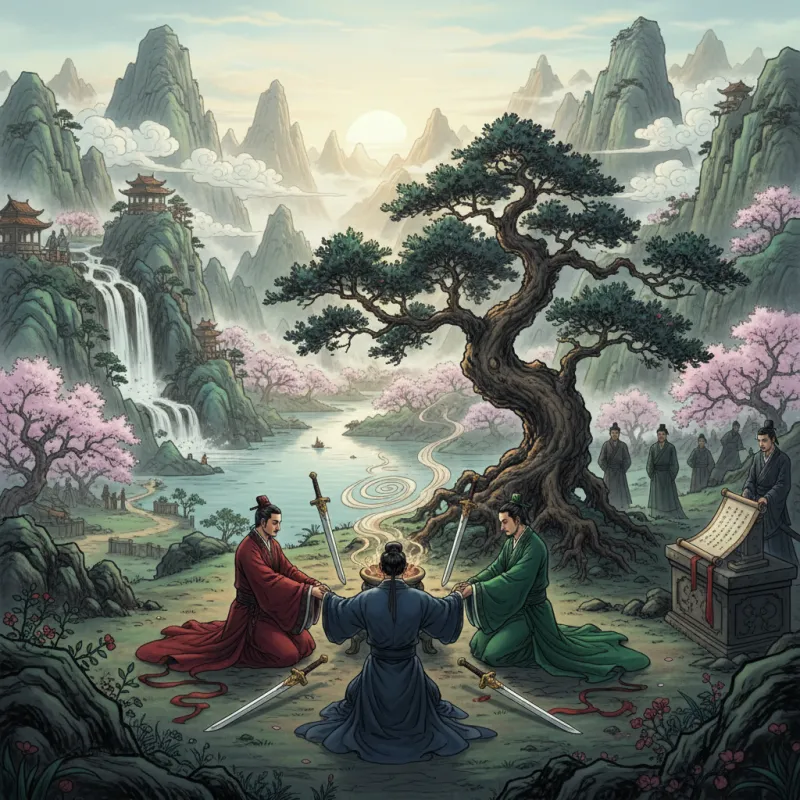
Three men kneel in a peach garden, their foreheads touching the earth. Incense smoke curls toward heaven. They speak in unison: "Though born on different days, we vow to die on the same day." Liu Bei, Guan Yu, and Zhang Fei — the most famous sworn brothers in Chinese history — set a template that would echo through centuries of martial arts fiction. But here's what the novels won't tell you: the jianghu version of this ritual is far more binding, far more dangerous, and far more likely to end in tragedy than the sanitized historical account.
The Sacred Mechanics of Jiéyì
The sworn brotherhood ritual — 结义 (jiéyì) or 结拜 (jiébài) — operates on a simple principle: you're choosing your family, and heaven is your witness. The basic structure appears in everything from Romance of the Three Kingdoms to Jin Yong's novels, but the details matter.
First, you need an altar. Outdoors is traditional — under a tree, in a garden, on a mountaintop. The location should feel significant, because you're making a contract with the cosmos itself. Indoor ceremonies happen, but they carry less weight. The altar holds three things: incense (always), wine cups (usually), and sometimes a written oath that gets burned after reading.
The participants kneel in age order. This is non-negotiable. The eldest becomes 大哥 (dàgē, big brother), the youngest becomes 小弟 (xiǎodì, little brother), and everyone in between gets numbered. In Gu Long's The Legend of Chu Liuxiang, when Chu Liuxiang, Hu Tiezhua, and Ji Bingyan perform their ceremony, they spend half an hour arguing about who's actually oldest because birth order determines authority for life.
Then comes the oath. The standard version goes: "We three, though born on different days, months, and years, vow to die on the same day, month, and year. Heaven above and earth below, bear witness to our hearts. If we betray this oath, may heaven and man strike us down." Some groups customize it. The Seven Freaks of Jiangnan in Legends of the Condor Heroes added a clause about protecting the Song Dynasty. The oath from Water Margin includes specific promises about sharing wealth and never abandoning each other in danger.
After the oath, you drink wine mixed with blood. This is where fiction diverges from history. Historical sworn brotherhoods used regular wine. Wuxia sworn brotherhoods cut their palms or fingers, drip blood into the cups, and drink. The blood mixing symbolizes literal kinship — you're putting each other's essence into your body. Some novels skip this part for squeamish readers, but the hardcore ones lean into it.
Why Anyone Would Do This
On the surface, sworn brotherhood looks like a beautiful gesture of friendship. In practice, it's a strategic alliance with emotional benefits.
Consider the math: in the jianghu, you need backup. Your biological family might be farmers in Henan who've never held a sword. Your sworn siblings are people who've saved your life, who know your fighting style, who'll show up when you send a distress signal. Jianghu codes of conduct demand loyalty to sworn kin above almost everything else.
The emotional component is real, though. Qiao Feng and Duan Yu in Demi-Gods and Semi-Devils become sworn brothers because they genuinely like each other. Their ceremony happens spontaneously after a drinking session — they're already acting like brothers, so they formalize it. The ritual gives them permission to love each other openly in a culture that doesn't have great vocabulary for male friendship.
But there's also a darker pragmatism. Sworn brotherhood creates obligations. If you're a mid-tier martial artist and you become sworn brothers with someone powerful, you've just bought insurance. If you're powerful and you accept a weaker sworn sibling, you've just acquired a loyal subordinate who can't refuse your requests without violating heaven's mandate.
The age hierarchy matters here. The 大哥 (big brother) has authority. When the Seven Freaks of Jiangnan disagree, Ke Zhen'e's word is final because he's eldest. This isn't democratic — it's a command structure disguised as family.
The Betrayal Problem
Here's the uncomfortable truth: sworn brotherhood betrayals drive half the plots in wuxia fiction. The bond is sacred, which makes breaking it the ultimate narrative transgression.
Water Margin is basically a 120-chapter meditation on this theme. Song Jiang leads 108 sworn brothers, and the novel tracks how that brotherhood fractures under pressure. Some betray for money, some for women, some because they're cowards. Each betrayal is treated as a cosmic horror — the text literally stops to editorialize about how the betrayer has violated the natural order.
In Jin Yong's work, the betrayals are more psychologically complex. Yue Buqun in The Smiling, Proud Wanderer never formally betrays his sworn brothers, but he manipulates the relationship so thoroughly that the bond becomes meaningless. He uses the language of brotherhood to demand loyalty while giving none in return. It's technically not betrayal, but it's spiritually worse.
The most famous betrayal in modern wuxia is probably Murong Fu's treatment of his sworn brothers in Demi-Gods and Semi-Devils. He swears brotherhood with four men, then systematically uses and discards them in his quest for power. Jin Yong makes it clear: Murong Fu's downfall isn't caused by his enemies, it's caused by his violation of jiéyì. Heaven itself punishes him.
The Gender Question
Women can participate in sworn brotherhood ceremonies, but the novels are weirdly inconsistent about it.
In The Book and the Sword, the Red Flower Society includes female sworn siblings, and they're treated as full members. In Demi-Gods and Semi-Devils, A'Zhu and A'Bi become sworn sisters in a ceremony that mirrors the male version exactly. But in many novels, women form separate sworn sisterhoods — 结拜姐妹 (jiébài jiěmèi) — that operate under slightly different rules.
The difference seems to be about romance. Male sworn brothers can't marry each other's sisters without it being weird. Female sworn sisters can't marry each other's brothers without it being weird. But cross-gender sworn siblings create a minefield of potential romantic complications. Some novels lean into this — the sworn sibling relationship becomes a way to maintain closeness with someone you're attracted to but can't marry. Other novels avoid it entirely by keeping the ceremonies gender-segregated.
There's also the practical issue that many jianghu organizations don't admit women, so sworn brotherhood becomes a male-only institution by default. The martial arts sects that do include women tend to have more flexible approaches to sworn kinship.
Modern Interpretations
Contemporary wuxia has gotten more cynical about sworn brotherhood. The classic novels treated it as genuinely sacred — betrayal was rare and shocking. Modern novels treat it as a social technology that people exploit.
In Gu Long's work, sworn brotherhood is almost always strategic. Characters perform the ritual because it's useful, not because they feel deep emotional bonds. The Eleventh Son features a sworn brotherhood that exists purely for business purposes — the brothers barely like each other, but the formal relationship gives them legal cover for their activities.
Phoenix Cry's Ballad of the Desert takes this further by having characters explicitly discuss the ritual's game theory. One character refuses to become sworn brothers with someone he genuinely likes because he doesn't want the hierarchical obligations. He'd rather have an equal friendship than a structured brotherhood.
The most interesting modern take might be in Grandmaster of Demonic Cultivation, where Wei Wuxian and Lan Wangji never perform a sworn brotherhood ceremony despite being closer than most sworn siblings in fiction. The novel suggests that the ritual might actually limit relationships — once you formalize the bond, you're locked into specific roles. Their refusal to perform the ceremony becomes a statement about choosing authentic connection over social structure.
What It Actually Means
Strip away the incense and blood and oaths, and sworn brotherhood is about creating chosen family in a world where biological family can't help you. The jianghu is full of orphans, exiles, and people whose birth families are liabilities. The ritual gives them a way to build kinship networks that function like clans.
The tragedy is that it works too well. The bond is so strong that it becomes a weapon. Villains exploit it to control people. Heroes die because they can't abandon sworn siblings even when they should. The ritual that's supposed to create safety becomes a source of vulnerability.
But people keep doing it, in novel after novel, because the alternative is worse. Better to risk betrayal than face the jianghu alone. Better to have sworn siblings who might disappoint you than no siblings at all. The ritual persists not because it's perfect, but because it's necessary.
When Qiao Feng drinks blood-wine with Duan Yu and Xu Zhu, he knows the statistics. He's read the same stories we have. He knows sworn brotherhoods end badly more often than not. He does it anyway, because in that moment, the bond is real. That's the gamble at the heart of jiéyì: you're betting that this time, with these people, the oath will hold. Sometimes it does. The novels remember both outcomes, but they remember the betrayals longer.
Related Reading
- Unveiling Jianghu: The Rich Tapestry of Wuxia and Kung Fu Novels
- Martial World Etiquette: The Social Rules of the Jianghu
- Jianghu Slang: The Secret Language of the Martial World
- Wuxia Slang You Need to Know: A Guide to Jianghu Terminology
- The Jianghu Code: Unwritten Rules That Govern the Martial World
- Hidden Weapons: The Assassin's Arsenal
- Mythical Plants of the Shanhaijing: Trees That Grant Immortality and Flowers That Kill
- Wudang vs Shaolin: Two Philosophies of Combat
Explore Chinese Culture
- Explore Jin Yong's martial arts novels
- Explore cultivation fiction and immortal heroes
- Explore the real history behind wuxia