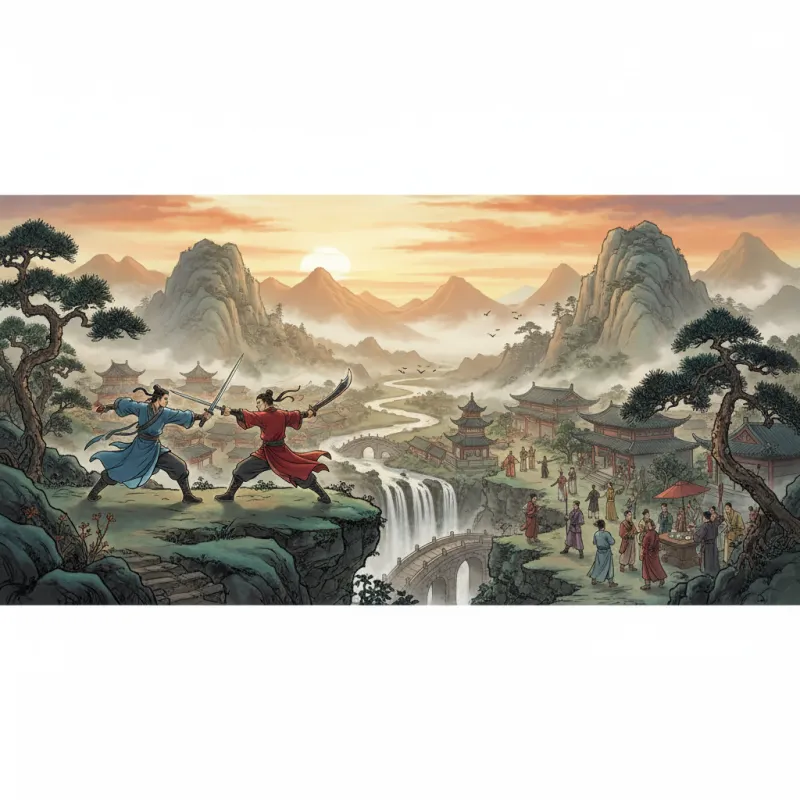
A young swordsman walks into a tavern in Luoyang. An older martial artist sits in the corner, drinking alone. The young man approaches, cups his fist in his left hand, bows slightly, and says: "This junior greets senior. May I ask your honored surname?" The older man doesn't look up. He takes another sip of wine. The young swordsman has just made a fatal mistake — not in his words, but in his approach angle, his distance, his assumption of permission to speak. By morning, he'll be lucky to leave the city alive.
This is the jianghu (江湖 jiānghú) — the "rivers and lakes" world of martial artists where social missteps kill faster than poison. The etiquette system governing these interactions is so complex, so nuanced, that entire plot arcs in wuxia novels turn on a single gesture performed incorrectly. Jin Yong understood this better than anyone. In The Smiling, Proud Wanderer (笑傲江湖 Xiào Ào Jiānghú), Linghu Chong's casual disregard for sect hierarchy isn't just rebellious — it's revolutionary, and it costs him everything.
The Hierarchy of Address
Every conversation in the jianghu begins with establishing relative status. This isn't about ego (though ego plays its part) — it's about survival. Speak to someone above your station with insufficient respect, and you've issued a challenge. Speak to someone below you with too much deference, and you've either insulted them by implying they're weak, or you've revealed yourself as a fraud.
The basic formula: "This junior/senior/humble one" (在下 zàixià, 晚輩 wǎnbèi, 前輩 qiánbèi) followed by the appropriate honorific for the other party. But the variations are endless. Age, martial skill, sect affiliation, reputation, and even the location of the meeting all factor into the calculation. In Demi-Gods and Semi-Devils (天龍八部 Tiānlóng Bābù), Qiao Feng's ability to navigate these forms perfectly — despite his eventual revelation as Khitan — is part of what makes him such a commanding presence.
The "honored surname" (貴姓 guìxìng) question is standard, but when you ask it matters enormously. Ask too quickly, and you're presumptuous. Wait too long, and you're either suspicious or disrespectful. The truly skilled can communicate volumes through timing alone. Huang Yaoshi in The Legend of the Condor Heroes (射鵰英雄傳 Shèdiāo Yīngxióng Zhuàn) famously makes people wait through an entire tea service before acknowledging their presence — a power move that only someone of his status can pull off.
The Cupped Fist Salute
The baoquan (抱拳 bàoquán) — right fist wrapped in left palm, held at chest level — is the universal greeting of the jianghu. But like everything else, it's more complicated than it looks. The height of the hands, the depth of the bow, the duration of the hold, the angle of the body: all of these communicate information.
Hands at chest level with a slight bow: standard greeting between equals. Hands raised to forehead level with a deep bow: showing great respect to a senior or master. Hands held loosely, barely covering the fist: casual greeting between friends or deliberate slight to someone you don't respect. In The Heaven Sword and Dragon Saber (倚天屠龍記 Yǐtiān Túlóng Jì), Zhang Wuji's tendency to give everyone the same respectful salute — regardless of their status — is initially seen as naive, then later as a sign of his genuine character.
Women typically perform the wanfu (萬福 wànfú) instead — hands clasped at the side, slight curtsy. But female martial artists often adopt the male baoquan as a statement of equality. Huang Rong does this selectively, switching between forms depending on whether she wants to emphasize her martial status or her femininity. It's a calculated choice every time.
The really interesting moments come when someone refuses to return the salute. This is a direct insult, a declaration that the other person is beneath acknowledgment. It's also a common prelude to violence. Gu Long's protagonists do this constantly — Li Xunhuan in Sentimental Swordsman, Ruthless Sword (多情劍客無情劍 Duōqíng Jiànkè Wúqíng Jiàn) will salute a beggar with full respect but leave a sect master hanging. It's his way of showing that he judges people by character, not status. It's also why people keep trying to kill him.
Seating Arrangements and Banquet Protocol
The formal jianghu banquet is a minefield. The seat of honor (上座 shàngzuò) is typically the one facing the door, furthest from the entrance. But in some regions it's the seat facing south. In some sects it's determined by the room's relationship to the main hall. Get it wrong and you've either claimed status you don't have or insulted your host by refusing the honor they're offering.
The standard move when offered the seat of honor: refuse three times. Accept on the fourth offer. Refuse more than three times and you're being difficult. Accept on the first or second offer and you're presumptuous. Unless you're significantly senior to everyone present, in which case accepting immediately is expected. Unless the host is your junior but the gathering is in your honor, in which case... you see the problem.
Jin Yong loves to torture his characters with banquet scenes. In The Book and the Sword (書劍恩仇錄 Shūjiàn Ēnchóu Lù), Chen Jialuo spends an entire chapter navigating a dinner with the Red Flower Society's various lodge masters, each of whom has their own ideas about precedence. One wrong move and the society fractures. The tension is excruciating, and there's not a single sword drawn.
Toasting follows its own elaborate rules. The junior always toasts the senior first. You must stand to toast someone of higher status. You must drain your cup completely — leaving wine is an insult. Unless you're a woman, in which case you can sip. Unless you're a female martial artist of high status, in which case you're expected to drink like the men. The number of toasts, the order of toasts, the words used in the toast: all of it matters. In Demi-Gods and Semi-Devils, the Apricot Forest banquet scene is essentially a social combat sequence, with toasts as weapons and seating positions as tactical advantages.
The Art of Refusing Without Refusing
Direct refusal is almost always an insult in jianghu culture. If someone invites you to their sect and you don't want to go, you can't just say no. You must construct an elaborate excuse that allows both parties to save face. "This humble one is unworthy of senior's attention" or "This one has pressing matters that cannot be delayed" or "This one's poor skills would only embarrass senior's distinguished sect."
The other party then insists. You refuse again, with different wording. They insist again. This can go on for quite a while. The number of refusals and insistences communicates how serious the invitation is and how serious the refusal is. Three rounds is standard. More than that and you're getting into genuine conflict territory.
The genius of this system is that it allows for genuine refusal while maintaining the fiction of mutual respect. Everyone knows what's really happening, but the forms are preserved. Gu Long's characters often violate this — they say what they mean directly, and it's shocking every time. When Li Xunhuan tells someone "I don't want to go," without elaboration or excuse, it's treated as almost violent in its bluntness.
Gift-giving follows similar patterns. Refuse the gift three times. Accept on the fourth offer. Unless the gift is clearly a bribe or an insult, in which case you refuse definitively on the third refusal by saying something like "Senior is too generous, but this one truly cannot accept." The phrasing matters. "Cannot" is final. "Should not" leaves room for further insistence.
Combat Etiquette and the Rules of Dueling
Even violence has its protocols. When two martial artists fight, there's an expected sequence: exchange names and affiliations, state the grievance, allow the other party to respond, then begin. Attacking without this preamble is considered assassination, not honorable combat. It's the difference between a duel and murder.
The challenge phrase varies by region and era, but the classic form is: "Please enlighten this one" (請賜教 qǐng cìjiào) or "Please exchange pointers" (請指教 qǐng zhǐjiào). This is technically a request for instruction, which frames the fight as a learning experience rather than a death match. It's polite fiction, but it matters. In The Smiling, Proud Wanderer, when Linghu Chong starts fights without the proper preamble, it's another sign of his rejection of orthodox jianghu culture.
There are rules about when you can intervene in someone else's fight (generally: never, unless they're your master, your sect brother, or your sworn brother). Rules about using weapons against an unarmed opponent (dishonorable, unless they attacked you first). Rules about how many people can fight one person (one-on-one is honorable, but if the person is a known villain, group attacks are acceptable). Rules about continuing to fight after someone yields (don't, unless they're truly evil).
The really interesting part is how these rules interact with sect hierarchies and sworn brotherhood bonds. If your sect master orders you to attack someone who hasn't issued a challenge, do you obey? If your sworn brother is fighting someone and losing, do you intervene? These conflicts between different levels of obligation drive huge amounts of wuxia drama.
When the Rules Break Down
The etiquette system only works when everyone agrees to follow it. And in every great wuxia novel, there comes a moment when someone powerful enough simply stops playing the game. This is usually the villain, but not always.
In The Smiling, Proud Wanderer, Dongfang Bubai doesn't bother with any of the forms. He doesn't announce himself, doesn't exchange names, doesn't explain his grievances. He just acts. It's terrifying precisely because it violates every expectation. The heroes spend so much energy navigating social rules that when someone ignores them entirely, they're caught flat-footed.
But the most interesting moments come when heroes break the rules. Guo Jing in The Legend of the Condor Heroes is so straightforward that he often violates etiquette without meaning to. He says what he thinks, acts on his principles, and treats everyone with the same basic respect regardless of status. It should get him killed. Instead, it makes him beloved. His sincerity is so obvious that people forgive the breaches of protocol.
Zhang Wuji does something similar in The Heaven Sword and Dragon Saber, but more consciously. He understands the rules and chooses to break them when they conflict with his values. When he refuses to take the seat of honor at the Ming Cult gathering because he doesn't think he's earned it, he's violating protocol — but he's also demonstrating the humility that makes him worthy of leadership.
The etiquette system, in the end, is a tool. It can be used to maintain order, to demonstrate respect, to navigate complex social situations. But it can also be used to exclude, to humiliate, to maintain unjust hierarchies. The best wuxia novels understand this tension. They show us characters who master the forms, then ask: what do you do with that mastery? Do you use it to climb the hierarchy, or to question whether the hierarchy should exist at all?
That's the real drama of jianghu etiquette. Not the rules themselves, but what happens when someone has to choose between following them and doing what's right.
Related Reading
- Unveiling Jianghu: The Rich Tapestry of Wuxia and Kung Fu Novels
- Sworn Brotherhood in Wuxia: The Sacred Ritual of Jiéyì
- Wuxia Slang You Need to Know: A Guide to Jianghu Terminology
- Jianghu Slang: The Secret Language of the Martial World
- The Jianghu Code: Unwritten Rules That Govern the Martial World
- The Enigmatic World of Shapeshifters in Wuxia Fiction: Unveiling Jianghu Adventures
- Xiao Feng: The Most Tragic Hero in Wuxia
- The Three Pure Ones: Supreme Deities of Daoism
Explore Chinese Culture
- Explore Jin Yong's martial arts novels
- Explore cultivation fiction and immortal heroes
- Explore the real history behind wuxia