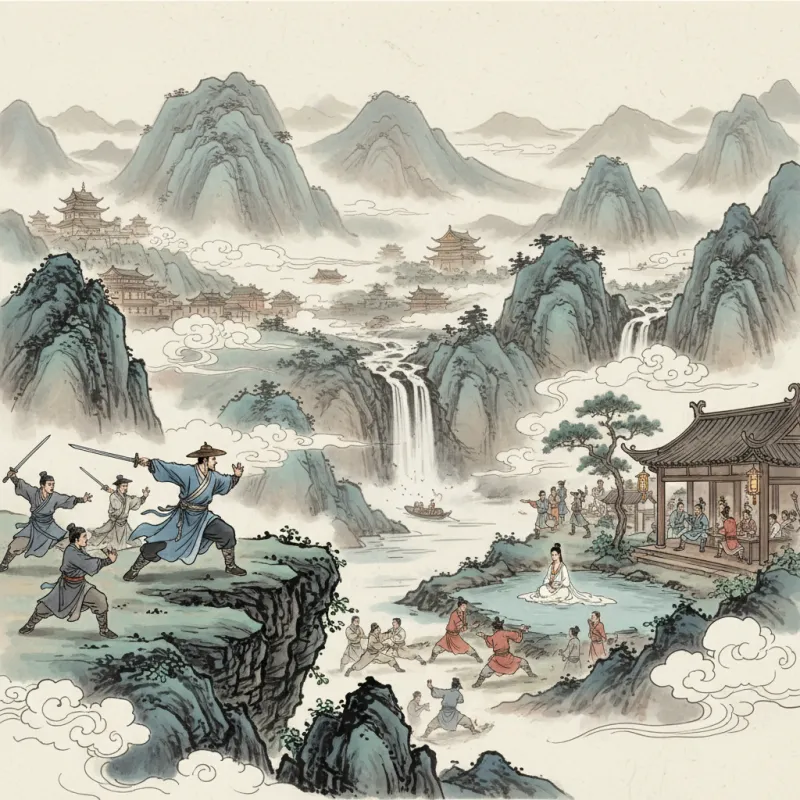
You pick up a wuxia novel, eager to dive into sword fights and revenge plots. Three pages in, you're lost. Characters keep talking about their "shifu" and "shixiong," someone's "qinggong" is apparently impressive, and the hero just swore to uphold "yi" even if it kills him. The English translation helps, but something's missing — the texture, the weight these words carry in the original Chinese.
Learning wuxia terminology isn't about memorizing a glossary. It's about understanding a parallel moral universe where loyalty trumps law, where a debt of gratitude can span generations, and where the right to call someone "elder brother" means everything. These aren't just words. They're the building blocks of every relationship, conflict, and dramatic choice in the genre.
Shifu (师父) — More Than Just "Master"
The shifu-disciple bond is the most sacred relationship in jianghu. Your shifu isn't just a teacher who shows you some moves. They're a parent figure who accepts responsibility for your moral education, your reputation, and your debts. When Jin Yong's Guo Jing calls Hong Qigong "shifu," he's pledging lifelong loyalty to the beggar sect's leader — a commitment that will shape every major decision he makes.
The character 师 (shi) means "teacher" or "expert," while 父 (fu) means "father." That combination tells you everything. You can have multiple teachers (laoshi, 老师) in your life, but you typically have one shifu in martial arts. Betraying your shifu is worse than betraying your blood family. In The Smiling, Proud Wanderer, when Linghu Chong is falsely accused of betraying his shifu Yue Buqun, he'd rather die than defend himself — because even the accusation is unbearable.
The female equivalent is shimu (师母), literally "teacher-mother," referring to your shifu's wife. She holds nearly equal authority and respect.
Shixiong, Shimei, and the Sect Family
Once you join a sect, everyone becomes family — but it's a precisely ranked family. Your fellow disciples aren't just classmates. They're shixiong (师兄, older martial brother), shidi (师弟, younger martial brother), shijie (师姐, older martial sister), or shimei (师妹, younger martial sister). The ranking depends on when you entered the sect, not your actual age.
This system creates instant social structure. When 15-year-old Yang Guo meets his shishu (师叔, martial uncle) Xiao Longnu in The Return of the Condor Heroes, she's only 18, but she outranks him by an entire generation because she's his shifu's martial sister. Their eventual romance scandalizes jianghu precisely because it violates this hierarchy.
The terms extend upward too. Your shifu's shifu is your shizu (师祖, martial grandfather). Your shifu's martial siblings are your shishu (uncle) or shigu (姑, aunt). These relationships create webs of obligation that drive entire plots. In Demi-Gods and Semi-Devils, Xiao Feng's discovery of his true parentage doesn't just affect him — it reshapes his position in multiple sect hierarchies and forces him to choose between conflicting loyalties.
Yi (义) — Righteousness, Loyalty, and Brotherhood
Yi is the moral center of jianghu. Usually translated as "righteousness" or "loyalty," it's the principle that you stand by your commitments even when it costs you everything. It's why heroes keep promises to dying strangers, why sworn brothers die for each other, and why revenge debts must be paid regardless of consequences.
The concept comes from Confucian ethics, but jianghu yi operates differently from mainstream morality. It's personal and reciprocal rather than abstract. You don't owe yi to society or the law — you owe it to specific people who've shown you kindness, taught you skills, or sworn brotherhood with you. This creates the genre's central tension: what happens when yi to one person conflicts with yi to another?
Jin Yong explores this constantly. In The Legend of the Condor Heroes, Guo Jing's yi to his Mongolian sworn father Genghis Khan conflicts with his yi to the Chinese people. The entire novel hinges on how he resolves this impossible choice. Characters who abandon yi — like the various traitors who betray their sects for power — become irredeemable villains, while characters who uphold yi even foolishly (like Guo Jing himself, often) remain heroic.
The phrase "jianghu yiqi" (江湖义气) refers to this specific code of honor. It's what separates true jianghu people from mere martial artists or government officials.
Qinggong (轻功) — The Art of Lightness
Qinggong literally means "light skill" — the ability to move with supernatural grace and speed. In wuxia novels, masters of qinggong can run up walls, leap across rooftops, and balance on bamboo leaves. It's not flying (that's a different skill), but it's close.
Every major school has its own qinggong techniques. The Wudang sect's "Ti Yun Zong" (梯云纵, Cloud Ladder) lets practitioners rise straight up as if climbing invisible stairs. Shaolin's "Gecko Wall-Walking Skill" does what it says. The most famous might be Duan Yu's "Lingbo Weibu" (凌波微步, Wave Striding Steps) in Demi-Gods and Semi-Devils, which lets him dodge attacks by following patterns from the I Ching.
Qinggong isn't just about movement — it's about freedom. Characters with superior qinggong can escape any trap, pursue any enemy, and live outside normal constraints. When令狐冲 (Linghu Chong) loses his internal energy and can barely walk, the loss of his qinggong is as devastating as losing his sword arm. The ability to move freely through space represents autonomy in jianghu.
Neigong and Waigong — Internal vs. External Cultivation
Martial arts in wuxia divide into neigong (内功, internal skill) and waigong (外功, external skill). Waigong is what you can see — punches, kicks, sword techniques, weapon forms. Neigong is the cultivation of internal energy (qi, 气) that powers everything else.
A martial artist with strong waigong but weak neigong is like a sports car with no engine. They might look impressive, but they'll lose to someone with deep internal cultivation. This is why elderly masters can defeat young fighters — neigong accumulates over decades of meditation and practice. In The Heaven Sword and Dragon Saber, Zhang Wuji spends years building his neigong through the "Nine Yang Divine Skill" before learning any actual fighting techniques, but once he does, he becomes nearly invincible.
The distinction matters for understanding power levels and training arcs. When a character goes into seclusion to "cultivate their internal energy," they're working on neigong. When they practice sword forms, that's waigong. The most complete martial artists excel at both, but neigong is considered the foundation. As the saying goes: "Train waigong for ten years, train neigong for a lifetime."
Wulin (武林) — The Martial Forest
Wulin (武林) and jianghu overlap but aren't identical. Wulin specifically refers to the martial arts community — the sects, schools, and individual fighters who practice kung fu. Jianghu is broader, including merchants, entertainers, thieves, and anyone living outside mainstream society.
When characters talk about "wulin affairs" (武林事), they mean politics within the martial arts world: sect rivalries, succession disputes, tournaments to determine the strongest fighter. The "wulin mengzhu" (武林盟主, martial arts alliance leader) is the closest thing to a governing authority, though their power depends entirely on personal prestige and strength.
Major wulin events drive plots. The "Huashan Sword Tournament" in Jin Yong's novels determines who's the strongest martial artist of the generation. These aren't just fights — they're political theater where reputations are made and destroyed. Understanding wulin means understanding that martial arts skill translates directly to social and political power in this world.
Enqing and Chouren — Debts That Must Be Repaid
Enqing (恩情, debt of gratitude) and chouren (仇人, enemy/person of enmity) are the twin engines of wuxia plots. If someone saves your life, teaches you a skill, or shows you significant kindness, you owe them enqing. This debt must be repaid, even if it takes your entire life. Similarly, if someone kills your shifu, destroys your sect, or wrongs your family, they become your chouren, and revenge becomes mandatory.
These aren't abstract concepts. They're concrete obligations that characters track meticulously. In The Book and the Sword, Chen Jialuo discovers that the Qing emperor is actually his blood brother, but the emperor is also his chouren because the Qing dynasty destroyed the Ming. The entire novel wrestles with this impossible situation.
The phrase "en yuan" (恩怨, gratitude and enmity) describes the tangled web of debts and grudges that connect everyone in jianghu. Most conflicts arise because someone's trying to repay enqing or settle chouren, often creating new debts in the process. It's why wuxia plots can span generations — because these obligations pass from parent to child, from shifu to disciple, creating cycles of revenge and repayment that only end when someone chooses to break them.
Understanding these terms transforms how you read wuxia. Suddenly the hero's choices make sense. The relationships have weight. The conflicts feel inevitable rather than arbitrary. You're not just reading about sword fights anymore — you're navigating a complete moral universe with its own logic, its own values, and its own tragic beauty. Welcome to jianghu. Watch your back, honor your debts, and never, ever betray your shifu.
Related Reading
- Martial World Etiquette: The Social Rules of the Jianghu
- The Jianghu Code: Unwritten Rules That Govern the Martial World
- Jianghu Terminology Glossary: Essential Martial World Vocabulary
- Unveiling Jianghu: The Rich Tapestry of Wuxia and Kung Fu Novels
- Jianghu Slang: The Secret Language of the Martial World
- The Enigmatic World of Shapeshifters in Wuxia Fiction: Unveiling Jianghu Adventures
- The Real History Behind Wuxia Fiction
- External vs. Internal Martial Arts: The Great Divide in Wuxia
Explore Chinese Culture
- Explore Jin Yong's martial arts novels
- Explore cultivation fiction and immortal heroes
- Explore the real history behind wuxia