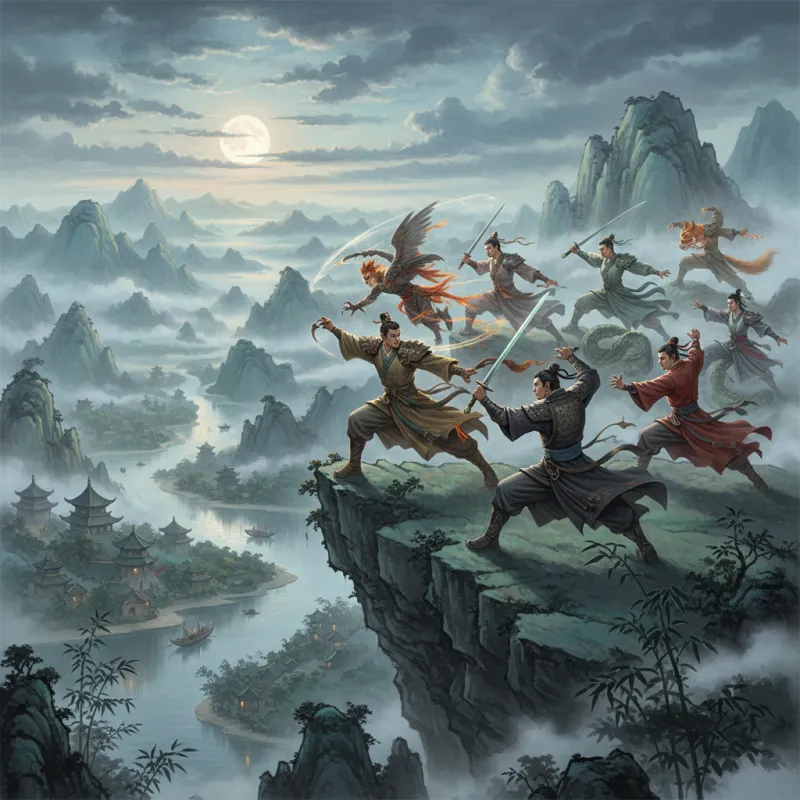
A fox spirit slips through the moonlit courtyard of the Shaolin Temple, her nine tails dissolving into shadow as she assumes the face of the abbot himself. By dawn, three disciples lie dead, their throats torn, and the real abbot finds himself accused of murder he cannot remember committing. This is the terror and fascination of shapeshifters in wuxia fiction—beings who don't just challenge our heroes with superior martial arts, but who undermine the very foundation of trust that holds the jianghu together.
The Shapeshifter's Place in Jianghu Hierarchy
Unlike the straightforward martial arts masters who earn their reputation through decades of training, shapeshifters occupy a uniquely destabilizing position in the martial world. They're neither purely demonic nor entirely human, existing in that uncomfortable gray zone that wuxia fiction loves to explore. The term "huaxing" (化形, transformation of form) appears throughout classical texts, but it's the emotional weight of these transformations that matters most.
Consider Jin Yong's treatment of shapeshifting in his novels. While he rarely employs literal transformation, the psychological shapeshifting of characters like Yue Buqun in The Smiling, Proud Wanderer (笑傲江湖, Xiào Ào Jiānghú) proves far more unsettling. Yue presents himself as a righteous sect leader for decades before revealing his true, power-hungry nature. The readers' horror stems not from witnessing a physical transformation, but from realizing we've been deceived alongside the protagonist Linghu Chong. This is shapeshifting at its most sophisticated—the mask worn so long it fuses with the face beneath.
Fox Spirits and the Seduction of Power
The húlijīng (狐狸精, fox spirit) represents the most iconic shapeshifter in Chinese supernatural tradition, and wuxia fiction has eagerly adopted these creatures. But here's what most casual readers miss: fox spirits in wuxia aren't just about seduction and trickery. They're about the price of immortality and the loneliness of living between worlds.
Gu Long understood this better than most. His fox spirit characters rarely appear as simple antagonists. Instead, they're tragic figures who've sacrificed their original nature for power or love, only to find themselves belonging nowhere. The fox spirit in The Eleventh Son doesn't transform to deceive—she transforms because she's forgotten what her true face looks like after centuries of wearing others. That's the real horror: not the transformation itself, but the loss of self that comes with it.
The mechanics of fox spirit transformation in wuxia typically require one of three elements: consuming human essence (a dark path that leads to demonic cultivation), achieving enlightenment through Buddhist or Daoist practice, or obtaining a magical artifact. The choice reveals everything about the character's moral trajectory. A fox spirit who chooses the first path becomes an antagonist; one who chooses the second might become a cultivation practitioner worthy of respect; the third creates a dependency that drives plot complications.
Snake Demons and the Transformation of Identity
While fox spirits seduce and deceive, snake demons (shéyāo, 蛇妖) in wuxia fiction embody transformation as rebirth. The Legend of the White Snake (白蛇传, Bái Shé Zhuàn) casts a long shadow over the genre, but wuxia authors have twisted this tale in fascinating directions.
Liang Yusheng's snake demon characters often struggle with the physical pain of transformation—a detail other authors gloss over. His descriptions emphasize the agony of bones reshaping, skin splitting and reforming, the temporary blindness as eyes adjust to new forms. This isn't magical girl transformation with sparkles and costume changes. It's body horror that serves a purpose: reminding readers that power always costs something, and shapeshifting costs more than most.
The snake's association with shedding skin makes it a perfect metaphor for characters attempting to escape their past. In Seven Swordsmen from Mount Tian (七剑下天山, Qī Jiàn Xià Tiānshān), the character of Green Snake doesn't just change her appearance—she's literally trying to shed her identity as an assassin, to become someone new. But wuxia fiction is unforgiving: you can change your face, but your martial arts style gives you away. Your habits betray you. The past clings like old skin that won't quite peel free.
The Doppelgänger Problem in Martial Arts Combat
Here's where shapeshifting creates unique narrative tension in wuxia: how do you fight someone who can become anyone? Traditional martial arts rely on reading your opponent—their stance, their breathing, the micro-movements that telegraph their next strike. Shapeshifters break this system entirely.
The best wuxia authors use this to explore questions of identity and recognition. In Wen Rui'an's works, characters must learn to recognize each other through means beyond appearance: the rhythm of breathing, the specific sound of footsteps, even the particular way someone holds their sword. One memorable scene features a protagonist identifying his shifu (师父, master) among a dozen identical copies by the almost imperceptible hesitation before the master's sword strikes—a habit formed from decades of teaching students to defend themselves.
This creates a fascinating inversion of typical wuxia combat dynamics. Usually, the more skilled fighter wins. But against a shapeshifter, skill matters less than knowledge—intimate, personal knowledge of your allies and enemies. The strongest warrior in jianghu might fall to a shapeshifter's deception, while a weaker fighter who truly knows their companions might prevail.
Transformation as Cultivation Method
Some wuxia novels treat shapeshifting not as an innate ability but as an advanced cultivation technique. This reframes transformation from supernatural gift to martial achievement, and the implications are profound.
Zu: Warriors from the Magic Mountain (蜀山剑侠传, Shǔshān Jiànxiá Zhuàn) presents transformation as the ultimate expression of qi (气, vital energy) control. Masters who've achieved this level can restructure their physical form because they've transcended the illusion that body and spirit are separate. It's not about becoming someone else—it's about realizing you were never fixed to begin with.
This philosophical approach to shapeshifting aligns with Daoist concepts of wu wei (无为, effortless action) and bian (变, change). The shapeshifter who's mastered their art doesn't force transformation; they simply allow their form to flow into whatever shape the moment requires. It's the difference between an actor putting on a costume and water taking the shape of its container.
The training sequences for this type of shapeshifting are brutal. Practitioners must first learn to control every muscle, every bone, every drop of blood in their body. Then they must forget that control, allowing transformation to become as natural as breathing. Many students go mad in the process, their sense of self fragmenting under the strain of constant change. The survivors emerge as something beyond human—not necessarily better, but definitely other.
The Ethics of Wearing Another's Face
Wuxia fiction loves moral complexity, and shapeshifting provides endless ethical dilemmas. Is it murder to kill someone while wearing your enemy's face, knowing they'll be blamed? Is it theft to seduce someone while disguised as their lover? These questions haunt the genre's more thoughtful works.
The Condor Trilogy touches on this through characters who use disguise and deception, even without literal shapeshifting. When Huang Rong disguises herself as a beggar, she's not just hiding her identity—she's experiencing the world from a different social position, learning empathy through enforced perspective-taking. The temporary nature of her disguise makes it safe; she can always return to being herself. But what about those who can't?
The most tragic shapeshifter characters are those who've worn so many faces they've forgotten their original one. They become collectors of identities, trying on lives like clothes, never quite fitting anywhere. Some wuxia authors suggest this is the inevitable fate of all shapeshifters—that the ability to be anyone ultimately means being no one.
Modern Interpretations and Continuing Evolution
Contemporary wuxia and xianxia fiction has pushed shapeshifting in new directions, influenced by global fantasy traditions while maintaining distinctly Chinese characteristics. Web novels like Grandmaster of Demonic Cultivation (魔道祖师, Mó Dào Zǔ Shī) feature possession and body-swapping that raises questions about identity and consciousness that classical wuxia only hinted at.
The digital age has also changed how readers engage with shapeshifter narratives. Online discussions dissect the logic of transformation magic, debate the physics of mass conservation during transformation, and create elaborate taxonomies of shapeshifter types. This analytical approach might seem to strip away the mystery, but it actually deepens engagement—readers become co-creators, filling gaps the original authors left open.
What remains constant across eras is the shapeshifter's role as a mirror held up to jianghu society. They reveal the masks everyone wears, the gap between reputation and reality, the performance inherent in social identity. In a world where martial artists cultivate personas as carefully as they cultivate qi, the shapeshifter simply makes literal what was always metaphorical.
The enduring appeal of shapeshifters in wuxia fiction lies not in the spectacle of transformation, but in what transformation reveals about the human condition. We're all shapeshifters in our way, presenting different faces to different audiences, wondering which version is truly us. The fox spirit who's forgotten her original form isn't a monster—she's a warning about the cost of adaptability taken too far, about losing yourself in the roles you play. And in the unforgiving world of jianghu, where survival often depends on reading others correctly while hiding your own truth, that warning resonates with particular force.
Related Reading
- Animal Spirits and the Path to Becoming Yaoguai
- Acupoint Striking (Dianxue): The Deadly Art of Pressure Points
- Internal vs External Martial Arts: The Great Debate
- Real Chinese Martial Arts Schools That Inspired Wuxia Fiction
Explore Chinese Culture
- Explore Jin Yong's martial arts novels
- Explore cultivation fiction and immortal heroes
- Explore the real history behind wuxia