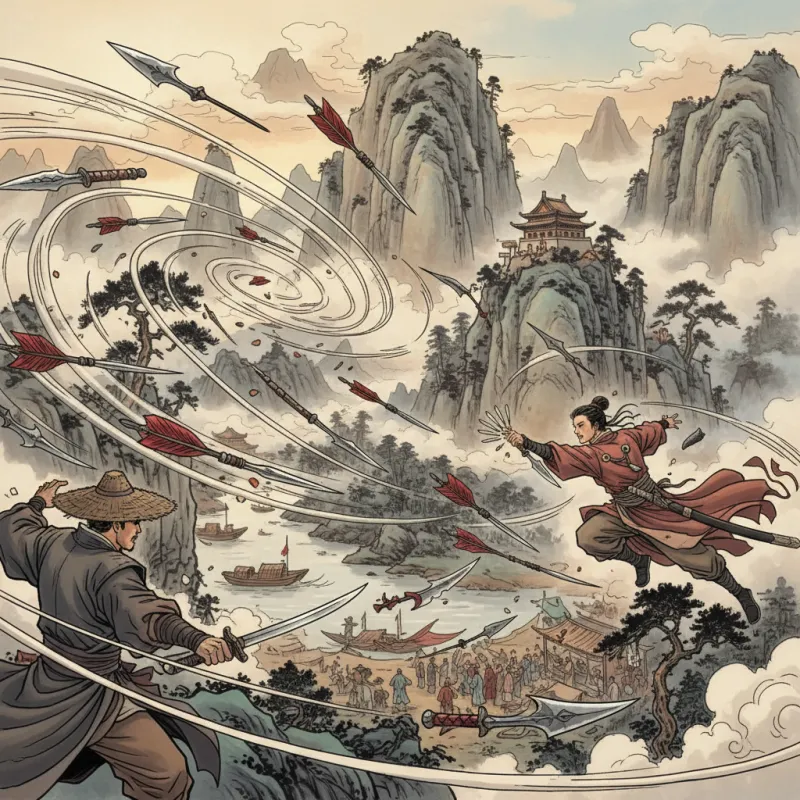
A blade flashes in moonlight, and a bandit drops dead fifty feet away. No sound. No warning. Just a thin line of steel protruding from his throat. This is the reality of hidden weapons in wuxia — not the flashy sword duels that fill entire chapters, but the split-second kills that authors often relegate to a single sentence. Yet these throwing knives, needles, and darts represent some of the most sophisticated martial arts in the jianghu (江湖 jiānghú), requiring years of training that most swordsmen never achieve.
The Hierarchy of Hidden Weapons
Not all hidden weapons (暗器 ànqì) are created equal. The wuxia world maintains an unspoken hierarchy based on difficulty, lethality, and — let's be honest — social status. Throwing knives (飞刀 fēidāo) sit at the top: visible, elegant, requiring genuine martial skill. They're the weapon of choice for righteous heroes and noble assassins alike. Needles (针 zhēn) occupy the middle ground — smaller, harder to detect, but also harder to master. And darts (镖 biāo) fill the practical bottom tier: easier to use, more forgiving of poor technique, but lacking the mystique of their more refined cousins.
This hierarchy isn't just literary convention. It reflects actual historical practice. During the Ming Dynasty, martial arts manuals like the Wubei Zhi (武备志) devoted entire sections to throwing blade techniques, treating them as a legitimate martial discipline rather than mere tricks. The best practitioners could hit targets at thirty paces with enough force to penetrate armor — a feat that required understanding trajectory, spin, and the specific balance point of each individual blade.
Throwing Knives: The Gentleman's Hidden Weapon
Li Xunhuan's Little Li Flying Daggers (小李飞刀 Xiǎo Lǐ Fēidāo) from Gu Long's novels set the gold standard for throwing knife mastery. The character never misses. Not once. This isn't plot armor — it's the logical endpoint of a lifetime devoted to a single technique. Gu Long understood something crucial: the throwing knife isn't a backup weapon or a surprise tactic. For true masters, it's the primary weapon, and everything else is secondary.
The physical requirements are brutal. A proper throwing knife weighs between four and eight taels (150-300 grams), with the balance point precisely at the center. Too light, and it lacks penetrating power. Too heavy, and the range suffers. The blade must be straight — any curve throws off the rotation. And unlike what movies suggest, you don't throw with a flick of the wrist. The power comes from the entire body: legs, hips, shoulders, all coordinating in a single explosive motion.
What separates masters from amateurs is the release point. Miss it by a fraction of a second, and your knife tumbles uselessly or arrives handle-first. This is why characters like Li Xunhuan practice for decades. They're not learning to throw harder or farther — they're training their nervous system to execute the same motion with mechanical precision, regardless of stress, injury, or distraction.
Needles: The Invisible Death
If throwing knives are the aristocrats of hidden weapons, needles are the assassins. Ox-hair needles (牛毛针 niúmáozhēn) — so named because they're as fine as ox hair — represent the absolute pinnacle of hidden weapon craft. They're nearly invisible in flight, make no sound, and leave wounds so small that victims often don't realize they've been hit until the poison takes effect.
The technical challenges are absurd. A needle weighs almost nothing, which means it has minimal kinetic energy. To achieve lethal penetration, practitioners must generate enormous velocity through pure technique. This requires a completely different throwing motion than knives — more of a sharp flick using finger strength rather than whole-body power. Master-level practitioners can embed needles an inch deep in wood from twenty paces. That's roughly equivalent to the penetrating power of a modern air rifle.
Jin Yong's The Heaven Sword and Dragon Saber features the Yin Yang Needles (阴阳针 yīnyáng zhēn), which perfectly illustrate the weapon's tactical role. They're not meant for direct combat — they're too small, too difficult to aim under pressure. Instead, they're ambush weapons, used when the target is distracted or unaware. The protagonist Zhou Zhiruo uses them to devastating effect precisely because her opponents never see them coming.
The real genius of needle techniques lies in targeting. Unlike knives, which can kill through sheer trauma, needles must hit specific acupoints (穴位 xuéwèi) to be effective. This means needle masters need comprehensive knowledge of human anatomy and meridian theory. They're not just martial artists — they're also physicians, capable of healing or killing with the same tools.
Darts and Projectiles: The Working Class Arsenal
Throwing darts (飞镖 fēibiāo) get less literary attention, but they're far more common in actual wuxia combat. They're easier to manufacture, easier to carry in quantity, and more forgiving of imperfect technique. A mediocre martial artist can become competent with darts in months, while knife mastery takes years and needles take decades.
The standard dart weighs about three taels (roughly 110 grams) and features a weighted head with a thin shaft and stabilizing tail. Unlike knives, darts don't rely on rotation — they fly straight, like miniature arrows. This makes them more accurate at short range but limits their maximum distance. Most dart techniques focus on rapid-fire volleys rather than single perfect throws. The idea is to saturate an area with projectiles, making evasion difficult even for skilled opponents.
Escort agencies (镖局 biāojú) favored darts for practical reasons. They're cheap enough to use in quantity, effective enough to deter bandits, and don't require the years of training that escort guards couldn't afford. The famous Longmen Escort Agency techniques, documented in various wuxia novels, emphasize throwing multiple darts in quick succession — three or five at once, creating a spread pattern that's nearly impossible to dodge completely.
What darts lack in prestige, they make up for in versatility. They can be thrown overhand, sidearm, or underhand. They work in confined spaces where knife techniques would be impractical. And they're effective at ranges where needles lose too much velocity. For the average jianghu fighter, darts represent the sweet spot between accessibility and lethality.
Poison: The Great Equalizer
Here's the uncomfortable truth that wuxia novels often gloss over: most hidden weapons aren't lethal on their own. A throwing knife to the shoulder hurts, but it won't stop a determined opponent. A needle in the arm is barely noticeable. This is where poison (毒 dú) enters the equation, transforming minor wounds into death sentences.
The ethics of poison use divide the martial world more sharply than any other issue. Righteous sects officially condemn it, calling it the tool of cowards and villains. Yet somehow, when the protagonist needs to defeat an overwhelmingly powerful enemy, a conveniently poisoned weapon often appears. The hypocrisy is blatant, but it reflects a deeper truth: in actual combat, survival trumps honor.
Historical records from the Tang and Song dynasties document dozens of poison formulas used on weapons. Some acted within seconds, causing paralysis or cardiac arrest. Others took hours, allowing the assassin to be far away when the victim finally collapsed. The most sophisticated poisons were designed to mimic natural death — heart failure, stroke, sudden illness — leaving no evidence of foul play.
The Poison Techniques used in wuxia draw heavily from these historical sources, though authors often exaggerate the effects for dramatic purposes. Real poisons rarely cause the instant death or spectacular symptoms described in novels. But they don't need to. A poison that causes progressive weakness over several hours is actually more useful than instant death — it gives the victim time to lower their guard, to dismiss the minor wound as insignificant, right up until they can no longer stand.
Training Methods and Secret Techniques
Becoming proficient with hidden weapons requires training methods that border on obsessive. Historical martial arts manuals describe practitioners throwing thousands of repetitions daily, year after year. The goal isn't just accuracy — it's developing muscle memory so ingrained that the throw becomes automatic, requiring no conscious thought.
For throwing knives, traditional training starts with stationary targets at close range, gradually increasing distance and adding movement. Advanced practitioners train while running, jumping, falling, even hanging upside down. The logic is simple: combat is chaotic, and you need to throw accurately from any position, under any circumstances. Some schools required students to hit moving targets in complete darkness, relying purely on sound and spatial awareness.
Needle training is even more demanding. Because needles are so light, even slight variations in technique produce wildly different results. Masters often spent years perfecting the finger flick, using specialized exercises to build the specific muscles involved. Some schools had students practice by throwing needles through sheets of paper suspended in the air — if the needle tumbled or lost velocity, it would bounce off rather than penetrate.
The secret techniques (秘技 mìjì) passed down through various schools often focused on unconventional applications. Throwing multiple weapons simultaneously, curving trajectories around obstacles, or using environmental factors like wind and rain to enhance or disguise attacks. The Hidden Weapon Techniques section explores these advanced methods in detail, but the core principle remains constant: hidden weapons succeed through surprise, precision, and perfect timing.
The Psychological Dimension
What makes hidden weapons truly terrifying isn't their lethality — it's the psychological warfare they enable. A swordsman announces their presence. A hidden weapon user could be anyone, anywhere, waiting for the perfect moment. This creates a paranoia that wears down even the strongest martial artists.
Gu Long understood this better than any other wuxia author. His villains don't just use hidden weapons — they weaponize the fear of hidden weapons. They let rumors spread about their abilities, exaggerating their range and accuracy. They stage public demonstrations, killing targets at impossible distances. And then they wait, letting their enemies' imaginations do the real work.
The counter to hidden weapons isn't better armor or faster reflexes — it's mental discipline. The ability to remain calm when you know a needle could strike at any moment, to focus on the fight in front of you rather than the invisible threats surrounding you. This is why the greatest martial artists in wuxia often seem almost supernaturally aware. They're not reading minds or seeing the future. They're simply maintaining perfect situational awareness, tracking every person in range, noting every potential hiding spot, calculating angles and distances unconsciously.
The Modern Relevance
Hidden weapons have largely disappeared from modern martial arts, relegated to historical curiosity or performance demonstrations. But their principles remain relevant. The emphasis on precision over power, the importance of timing and positioning, the psychological aspects of combat — these translate directly to contemporary self-defense and tactical training.
More importantly, hidden weapons represent a philosophical approach to conflict that wuxia novels explore in depth: the idea that intelligence and skill can overcome raw power, that the weak can defeat the strong through superior technique and preparation. This resonates because it's fundamentally optimistic. It suggests that mastery is achievable through dedication, that there's always a path to victory if you're clever enough to find it.
The throwing knife, the needle, the dart — these aren't just weapons. They're symbols of the jianghu's core values: skill over strength, preparation over improvisation, and the deadly effectiveness of patience combined with perfect execution. That's why they endure in wuxia fiction, even as swords get all the glory. Because when the story reaches its climax and the hero faces impossible odds, it's often a hidden weapon — small, silent, and absolutely lethal — that decides everything.
Related Reading
- The Tang Clan: Masters of Hidden Weapons and Poison
- Unveiling Hidden Weapons in Wuxia: The Intrigue of Jianghu Culture
- The Concealed Weapon Arsenal: Every Hidden Weapon in the Jianghu
- Sleeve Arrows and Mechanical Weapons in Wuxia Fiction
- Hidden Weapons in Wuxia: The Deadly Art of Surprise
- The Three Pure Ones: Supreme Deities of Daoism
- Lingzhi: The Mushroom of Immortality from Myth to Medicine
- Martial Arts Systems in Wuxia: Internal vs External, Orthodox vs Unorthodox
Explore Chinese Culture
- Explore Jin Yong's martial arts novels
- Explore cultivation fiction and immortal heroes
- Explore the real history behind wuxia